

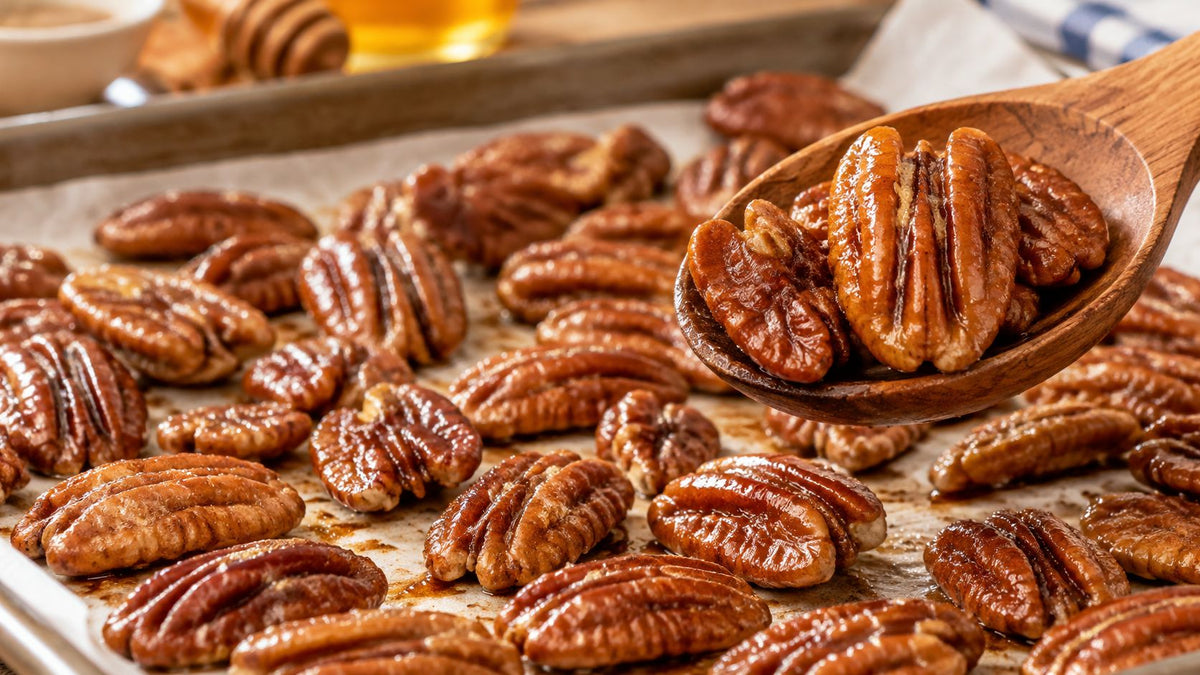
How to Make Honey Roasted Pecans: A Simple Oven Recipe
You've got a bag of pecan halves, a jar of honey, and about half an hour before you want something warm and crisp to put out for snacking. That's exactly when learning how to make honey roasted pecans pays off. The trick isn't a secret ingredient. It's timing. The nuts and the glaze finish at different moments, and the coating only turns crisp after the tray cools. Judge them separately and you'll avoid the sticky, scorched batches that ruin most first tries.
Table of Contents
- Ingredients and Ratios for Your Batch
- Choosing the Right Honey for Pecans
- How to Roast Honey Pecans Step by Step
- Reading the Color, Smell and Cooling Stage
- Fixing Sticky, Soggy or Burned Pecans
- Storing Your Pecans and Your Next Batch
Ingredients and Ratios for Your Batch
Start with the standard batch. You'll need 2 cups shelled, dry pecan halves, 2 tablespoons raw honey, 1 tablespoon melted butter, and 1/4 teaspoon salt. That follows the core ratio of about 1 tablespoon honey per cup of pecans, which the honey roasted pecan method from Carolina Honeybees uses to coat the nuts without making an excessively wet glaze.
One tablespoon of honey weighs about 21 g, so 2 tablespoons is about 42 g. If you're weighing, that keeps scaling honest.
Why halves work best
Use halves, not small pieces, when you can. Their broad surfaces hold an even coat, and they roast at a similar pace. Small pieces darken faster and give you burned bits next to pale ones.
A neutral oil can replace the butter if you need it to. The fat's job is simple. It helps the honey spread thin and smooth.
| Batch | Pecan halves | Raw honey | Melted butter | Salt |
|---|---|---|---|---|
| Small batch | 1 cup | 1 tablespoon (about 21 g) | 1/2 tablespoon | 1/8 teaspoon |
| Standard batch | 2 cups | 2 tablespoons (about 42 g) | 1 tablespoon | 1/4 teaspoon |
| Large batch | 4 cups | 4 tablespoons (about 84 g) | 2 tablespoons | 1/2 teaspoon |
The large batch isn't guesswork. A tested example uses 4 cups of pecans with 4 tablespoons of honey, spread in a single layer at 300°F for about 15 minutes.
Before you start, gather a rimmed baking sheet, parchment, a large bowl, and a spatula. If you bake with honey often, these honey oatmeal cookies use a similar measured approach.
Choosing the Right Honey for Pecans
The honey is the flavor here, so don't treat it as plain sugar. Pecans are buttery on their own. Your jar decides whether the finish stays light or turns deep and dark.
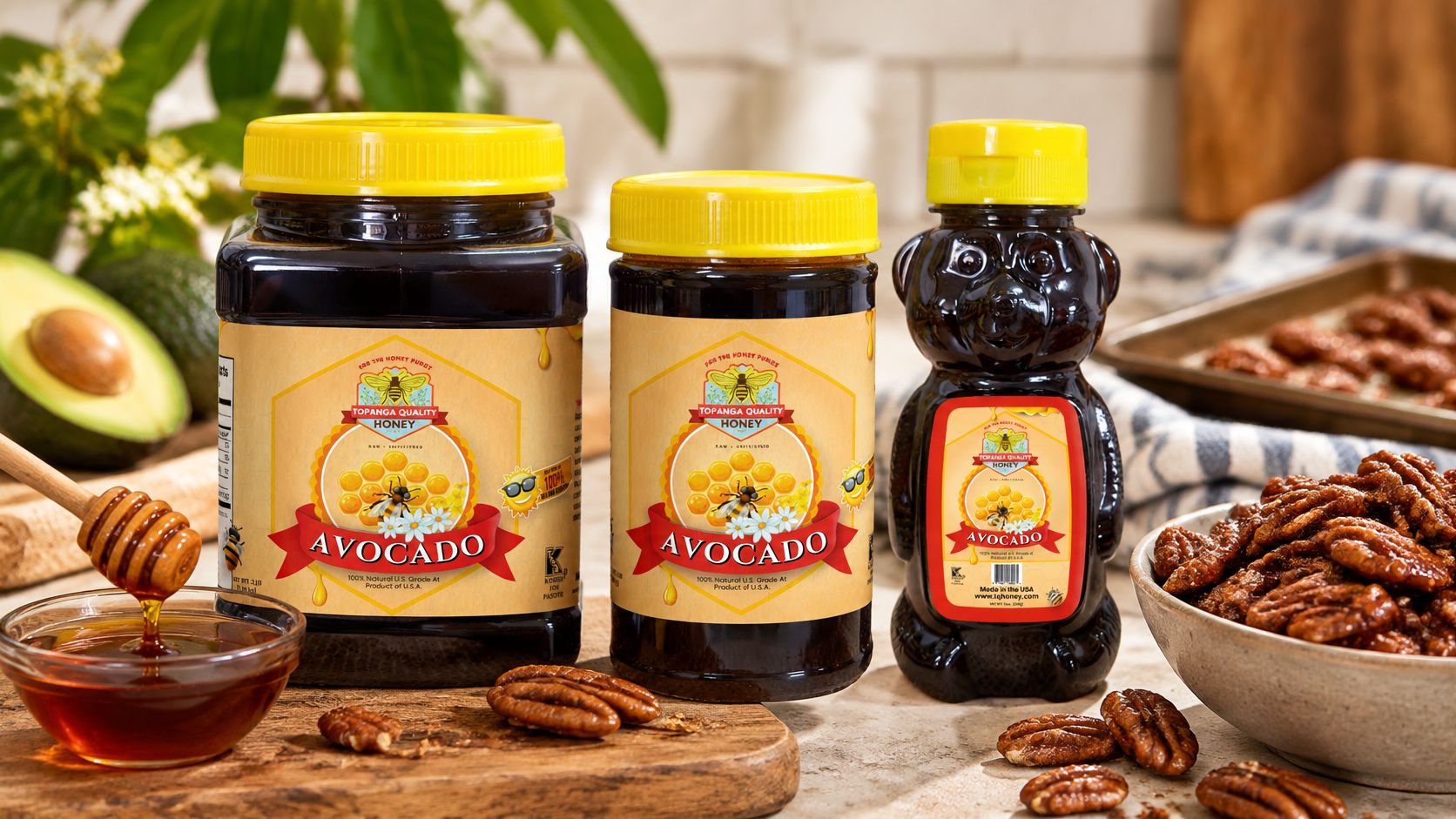
Four good options compared
- Raw Sage Honey: Pale gold and clean, with a soft herbal finish. I'd pick this when you want the pecan to lead and the honey to stay in the background.
- Raw Avocado Honey: Dark amber and buttery, with molasses and caramel notes. Despite the name, it doesn't taste like avocado. Choose it for a deeper, bakery style pecan.
- Raw Buckwheat Honey: Very dark, malty, and less sweet tasting than light honeys. It suits people who like bold, savory leaning snacks.
- Raw Cactus Honey: Nearly white, thick, and creamy, with mild, delicate sweetness. Use it when you want the lightest glaze of the four.
All of these are raw, unfiltered, organic, and kosher, and they're packed in California. We're a family owned California beekeeping company, and our hives move with the seasons to orchards, farms, and wildflower ranges.
Watch dark honeys closely: A dark jar can make the coating look done before it is, so check color and smell carefully at the mid-bake stir.
If you're still torn, taste a spoonful of each side by side first. The notes on how to taste honey help, and our honey varieties guide covers more jars in detail.
My plain recommendation is simple. Start with sage for classic, avocado for rich, and save buckwheat for when you want something assertive.
How to Roast Honey Pecans Step by Step
Work at 300°F (150°C) and don't rush it. That lower heat matters because honey browns fast. An academic pecan study on controlled roasting notes fructose can begin caramelizing near 110°C/230°F, while unglazed kernels in that work were dry roasted at 160°C for 10 minutes. A sugar film changes the rules.
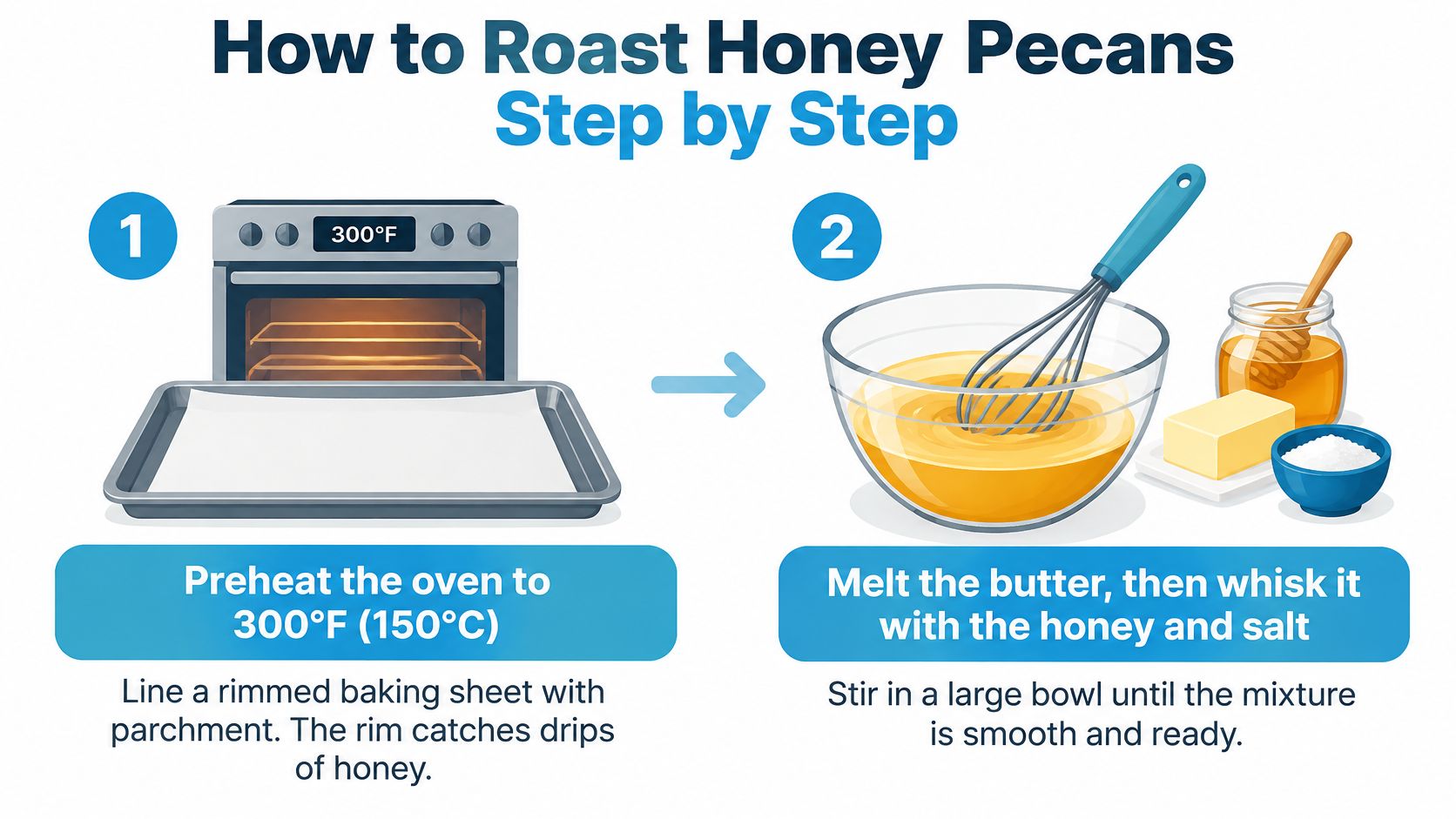
The method
- Preheat and line the tray: Heat the oven to 300°F (150°C) and line a rimmed baking sheet with parchment, because the rim catches drips of honey.
- Whisk the glaze: Melt the butter, then whisk it with the honey and salt in a large bowl until smooth, so no piece gets a thick, sugary patch.
- Coat the pecans: Add the nuts and toss until every surface has a light coat, scraping the bowl as you go because glaze pools at the bottom.
- Spread with gaps: Lay the pecans in one layer with space between pieces, since crowding traps steam and leaves centers soft.
- Bake and stir once: Bake for 10 minutes, then stir once so the bottom pieces turn over and brown evenly.
- Finish by color: Bake 5 to 8 minutes more, checking every two minutes, and pull the tray at deep golden, not dark brown.
- Cool on the tray: Let the pecans cool for at least 20 minutes before separating them, because the glaze stays fluid while hot and firms as it cools.
Total time is usually 15 to 18 minutes. Don't wait for the coating to feel hard in the oven. It won't, and waiting is how a good tray turns bitter.
Judge doneness by color and aroma, not the timer alone. Oven variation, tray loading, and coating thickness all move the burn point.
A finished batch should separate into individual pieces with a glossy but dry coating. It should smell warm and toasted, with honey behind the nut, not sharp or sugary.
If your honey has crystallized in the jar, that's normal for raw honey and it's still good. Set the jar in warm, not boiling, water until it pours again. For another sweet and salty use for a jar, try the ideas in our piece on bacon and honey.
Small test batches help if your oven runs hot. Roast a 1 cup batch first, note when the color turned, and use that timing for larger trays.
Reading the Color, Smell and Cooling Stage
Two things finish at different times, and confusing them causes most bad batches. The nut is done when the halves look a shade darker and smell toasted, like warm bread. The glaze is done when it bubbles slowly and looks glossy, not foamy or dark brown.
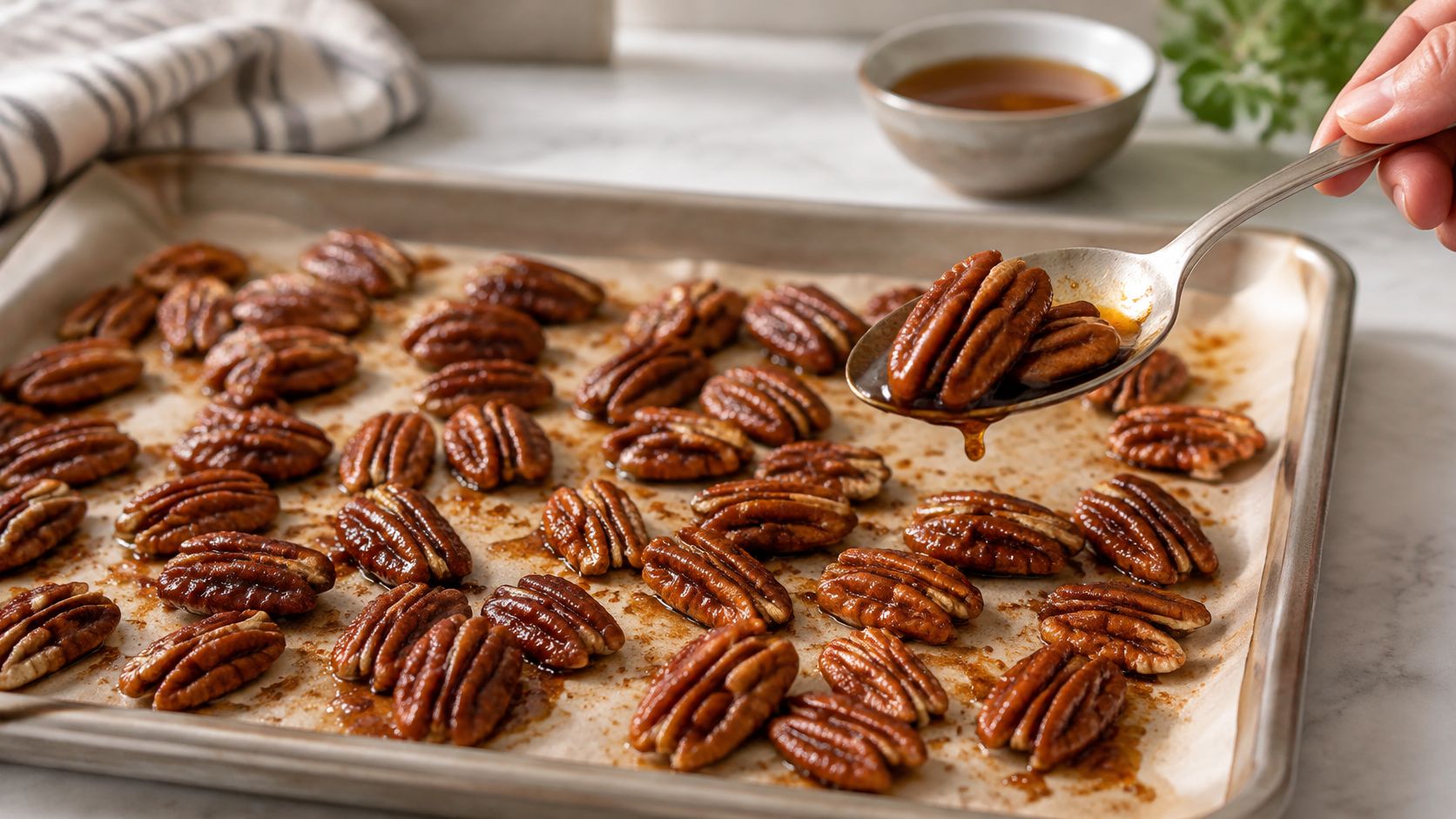
Test one piece the right way
Pull one pecan out, let it cool for two minutes, then bite it. A crisp shell with a firm glaze means you're there. A soft, bendy center means the nut needs more time, but at the same moderate heat.
Your equipment shifts the timing. Dark baking sheets brown faster than light ones, and a crowded tray takes longer because the steam has nowhere to go. In a humid kitchen, expect the glaze to stay a little tacky longer even after cooling.
Watching the surface change in real time makes the color cues easier to spot.
Keep these habits and you'll read a tray well.
- Use a thin metal spatula: It lifts pieces cleanly without scraping off the coating.
- Don't stir while hot: Moving soft glaze around strips it from the nuts.
- Wait the full 20 minutes: Texture judged before cooling tells you almost nothing.
A batch that looks slightly underdone while hot often turns out right once it cools. Trust the cool down.
Fixing Sticky, Soggy or Burned Pecans
Sticky, soft centers are the most common complaint, and they usually come from crowding or from sealing the nuts before they cooled. Honey adds water at the start and makes a sticky surface that can trap moisture. Spread the pieces out, let them cool fully, and only then decide if they need help.
If centers are still soft, return the separated pieces briefly to a 135 to 150°C (275 to 300°F) oven. Don't raise the heat sharply to speed things up. The surface will scorch before the middle dries.
What the numbers tell you
In controlled pecan research from Louisiana State University, roasting at 160°C for 10 minutes reduced kernel moisture from approximately 6.09 to 6.97% to 2.06 to 2.94% and water activity from 0.80 to 0.85 to 0.35 to 0.44. Those were unglazed nuts, but the point holds. Drying the kernel is what creates crispness after cooling.
| Symptom | Likely cause | Fix |
|---|---|---|
| Sticky or soft centers | Crowded tray or nuts stored before cooling | Return pieces to a 135 to 150°C (275 to 300°F) oven briefly |
| Dark, bitter coating | Oven too hot or nuts left in too long | Discard blackened pieces and lower the heat next time |
| Burned patches | Uneven glaze coverage | Whisk the glaze smooth and toss until every piece is coated |
| Pecans look done but taste raw | Browned surface, underdone center | Bake longer at the same temperature |
| Glaze pools in the bowl | Too much honey for the amount of nuts | Use 1 tablespoon honey per cup of pecans |
Burned patches come from uneven glaze, so whisk the honey, butter, and salt until smooth before the nuts go in. Blackened honey means the sugar overheated in spots. Throw those pieces out, because that bitterness doesn't fade.
Pecans that appear done but taste raw have a browned surface with an undercooked center. Allow them more time at the same temperature instead of increasing the heat. Glaze pooling in the bowl usually means you used too much honey.
Fixes for the current tray take minutes. The lower temperature and single layer are the changes that save the next batch.
Storing Your Pecans and Your Next Batch
The glaze finishes setting as the pecans cool, so wait until the nuts are completely cool before you seal them. A coating that looks soft coming out of the oven is supposed to look soft. It hardens on the cooling rack, and sealing too early traps steam against a glaze that is still setting. That moisture softens the coating you just worked to harden.
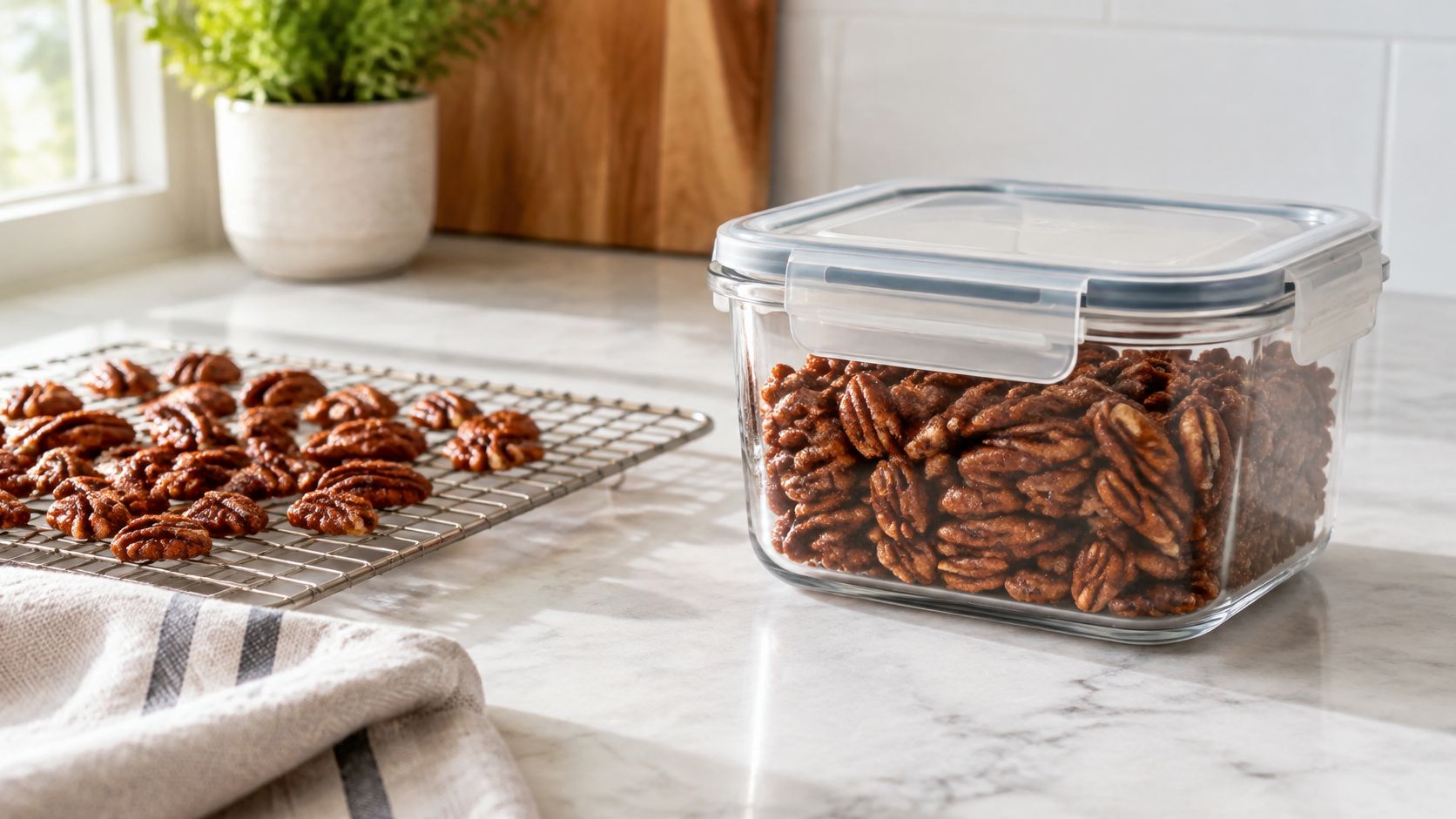
Store them in a tightly closed, moisture free, odor tight plastic or glass container. University of California food safety guidance on nut storage.pdf) states that shelled nuts absorb moisture and external flavors, and that nuts retain quality for a year or more when refrigerated at 40°F or below and for up to two years when frozen at 0°F or below.
Plain storage rules
- Room temperature for short term: A sealed container is fine for everyday snacking.
- Fridge or freezer for longer: Use 40°F (4°C) or below in the fridge, or 0°F (-18°C) or below in the freezer.
- Keep away from strong smells: Onions and spices will find their way into shelled nuts.
- Label and portion: Write the date on the container and split the batch so you aren't opening the whole jar every day.
Before serving, check that the pecans are crisp and the glaze looks dry. If a jar smells stale or painty, the nuts were old to begin with and no storage method fixes that.
Ready for the next batch
Open the raw sage honey product page, add a jar to your cart, and bake a 2 cup batch this week. It comes in sizes from 12 oz honey bears up to 3 lb jars, so a 1 lb jar covers this recipe with plenty left over. Sage honey sticks also stir into tea or drizzle over biscuits, yogurt, or fruit when you want sweetness without a strong honey flavor.
Want a deeper, buttery pecan instead? Use raw avocado honey in the same ratio. Need help choosing a jar? Call 818.937.3437.
Shipping is free on orders of $50 or more to the continental US, with a $9.95 flat rate under $50.
Visit Topanga Quality Honey to order raw, unfiltered honey packed in California, including the sage and avocado honeys that work in this recipe. Pick a 1 lb jar for your first 2 cup batch, roast a tray at 300°F, and let the pecans cool fully before you taste the result. Do not feed honey to infants under 12 months old.