


Honey Oatmeal Cookies Recipe: Ingredients, Steps and Fixes
You pull a tray of honey oatmeal cookies from the oven, and the edges look just right. By morning, though, the cookies have softened, or the centers feel damp instead of chewy. It's tempting to blame the bake time, but the trouble often starts with treating honey like dry sugar.
Honey changes the dough, not just the sweetness. This recipe keeps some granulated sugar for structure and uses a measured amount of honey for flavor and chew. The aim is an oatmeal cookie with distinct oats, buttery edges and a soft center, without a sticky middle.
Table of Contents
- Ingredients and Measurements for Honey Oatmeal Cookies
- Choosing a Honey Flavor for Light or Dark Cookies
- Swapping Sugar for Honey and Adjusting the Oven
- How to Bake Honey Oatmeal Cookies Step by Step
- Fixing Flat, Dense or Soft Honey Oatmeal Cookies
- Bake Your First Batch With a Honey You Love
Ingredients and Measurements for Honey Oatmeal Cookies
This recipe makes about 24 chewy cookies from a short ingredient list, and the step that trips bakers up is measuring a sticky liquid accurately. Weigh anything you can, especially the honey, flour and oats.
The sweetener is split deliberately. In this formula, 1/4 cup raw honey, about 84 g, stands in for part of the sugar, and 1/2 cup granulated sugar stays in the bowl. Honey runs denser than granulated sugar, so a heaped cup or a heavy pour pulls in more moisture than planned. That extra water is what keeps the crumb chewy on day one and soft by day two, which is why the gram column matters more than the cup column here.
Honey Oatmeal Cookie Ingredients and Measurements
| Ingredient | Amount | Weight | Role in the dough |
|---|---|---|---|
| Unsalted butter, softened | 1/2 cup | 113 g | Richness and a tender bite |
| Granulated sugar | 1/2 cup | 100 g | Sweetness and spread |
| Raw honey | 1/4 cup | About 84 g | Replaces part of the sugar and adds moisture |
| Large egg | 1 | About 50 g without shell | Binds and adds structure |
| Vanilla extract | 1 teaspoon | About 4 g | Rounds out the honey flavor |
| All-purpose flour | 3/4 cup | About 90 g, spooned and leveled | Gives the cookie its frame |
| Old-fashioned rolled oats | 1 1/2 cups | 135 g | Chew and oat flavor |
| Baking soda | 1/2 teaspoon | About 2 g | Leavening that helps balance honey's acidity |
| Ground cinnamon | 1/2 teaspoon | About 1 g | Warm spice |
| Fine sea salt | 1/2 teaspoon | About 3 g | Keeps the sweetness in balance |
Use old-fashioned rolled oats for a recognizable oat texture. Quick oats absorb liquid faster and produce a different dough, which makes a first batch harder to judge.
Flour needs particular care, because a packed cup holds more than a loosely filled one. If you move between cup-based and weight-based baking, UK baking measurements explained by Monopack walks through the conversions. For this batch, follow the gram weights instead of converting again.
Before mixing: The butter should yield to gentle pressure but shouldn't look melted or oily.
The egg and vanilla are the only other liquids in the bowl. Both go in at full measure: the egg binds the dough and gives it structure, and the vanilla rounds out the honey's flavor.
Optional raisins, chopped pecans or dark chocolate chips go in after the dry ingredients, about 1/2 cup total. For a different oat-and-honey preparation where a looser texture is intentional, try these granola and honey ideas. Have everything measured before the mixer goes on.
Choosing a Honey Flavor for Light or Dark Cookies
Choose honey for the flavor you want beside the oats; a jar's darkness is a poor guide. A mild honey leaves room for butter and cinnamon. A stronger one becomes a defining flavor of the cookie.
The same moisture that keeps a honey cookie chewy out of the oven can turn it soft by the next day, so pick a variety for taste and browning behavior rather than expecting it to change the texture. The comparison below shows how much the color shifts.
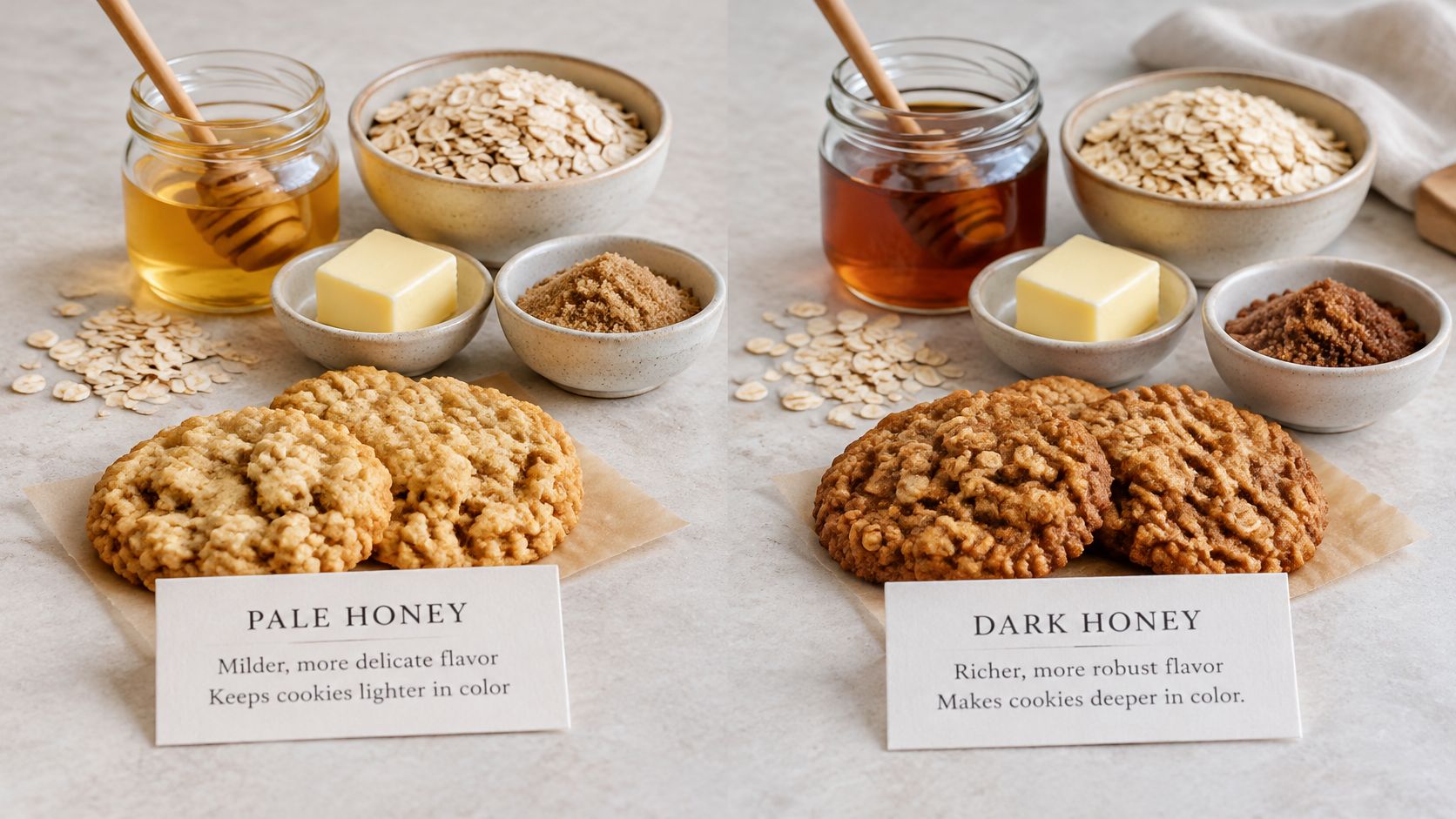
Honey Varieties for Oatmeal Cookies
| Honey | Flavor | Effect on the cookie | Best use |
|---|---|---|---|
| Sage (California) | Mild, almost neutral sweetness | Light golden edges, oat flavor stays in front | Everyday cookies and a first batch |
| Clover (USA) | Classic, mild and sweet | Light golden edges, neutral sweetness | Lunch-box and tea-time cookies |
| Orange blossom (California) | Fresh, sweet citrus aroma | Light edges with a bright note | Cookies with a citrus lift |
| Avocado (California) | Rich, buttery, molasses and caramel | Darker edges, with browning needing closer attention | Spiced cookies with coffee |
| Buckwheat (USA) | Malty and molasses-forward | Very dark-looking edges that make doneness harder to judge | Bold cookies for strong-flavor fans |
Sage is the easiest starting point if you want to judge the recipe without a strong honey flavor competing with the oats. Orange blossom offers a fresh citrus aroma without requiring juice or zest, while clover gives a familiar, mild sweetness.
Avocado works well when you want a richer cookie with cinnamon. Beyond baking, it can be spooned into coffee, brushed over roasted vegetables or paired with aged cheddar and blue cheese. Buckwheat is the more assertive choice, with a malty, molasses-like character that stays present in the finished dough.
Taste Before You Measure
Dark honey browns the edges faster, so judge doneness by the bottoms, not by color. A deep edge on a buckwheat batch is expected; lift a cookie and check the underside before deciding it is done.
Taste a small spoonful plain and notice the finish as well as the first sweetness. Our guide to tasting honey can help you name those differences before choosing a baking honey.
For another visual reference, watch the video below.
Keep the honey amount unchanged when comparing varieties. Otherwise, you'll be comparing different dough formulas as well as different flavors.
Swapping Sugar for Honey and Adjusting the Oven
A cup-for-cup honey substitution is the most common mistake. Honey brings both greater sweetness and additional water, so replacing all the granulated sugar without adjusting the formula can leave you with excessive spread and a damp center.
The National Honey Board's baking guidance recommends beginning by substituting honey for up to half the sugar called for. University of Missouri Extension gives a substitution range of 1/2 to 2/3 cup honey for each 1 cup sugar in its honey guidance, reflecting honey's greater sweetening power.
Keep the Swap Partial
In this recipe, the retained granulated sugar matters. Beating it with softened butter builds the dough's texture, while the smaller honey portion adds flavor and moisture without turning the entire sweetening system liquid.
Change the sugar and oven together, and keep the egg and butter as they are. This formula has no milk or water to pour off. Removing some egg weakens binding, and cutting butter changes tenderness, so the added liquid stays balanced by the dry mix as written.
Lower the Oven Temperature and Watch the Edges
Use 325°F rather than 350°F for the honey version, and begin checking before the original recipe's expected finish. With dark honey, watch the bottoms and the firmness of the edges rather than waiting for an obvious color change across the top.
The baking soda already measured into the ingredient list is part of the formula. Hold it at the measured amount; adding honey on its own doesn't call for extra leavening.
That added water is also why a honey cookie stays chewy out of the oven and can turn soft by the next day, so judge doneness by set edges rather than softness in the center. Bake one tray at 325°F, then record the bottoms and edge set before changing anything else. For other applications, our guide to baking with honey offers more ways to treat honey as an ingredient in the dough.
How to Bake Honey Oatmeal Cookies Step by Step
Set the oven to 325°F with a rack in the center. Line baking sheets with parchment, and have a wire cooling rack ready before you mix. Honey makes this dough softer and stickier than an all-sugar version, which is why each step below pairs the action with what you should see.
The process graphic gives a quick overview. Follow the measured ingredient table and the detailed method.
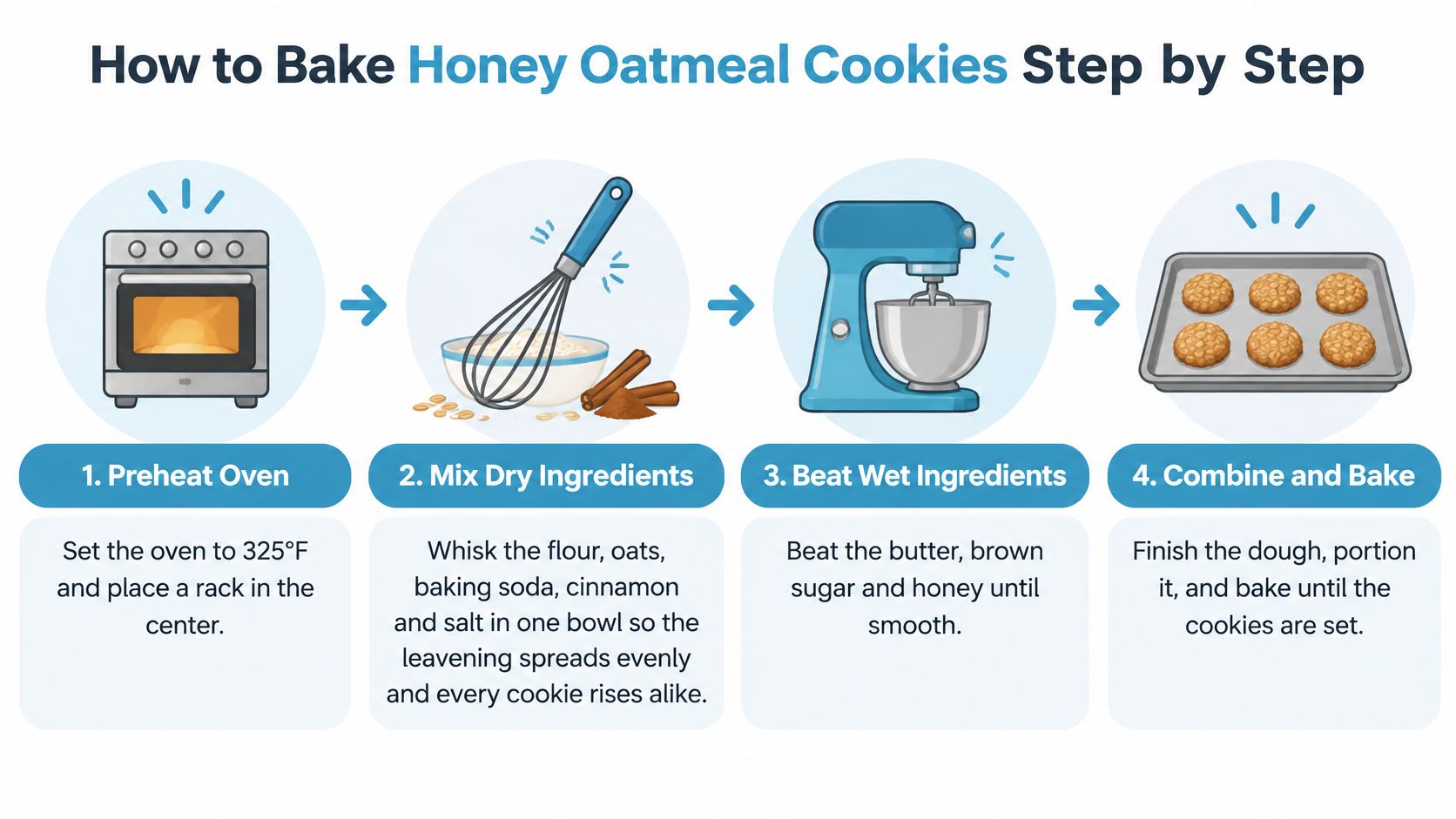
Mix and Portion the Dough
- Whisk the dry ingredients. Combine the flour, oats, baking soda, cinnamon and salt in a bowl, reaching into the bottom with the whisk. Even distribution prevents pockets of salt or leavening, so every cookie bakes at the same pace.
- Beat the butter and sugar. Beat the softened butter and granulated sugar until smooth, about two minutes, scraping the bowl with a flexible spatula. Stop if the butter begins to look greasy, because warm, partly melted butter makes spread harder to control.
- Beat in the honey, then the egg and vanilla. Scrape the bottom and sides again so no thick honey hides beneath the butter mixture. Undissolved streaks of honey bake into darker, wetter spots in the finished cookie.
- Add the dry mixture. Stir just until no dry streaks remain, then fold in any optional additions with a spatula. Stop once the dough comes together, since extra mixing makes the cookies tough.
- Chill soft, sticky dough for 30 minutes. Cover the bowl while it rests. The dough is ready when a spoonful holds a mound on the parchment; if it already scoops cleanly, you can skip the wait.
- Scoop roughly 2 tablespoons per cookie, leaving 2 inches between portions on the parchment. Keep the mounds consistent, and divide the dough evenly if you want the approximate stated yield, since scoop packing and add-ins change portion size.
Bake and Cool With Care
- Bake for 10 to 12 minutes. Start checking at 9 minutes and pull the tray when the edges are golden and set. The centers should still look slightly underdone, with a surface that has lost its wet shine. Honey keeps the crumb moist, so the middle will feel soft even when the cookie is done, and it finishes setting on the hot sheet.
- Rest the cookies on the baking sheet for 5 minutes, then transfer them with a thin spatula to the wire rack. They are fragile while hot, and this short rest lets them firm up enough to move without breaking.
Check underneath: Lift an edge with a spatula. A golden bottom confirms doneness; a dark brown bottom means the tray needs attention even if the tops still look pale.
Use a cool baking sheet for every round. Fresh dough landing on a hot tray starts spreading before the oven can set the edges.
If you also bake with strongly flavored ingredients, matcha baking tips from TOO MATCHA offer a useful comparison for a separate cookie project. Save experiments like that for a later batch so this first one gives you a clean baseline.
A good batch has golden edges, a soft center and no dark brown bottoms. Let the cookies cool completely before you judge them. A warm honey cookie always seems softer than it will be at room temperature.
Fixing Flat, Dense or Soft Honey Oatmeal Cookies
Cookies that look right from the oven but feel soft the next morning aren't necessarily underbaked. Honey retains moisture, which helps a chewy cookie stay tender but works against a crisp finish.
Decide which texture you want before changing the dough. For crisper cookies, try a slightly longer bake and complete cooling before storage. For chewy cookies, protect the soft center rather than baking until the whole cookie feels firm.
Honey Oatmeal Cookie Problems, Causes and Fixes
Work through these practical checks before making several changes at once. The order is a troubleshooting sequence, not a measured ranking of how often each problem occurs.
| Symptom | Likely cause | Fix |
|---|---|---|
| Spreads thin and flat | Dough too warm or too much liquid | Remaining dough: Chill before scooping. Next batch: Weigh the honey and avoid melted butter. |
| Dense, crumbly texture | Too much flour or honey cut back too far | Next batch: Weigh the flour and keep the honey at 1/4 cup. |
| Dark edges, pale centers | Honey browns faster than sugar | Current tray: Check the bottoms and edge firmness. Next batch: Confirm the oven temperature and use a light-colored sheet. |
| Soft and damp the next day | Honey holds moisture after baking | Current batch: Let any residual warmth escape before sealing. Next batch: Bake 1 minute longer for a crisper cookie. |
| Hard or dry | Overbaked | Next batch: Pull them when the edges are set, not when the centers look firm. |
| Honey looks cloudy or grainy | Natural crystallization in raw honey | Before mixing: Set the jar in warm, not boiling, water to re-liquefy. |
Separate Measurement Problems From Baking Problems
For dense cookies, inspect the flour measurement before adding more honey. Scooping flour straight from the bag can compact it; spoon it into the cup and level it, or use a scale. Oat type matters, too, so keep the same oats while you work out the problem.
A cookie that's already baked flat can't be made thick again. Chilling helps the dough still in the bowl, not the cookies on the cooling rack, and extra flour should never be the first response to dough that's warm.
Store cookies only when they're completely cool. An airtight lid traps steam as effectively as it protects finished cookies from drying out.
For a crisper result, extend baking cautiously rather than waiting for a uniformly dark top. For a chewier result, use set edges as the stopping point and allow cooling to finish the texture.
Cloudy or grainy raw honey is a separate issue from cookie spoilage. Natural crystallization doesn't mean the honey has gone bad; gentle warming makes it easier to measure and blend evenly into the dough.
Bake Your First Batch With a Honey You Love
I'd start with sage because its mild flavor makes the oat, butter and cinnamon balance easier to judge. Once that batch works, swap in avocado or buckwheat with the other ingredients unchanged, then compare the cooled cookies side by side. A darker honey pushes the flavor further, which is exactly what a second batch is for.
Write a short baking note for each batch. Record the honey amount, baking sheet, oven setting and the moment you pulled the tray, plus how the cookies feel after cooling and again the next morning. That second check matters: the same moisture that keeps a honey cookie chewy can soften it overnight, and your notes will show which honey went furthest.
Make the Next Batch Deliberately
- Change one thing: Pick a single variable per batch, a new honey or a different bake time.
- Compare cooled cookies: Warm cookies won't show you the final texture.
- Package only when ready: Let the cookies cool fully before boxing them for a gift.
If you're planning a homemade cookie gift, you can browse gift packaging boxes from Packaging Panda and choose packaging that accommodates a separate food-safe liner.
The honey pictured below, Raw California Wildflower Honey, is another California floral option worth a batch.
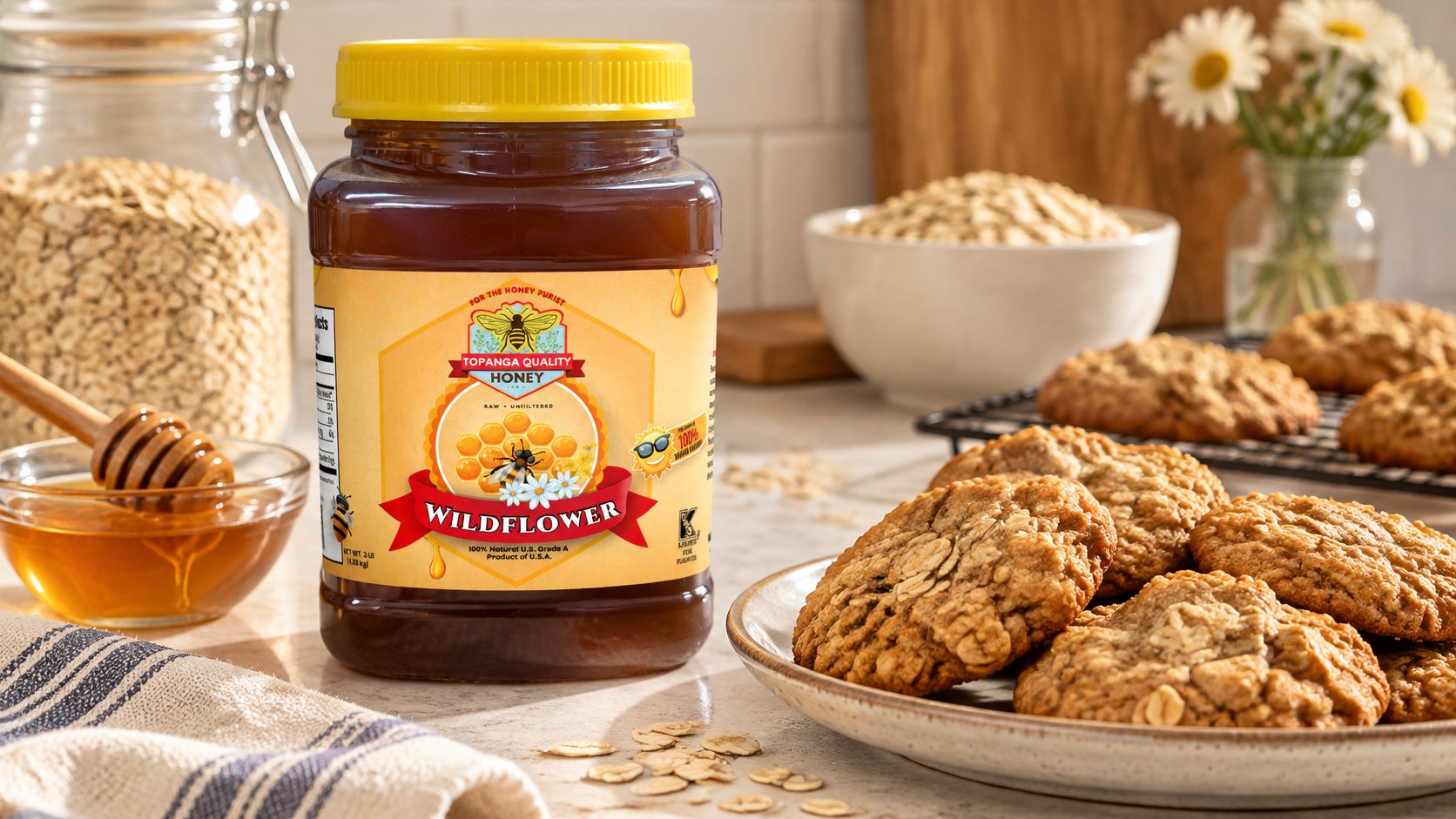
Treat this formula as a starting point you can refine, and hold the flour at its measured amount so the honey stays the variable you're testing. Bake the sage batch first, then swap in one other honey.
Topanga Quality Honey is a family-owned California beekeeping company offering raw, unfiltered, organic and kosher honey, with all honey packed in California. Visit Topanga Quality Honey, choose a jar of sage for its gentle flavor, and start your first batch with the measured recipe above.
Do not feed honey to infants under 12 months old.