

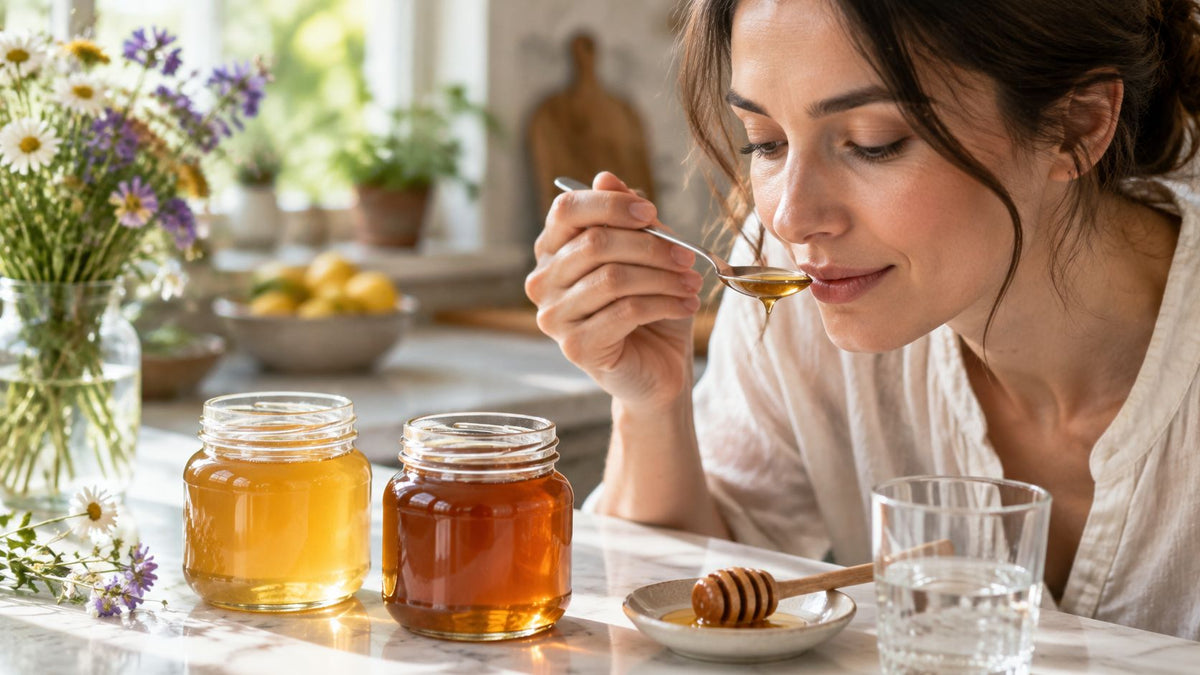
How to Taste Honey for Aroma and Flavor
You've got a couple of honey jars on the kitchen counter, and both labels say honey. One looks pale and quiet. The other is almost black, and you're wondering whether it'll taste stronger, sweeter, or just different.
A clean spoon and a little patience will tell you more than the color alone. Learning how to taste honey starts with separating what you see, what you smell, and what stays in your mouth after you swallow.
Table of Contents
- Why One Honey Tastes Unlike Another
- A Sheet for Color Aroma and Finish
- How to Taste One Spoon of Honey
- Flavor Notes in Familiar Varieties
- Crystals Warm Jars and Off Smells
- Taste Two Honeys Side by Side
Why One Honey Tastes Unlike Another
Start with the pale jar. Hold it against a light background, then set it down before you smell it. Do the same with the dark jar, and hold off deciding which one ought to be better.
Bees make honey from the nectar they gather, so the flowers and growing conditions shape its character. A floral scent, a little tang, a malty flavor, or a lingering bitterness can each belong to a clean honey. Pale color and sugar crystals are observations to write down, and neither one works as a score.
Give each sense its turn
A spoon of honey reaches several senses at once, so keep the order steady: look, smell, taste, then notice the finish. Write down thickness and grain separately from flavor. A beautiful color or a creamy texture shouldn't carry your whole judgment.
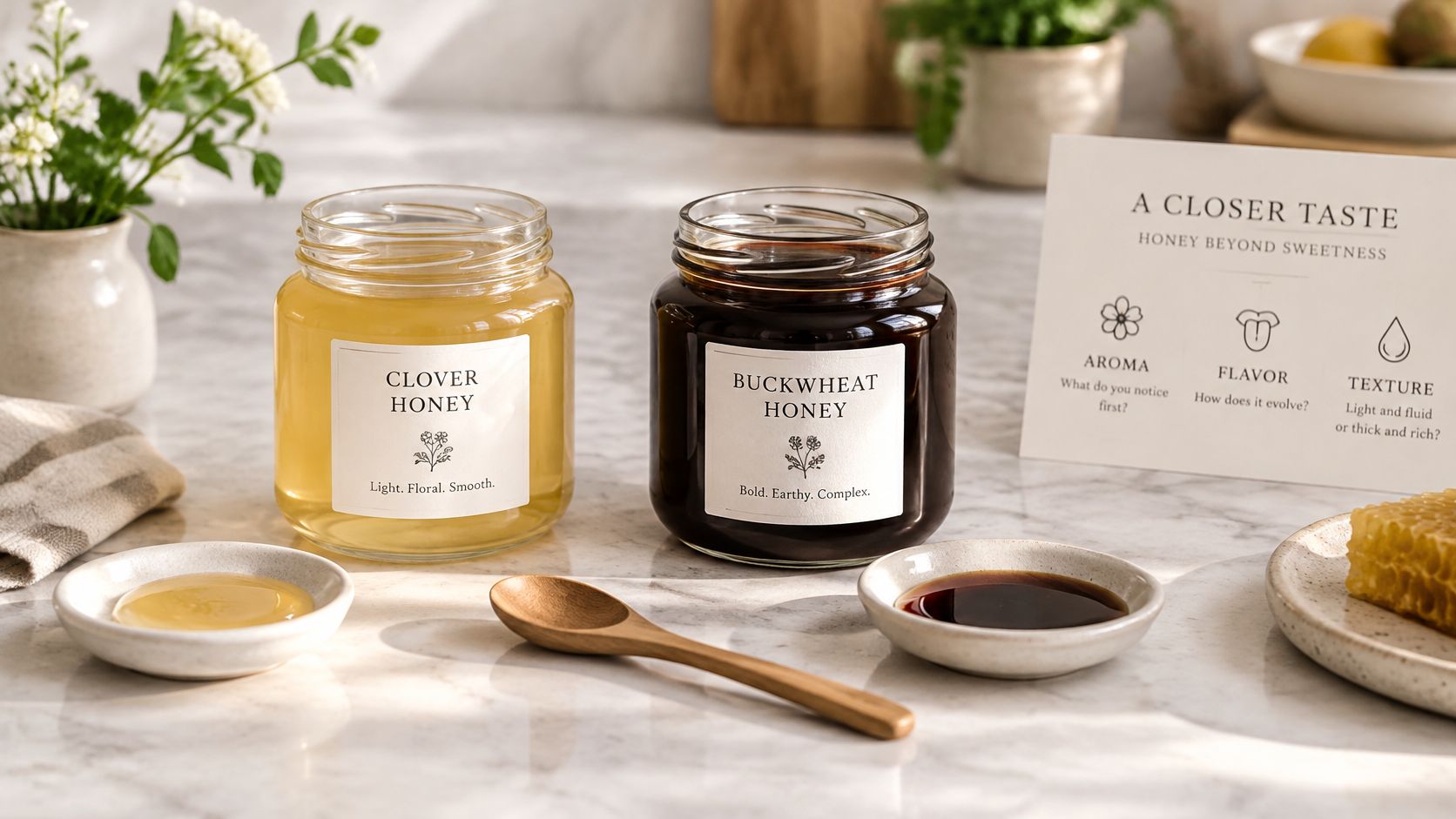
These jars show how different honey can look before you've tasted either sample.
At Topanga Quality Honey, we're a family-owned California beekeeping company. Every honey we sell is raw, unfiltered, organic and kosher, and every jar is packed in California.
A darker spoon may taste stronger, but stronger isn't a quality grade.
If you enjoy comparing foods, Learn Olive Oil's sensory tasting guide shows the same habit at work: smell first, taste second, judge last. For honey, describe the jar in front of you and let each spoon earn its own notes.
A Sheet for Color Aroma and Finish
Before opening a jar, draw a simple tasting sheet. Give each sample its own column, and work down the rows before deciding whether you like it. Write the description first and the preference second. You can choose which honey goes on your toast after you have recorded what it tastes like.
Use ordinary words you can recognize again. Floral is useful if that is what you notice; you do not need to name a particular flower. Faint is a valid result. Write it down.
Honey tasting sheet
| Stage | What to notice | Words to write |
|---|---|---|
| Look | Color, clarity, crystals | Pale to nearly black; clear, cloudy, liquid, creamy or crystallized |
| Smell before stirring | First aroma | Floral, citrus, fruity, herbal, malty or faint |
| Smell after stirring | Aroma released by a stir | Stronger same notes, or a new note |
| Taste | Sweetness, tang, bitterness | Sweet, lightly tart, malty, bitter or less sweet |
| Mouthfeel | Thickness and grain | Runny, thick, creamy, fine crystals or coarse crystals |
| Finish | How long the taste stays | Short and clean, or a long echoing finish |
| Defects | Off smells and tastes | Clean, or sour, alcoholic or a foreign odor |
The UC Davis Honey and Pollination Center's sensory training treats aroma, flavor, texture, and appearance as separate measures and checks tasters' consistency through repeated evaluations. That is why this sheet has no single row labeled good or bad.
Notice that smell gets two rows while flavor sits with taste. Aroma reaches you through the nose before the spoon; flavor builds as the honey dissolves on your tongue. A quiet floral scent can turn herbal once you taste it, and the sheet gives each impression its own space so you catch the change.
What a filled sheet sounds like
Say the pale sample is liquid and clear. Your notes might read gently floral before stirring, more floral afterward, mildly sweet on the tongue, smooth, and short in the finish.
The very dark sample might smell malty, seem less sweet beside the pale one, feel thick, and leave a long toasted impression. Those are hypothetical tasting notes, not rules that every light or dark honey must follow.
Our explanation of why buckwheat honey is so dark gives context for an especially deep-colored honey. On your sheet, though, color stays in its own row.
Keep your vocabulary consistent across jars. If you write thick for one sample and slow-moving for another, decide whether you mean the same thing.
Keep plain water for sipping between samples. Adding water to the honey changes what you are comparing, and honey stirred into tea gives different notes than honey tasted pure.
How to Taste One Spoon of Honey
A good tasting starts before the spoon reaches your mouth. Set out clear glasses, clean spoons, plain water, and your sheet in a spot away from cooking smells, scented candles, and perfume, so the honey is the strongest aroma in the room.
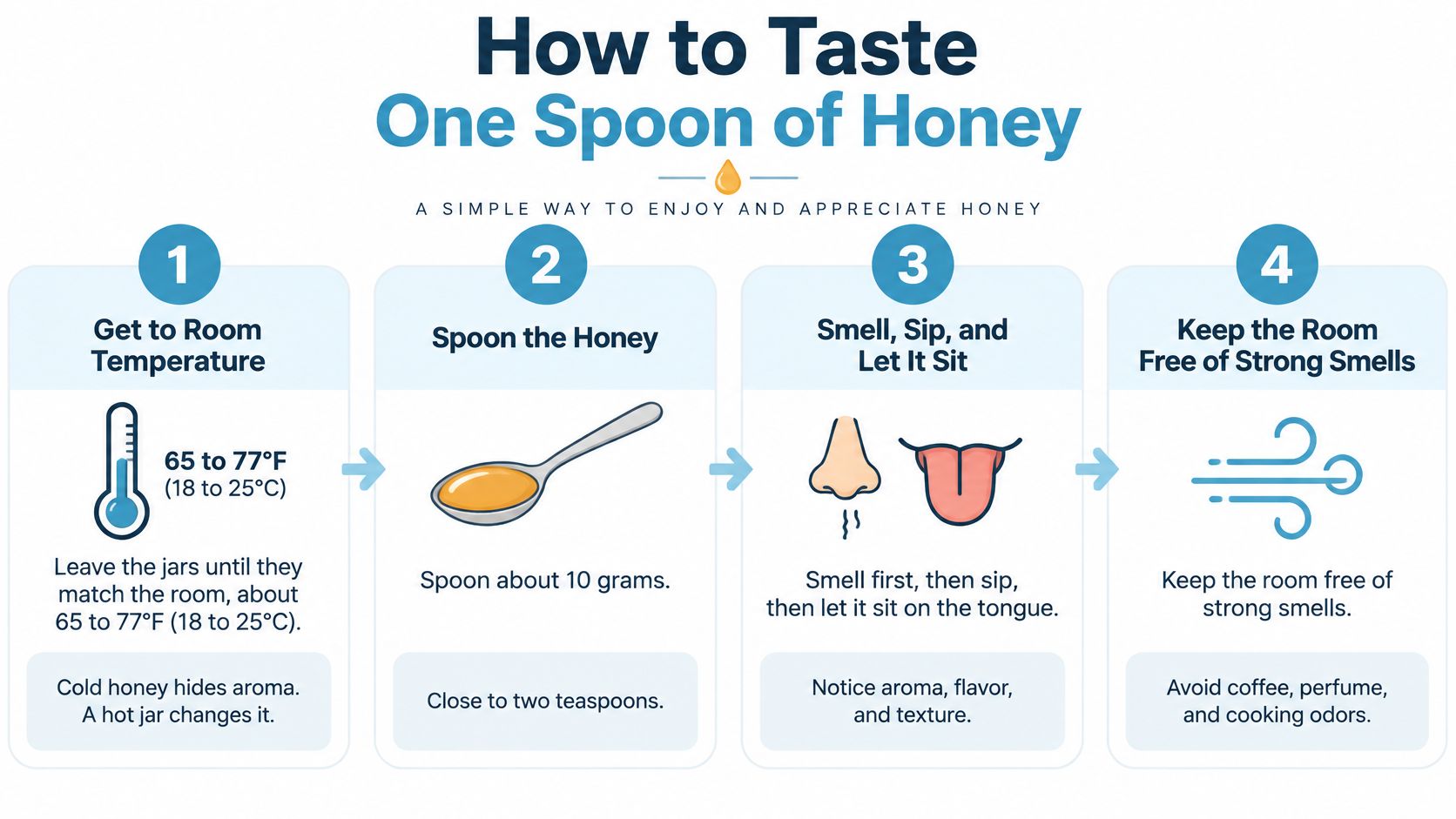
This visual guide shows the basic kitchen sequence.
Set up a fair spoonful
The International Honey Commission's assessment procedure evaluates honey at 18 to 25°C, about 65 to 77°F, uses approximately 40 grams in a balloon-style wineglass, and calls for a 1–2 gram taste. Cold honey holds its aroma down, and a warm sample will not match the others, so let every jar reach room temperature before you begin.
For a home tasting, place about 10 grams in a transparent vessel, the amount described in the DLG sensory analysis guide. That is close to a couple of teaspoons, though a kitchen scale is more repeatable than judging a sticky spoon. Leave headspace above the honey so you can smell it without pressing your nose to the glass.
Let the taste develop
- Look before moving the glass. Record color, clarity, and the sample's physical state, then tilt gently to see how readily the honey moves. Treat slow movement as a description, not a quality signal.
- Smell before stirring, then smell again after a gentle stir. Take a comfortable sniff rather than a hard breath deep inside the glass. Write the first impression before stirring so you can tell whether the movement releases more of the same aroma or something new.
- Take a small taste and let it dissolve. The small portion described above is enough; a heaped breakfast spoon floods your palate before you can read it. Notice the first sweetness, then any tang or bitterness, then the texture. A bitter edge or a gritty grain can be varietal character, so record it the same way you record color.
- Swallow, record the finish, and reset. Notice what remains after the sweetness fades and how long it stays. Rinse with plain water, pause, and use an identical clean spoon and matching portion for the next sample.
Start with a small lineup rather than every jar in the cupboard. The Texas honey sensory-analysis protocol limits assessors to seven samples per day, with at least 30 minutes between samples. At home, stop earlier if the samples begin to blur together.
Skip the tasting right after coffee, toothpaste, mouthwash, alcohol, or a spicy meal. Wait until those flavors leave your mouth, because a quick rinse will not carry them off.
Wine tasters solve the same palate problem by separating observation from judgment. When you follow a structured wine tasting approach, the order is the same one you just used: look, smell, taste, finish. You do not need wine vocabulary for honey; the habit that transfers is giving each sense its own turn.
Watch the spoon technique, then practice slowly with your own sample.
Flavor Notes in Familiar Varieties
Think about a day's meals: tea at breakfast, coffee later, and cheese after dinner. Taste the honey plain first, then try it with the food or drink you enjoy. Otherwise, you may end up describing the coffee instead of the honey.
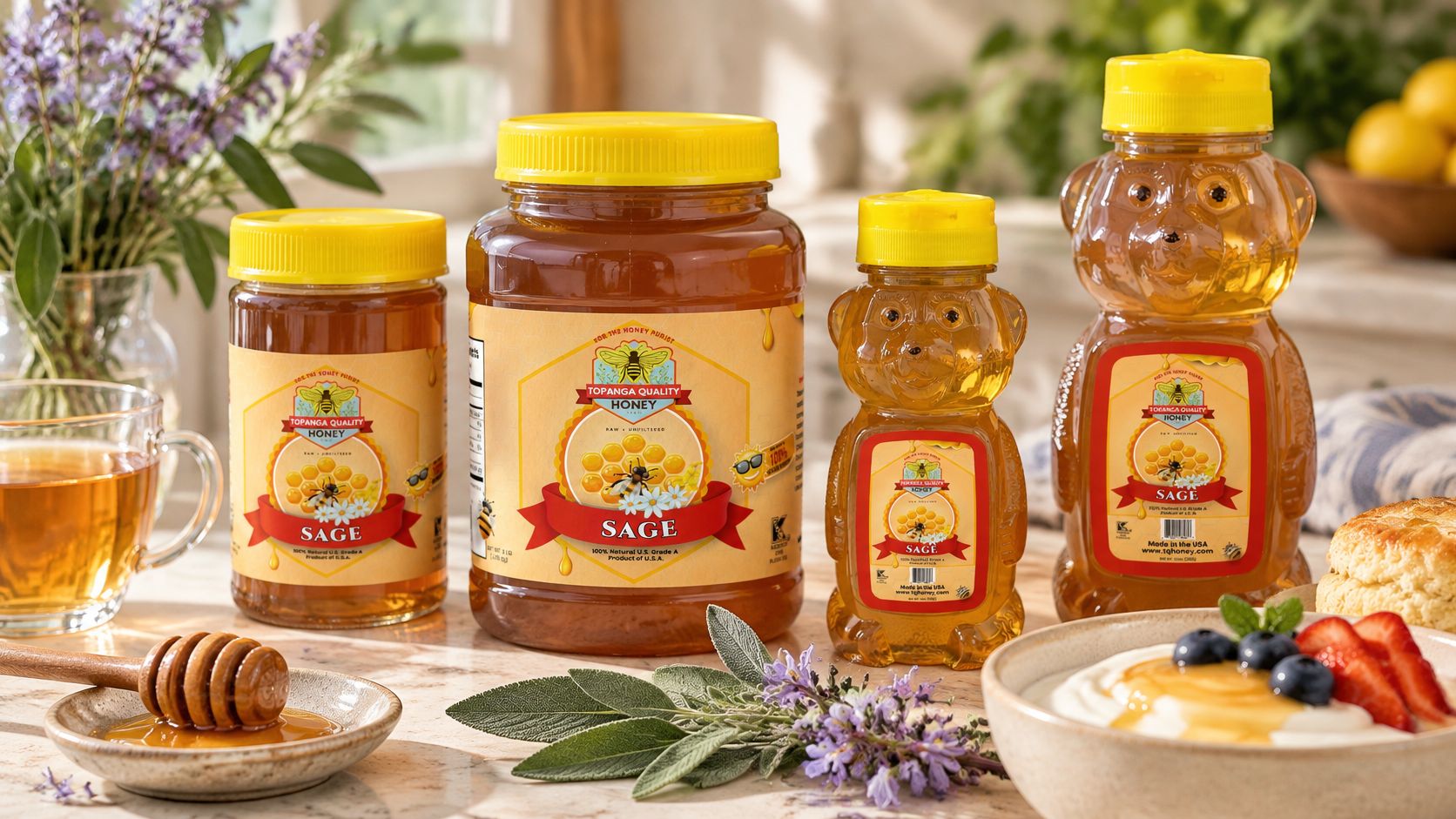
Raw Sage Honey is a California honey that pours pale gold, tastes clean and gently floral, and has a soft herbal finish. It stays liquid longer than most raw honeys and suits tea, biscuits, yogurt, or fruit when you don't want a strong honey flavor.
The pale color makes a useful starting point for a tasting, not a promise that every pale honey will taste alike.
What to expect from familiar honeys
Use these descriptions as starting cues, not answers to copy onto your sheet.
| Variety | Look | Aroma and flavor | Texture or first use |
|---|---|---|---|
| Sage, California | Pale gold | Gently floral, soft herbal finish | Stays liquid longer; tea, biscuits, yogurt, fruit |
| Orange blossom, California | Light | Fresh sweet citrus aroma | Tea or a light drizzle |
| Avocado, California | Dark amber | Buttery, molasses and caramel, not avocado fruit | Coffee, baking, aged cheese |
| Clover, USA | Light | Mild, sweet, gently floral | Baking, coffee, tea, dressings |
| Buckwheat, USA | Very dark, nearly black | Malty, molasses-like, less sweet | Strong coffee or dark baking |
| Cactus, Mexico | Nearly white | Mild, delicate sweetness | Thick and creamy |
| Blueberry blossom, USA | Light amber | Gently tart, buttery finish | Spoon or yogurt |
| California wildflower | Color changes with the season's bloom | Mixed wildflower character | Everyday drizzle |
| Blackberry, Oregon | Assess the jar's actual color | Blackberry blossom honey, jars only | Jar tasting, no honey bear |
| Brazilian wildflower, Brazil | Assess the jar's actual color | Mixed wildflower honey, jars only | Jar tasting, no honey bear |
Match the honey to the meal
For morning tea, compare a gently floral spoon with a citrus-scented spoon before adding either to the cup. Orange blossom's fresh aroma comes from citrus bloom; it isn't honey mixed with orange juice. Our guide to orange honey in the USA and California explains that distinction.
With coffee, a buttery or malty honey gives you a different comparison. Avocado blossom honey doesn't taste like avocado fruit, just as blueberry blossom honey isn't a berry purée. Floral-source names tell you where bees worked, not which fruit was stirred into the jar.
For cheese, try a small drizzle beside the cheese before combining them. That lets you notice whether the honey's finish remains distinct or disappears beneath the cheese's stronger flavor.
Cardón cactus honey comes from Mexico. Eucalyptus honey may come from California, South Africa, Australia, or Brazil; the honey varieties guide helps you compare the broader range.
Single-variety honeys have nothing added. Pomegranate honey sticks are different: they're honey blended with pomegranate, so their bright fruit note comes from the blend.
Crystals Warm Jars and Off Smells
Your spoon meets resistance, and the honey feels sandy instead of smooth. Before calling it spoiled, smell it. Raw honey can crystallize naturally and still be good.
Fine crystals can feel creamy; larger crystals can feel coarse against your tongue. Record that difference as mouthfeel, along with whether the honey spreads easily or breaks away in firm pieces.
Separate grain from fermentation
A Food Chemistry study on honey crystallization reports a peak crystallization rate around 14°C when moisture content was 16%. Botanical origin, temperature, water content, and sugar composition affect how honey sets, so jars from different flowers needn't develop the same texture.
That finding isn't a storage target for your kitchen. It explains why a cool cupboard can produce a firm jar even when nothing has gone wrong with the honey.
Odd honey and what it means
| What you notice | Likely meaning | What to do |
|---|---|---|
| Fine or coarse crystals, smell still clean | Natural crystallization | Record grain as texture; honey is still good |
| Set solid in a cool cupboard | Texture change, often encouraged by cool storage | Taste as-is, or loosen in warm, not boiling, water |
| Sour or alcoholic smell or taste | Possible fermentation defect | Don't call it a flower note or normal crystals |
| Aroma seems flat | Honey is cold, or the palate is tired | Bring to room temperature and rinse with water |
| Dark color assumed to mean old or poor | Floral origin affects color; age and heat can also deepen it | Assess aroma and flavor separately from color |
| Thicker, slightly tangy, not plain honey | A labeled blend such as Super Honey | Taste it as a blend, not as a crystallized single variety |
A light tang on the palate isn't automatically fermentation. Look for the overall impression: a distinctly sour or alcoholic off-smell is different from clean honey with a little acidity. You don't need to keep tasting a suspicious jar to find a nicer description for it.
Clean-smelling grain belongs in the texture row. An alcoholic off-odor belongs in the defects row.
Warm gently when you want a liquid texture
To re-liquefy crystallized honey, set the jar in warm, not boiling, water. Keep water out of the honey, and allow the crystals to loosen gradually. Our explanation of why honey can be hard covers this common texture change.
If texture matters to your comparison, taste the honey as stored before warming it. Warming changes its flow and aromatic release, so let the loosened sample return to room temperature before evaluating it again.
Honeycomb adds another sensation: soft, chewable wax around the honey. Record the chew separately from crystal grain. Super Honey is thicker and more textured because it's raw honey blended with bee pollen, propolis, and royal jelly, not because it has crystallized.
Your senses can flag an unusual jar, but they can't prove floral origin or detect every adulterant. Those questions require laboratory analysis, not a confident-sounding tasting note.
Taste Two Honeys Side by Side
A pale, gently floral honey next to a nearly black, malty one teaches more in two spoonfuls than a dozen jars tasted one at a time. Sage works well as the light anchor: it pours pale gold, tastes gently floral, and carries a soft herbal finish. Buckwheat makes a good dark partner, since its malty, molasses-like flavor reads less sweet than lighter honeys.
Cover the labels while you taste. Write your notes before checking the variety names, then swap the order when you repeat the comparison. You are training your tongue to recognize character, not to guess labels.
Make the comparison useful
- For tea drinkers: Taste both honeys plain, then ask which one leaves room for the tea's aroma.
- For bakers: Decide whether the finished food wants gentle sweetness or a stronger molasses note.
- For a shared tasting: Have everyone write privately before talking, so the first description spoken aloud does not become everyone's answer.
Contrast sharpens every sense at once. A finish that seemed short on its own can feel long once a heavier honey has set a new baseline, and a mild tang you might have read as a flaw in a solo tasting can read as varietal character next to a flat, purely sweet spoon. Record what you notice rather than ranking one jar over the other. The goal is a pair of honest notes, not a winner.
Selectable gift sets make this kind of pairing easy to assemble, since you choose the two or three varieties yourself and taste them side by side. Orders of $50 or more ship free to the continental United States, and smaller orders ship for a $9.95 flat rate.
Topanga Quality Honey offers raw, unfiltered honeys with distinct floral character, along with selectable sets for a kitchen tasting. Visit Topanga Quality Honey to choose a light-and-dark pair and put your tasting sheet to work. Do not feed honey to infants under 12 months old.