

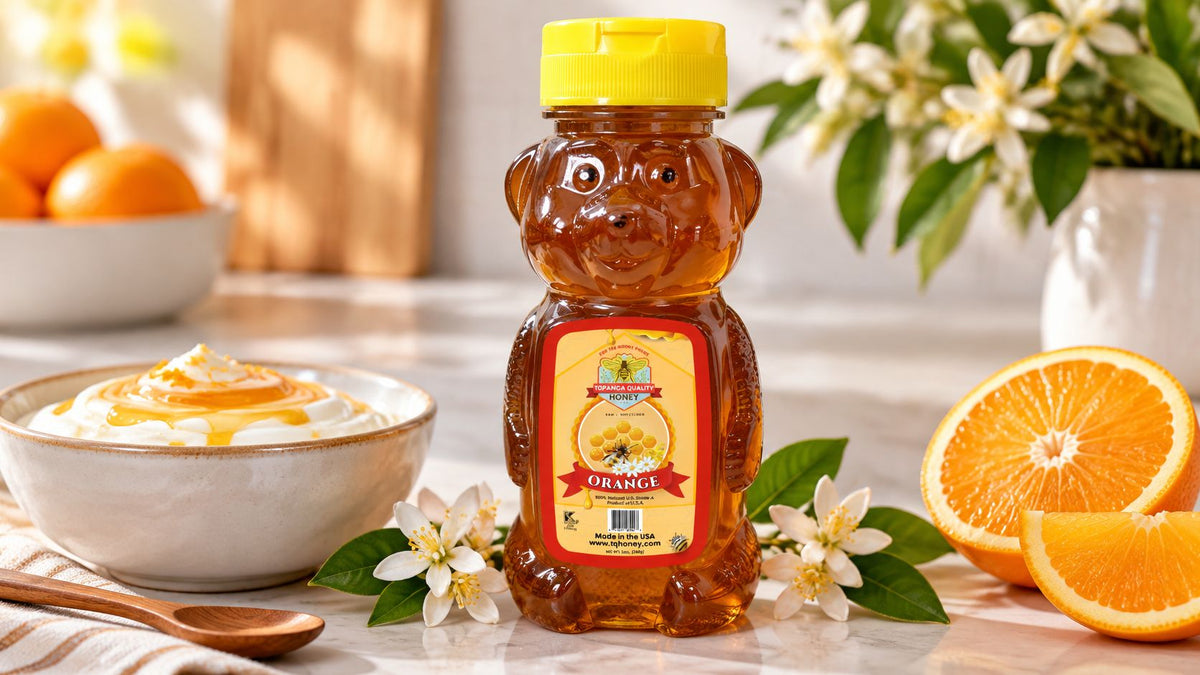
Orange Blossom Honey: Flavor, Texture and Best Uses
A jar marked “orange blossom” sits beside plain clover honey on the counter. One smells bright and citrusy; the other is mild and gently floral. The name orange blossom points to the honey's main floral source.
Topanga Quality Honey's Raw Orange Blossom Honey comes from bees working citrus groves in full bloom. Its fresh, sweet citrus aroma gives you a first clue to how it differs from familiar honeys.
Table of Contents
- What Orange Blossom Honey Is and Where It Comes From
- Orange Blossom Honey Compared with Other Honeys
- Everyday Uses and Starting Amounts
- Three Simple Recipes Built Around Orange Blossom Honey
- How to Check an Orange Blossom Honey Label
- Choose the Size and Format to Buy Next
What Orange Blossom Honey Is and Where It Comes From
The name orange blossom honey describes honey whose main floral source is citrus nectar. Bees working citrus groves in full bloom produce honey with a fresh, sweet citrus aroma. As with other single-floral honeys, the name identifies the chief source rather than promising that the bees visited only one kind of flower.
The Codex Standard for Honey permits a floral name when honey comes wholly or mainly from that source and has the matching sensory, physicochemical, and microscopic traits. So the name reflects more than aroma alone.
A short bloom and a moving yard
Citrus trees flower for a limited period, and bees gather nectar while the blossoms are open. The honey's flavor and aroma reflect that source. Topanga Quality Honey is a family-owned California beekeeping company, and its honey is packed in California. Packing location and floral source describe different things: California packing does not mean every honey comes from California.
Orange blossom honey has a fresh, sweet citrus aroma, while its smooth, silky body is especially noticeable in honey sticks. That texture makes it easy to portion, whether you are adding a little sweetness to a drink or tasting the honey on its own.
Topanga Quality Honey describes its honey as raw, unfiltered, organic, and kosher. Those qualities describe how the honey is presented and processed; “orange blossom” identifies its main floral source.
Orange Blossom Honey Compared with Other Honeys
If you already keep a jar of clover or sage, the fastest way to place orange blossom is to set it beside those honeys on color, flavor, and the job it does at breakfast or dinner.
| Honey | Color | Flavor | Best Everyday Use |
|---|---|---|---|
| Orange blossom | Light amber | Fresh, sweet citrus aroma, delicate floral | Tea, yogurt, vinaigrettes |
| Clover | Light | Mild, sweet, gently floral | Toast, tea, everyday sweetening |
| Sage | Pale gold | Gently floral with a soft herbal finish | Tea and drizzling |
| Cactus | Nearly white | Mild, delicate sweetness | Spreading and drizzling |
| Avocado | Dark amber | Rich, buttery, molasses and caramel notes | Coffee, baking and glazes |
| Buckwheat | Very dark | Malty, earthy, molasses-like, less sweet | Gingerbread, marinades and dark cakes |
Clover is the mild, sweet, gently floral honey familiar from childhood. It's the safe everyday sweetener. Sage pours pale gold and finishes with a soft herbal note, so it stays quiet in tea. Cactus is nearly white, thick, and gently sweet, better for spreading than for making a dish taste like citrus.
Avocado is the turn in the other direction. It's dark amber, rich and buttery, with molasses and caramel. Buckwheat goes further still: very dark, malty, earthy, and less sweet. Put buckwheat on a delicate green salad and it takes over. Orange blossom won't.
Why one jar pours differently from the next
A comparative physicochemical study found that orange blossom honey had the highest reducing-sugar level among the honeys tested and the lowest sucrose. It also had a higher fructose-to-glucose ratio, and therefore a lower tendency to crystallize than the other varieties in that study. That matches what you feel in the spoon. It often stays pourable longer than a darker, quicker-setting honey.
Raw honey can still crystallize, and crystallized honey is still good honey. To re-liquefy it, set the closed jar in warm water, not boiling water, and stir once it softens. Don't microwave it.
Nectar source, harvest season, how the honey is handled, climate, and storage all change composition. One California jar can pour a little differently from the next, so don't treat a single harvest as the rule for every orange blossom honey on earth.
Choose orange blossom when you want bright floral sweetness without molasses. Choose avocado or buckwheat when you want that darker, cooked-sugar depth.
A simple side-by-side tasting makes this obvious in one sitting. Our notes on how to taste honey cover aroma, sweetness, and finish without any special gear. For the wider set of colors and uses, the honey varieties guide and the full raw honey range sit next to this comparison.
Everyday Uses and Starting Amounts
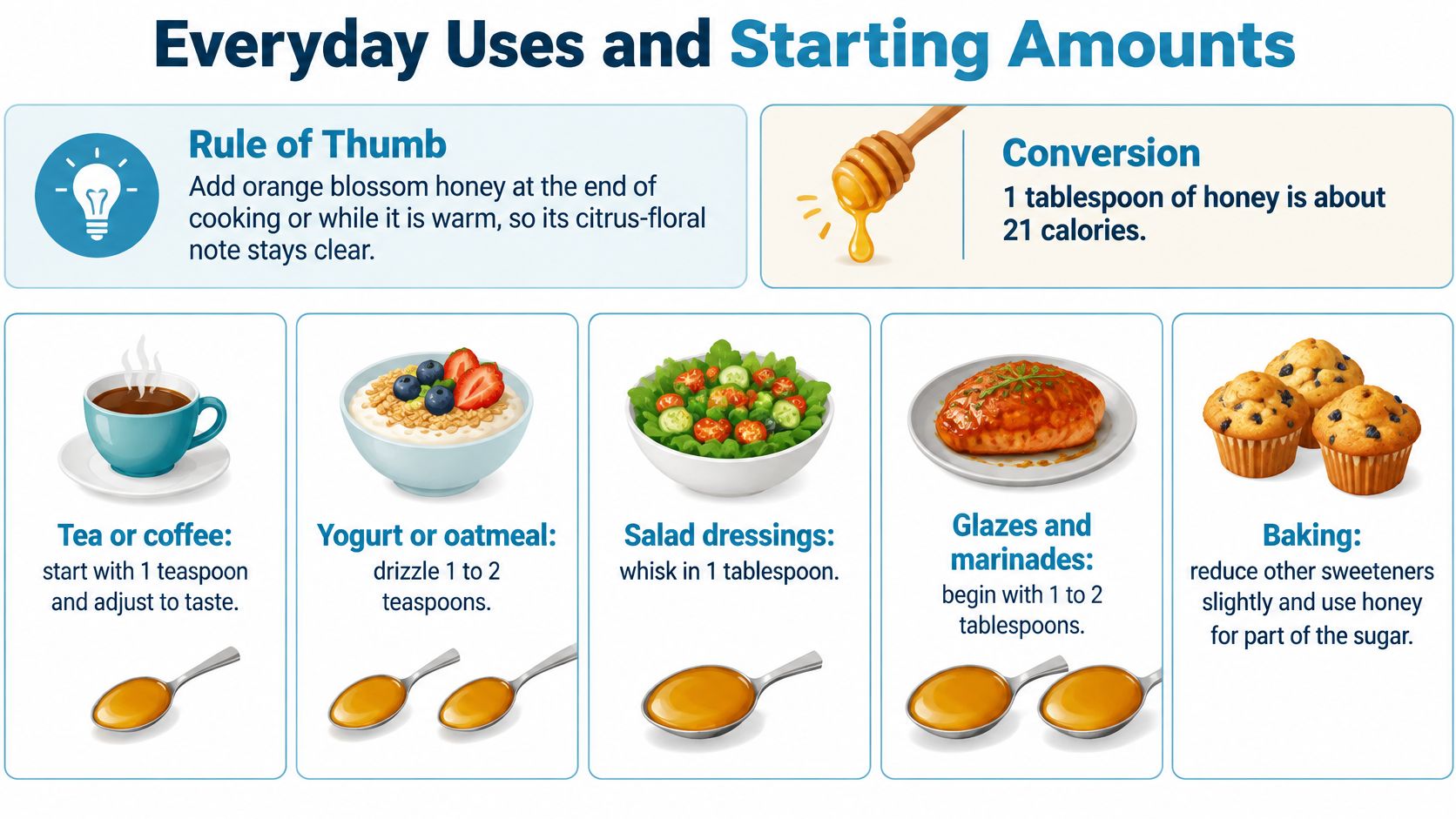
Add orange blossom honey at the end of cooking, or while the food is still warm, so the citrus-floral note stays clear. One tablespoon of honey is about 21 g. A cup of plain yogurt takes about one tablespoon. That's enough to taste the flowers without turning breakfast into candy.
| Use | How to Add It | Starting Amount |
|---|---|---|
| Plain yogurt or oatmeal | Stir in just before serving | About 1 tablespoon per cup |
| Pancakes or waffles | Drizzle warm over the top | 1 to 2 tablespoons per serving |
| Roasted salmon | Brush or toss before roasting | 2 tablespoons per pound of fish |
Warm it, don't scorch it
Warm honey pours in a thin ribbon. Cold honey from the back of the fridge sits in a lump and never coats the food evenly. A few minutes in warm water is enough. If the jar has started to set, that same warm-water step softens it without cooking it.
Honey burns faster than you expect. Keep it out of the hottest part of the pan. Brush it on salmon near the end of roasting, or toss it with vegetables after they've already taken color. A hard sear in a dry skillet will scorch the sugars and leave a bitter edge where you wanted citrus.
- Taste before you add more. The floral note is light, so a second spoonful can disappear into a spicy dish and then suddenly show up as plain sweetness.
- Keep it on lighter food. Tea, yogurt, fruit, white fish, and simple greens let the aroma come through. Darker honeys are the ones that stand up to molasses, coffee, and gingerbread.
- Measure the first time. After that you'll know your own spoon. The three recipes below, honey-glazed carrots, a citrus vinaigrette, and iced honey tea, use these same starting amounts in full steps.
Three Simple Recipes Built Around Orange Blossom Honey
Each of these keeps honey as a real ingredient, not a garnish you could skip. The carrots are the place to see how a late glaze behaves.
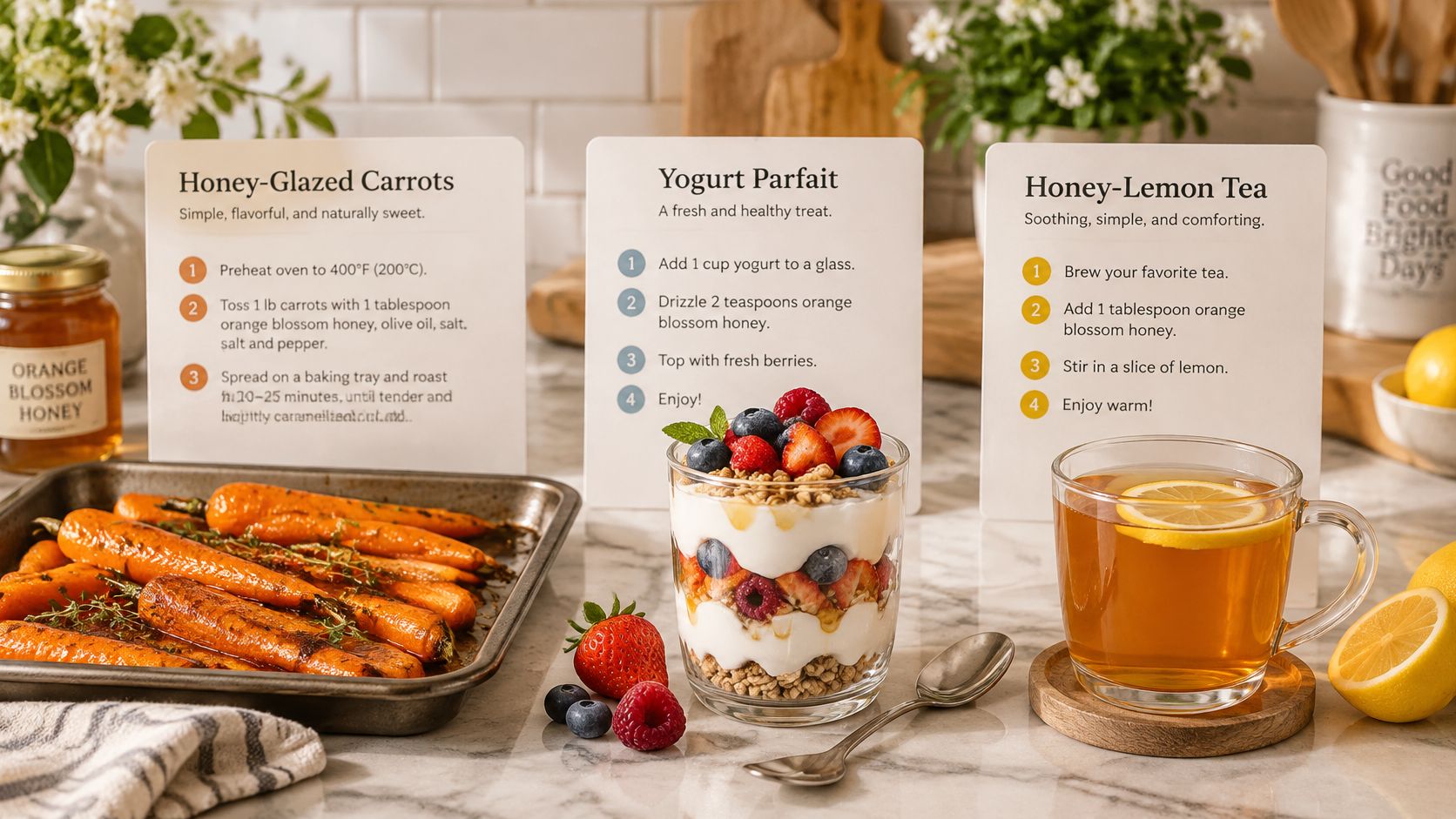
Honey-glazed carrots
- Heat the oven to 425°F.
- Toss 1 lb carrots with 1 tablespoon olive oil and a pinch of salt.
- Roast 15 minutes.
- Melt 2 tablespoons orange blossom honey (about 42 g) with 1 tablespoon butter and brush it over the carrots.
- Roast 10 to 15 more minutes, until the carrots are glossy.
The floral brightness cuts the roasted sweetness so the carrots don't taste only like sugar. Watch the edges. If the glaze boils hard on the pan, it will darken and turn bitter, so pull the pan when the shine appears.
The same late-addition idea shows up in savory glazes. If you're timing a tomato-based pie sauce so the sugars don't scorch, these barbecue pizza sauce timing tips are a useful cross-check before you brush anything sweet onto hot food.
Citrus vinaigrette
- Whisk 1 tablespoon orange blossom honey (about 21 g) with 2 tablespoons lemon juice and a pinch of salt.
- Slowly whisk in 1/4 cup olive oil until the dressing looks even.
- Toss it with greens right before serving.
Honey helps the oil and lemon stay together, and the citrus-floral note sits beside the lemon instead of fighting it. Don't dress the salad early. Salt and acid will wilt the leaves while the honey taste fades into the oil.
Iced honey tea
- Stir 1 tablespoon orange blossom honey into 1/4 cup hot water until it dissolves.
- Add 2 cups cooled brewed tea.
- Pour over ice, and add lemon if you like.
Hot water is doing the dissolving. Cold tea won't grab thick honey, and you'll end up with a sweet puddle at the bottom of the glass. Black tea, green tea, or a plain herbal blend all work. If you want the same floral note in a frozen dessert, our honey citrus ice cream uses that pairing in a scoop instead of a glass.
How to Check an Orange Blossom Honey Label
You're comparing two jars at the store. One says “orange blossom,” while the other lists a region and harvest details. Those words tell you different things: orange blossom names the honey's main nectar source, while raw, unfiltered, and organic describe handling or certification.
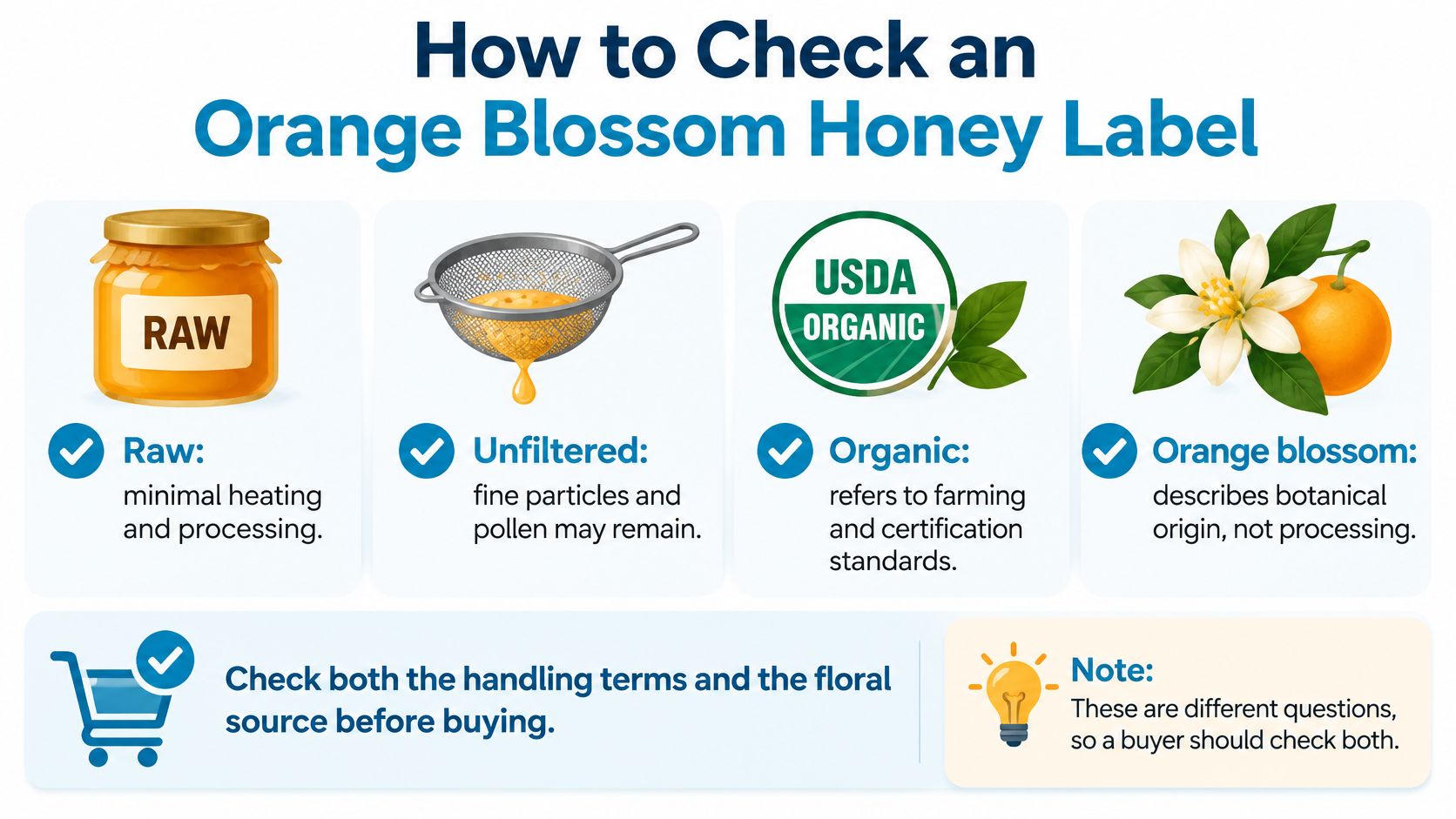
Topanga Quality Honey describes its single-variety jars, including orange blossom, as raw, unfiltered, organic, and kosher, with nothing added. Those details answer questions about the product, while botanical origin concerns the flowers bees foraged. For a closer look at how farming rules differ from ordinary honey handling, read this guide to organic honey versus regular honey.
What pollen percentages do and don't prove
There is no single global pollen cutoff for classifying citrus honey. Criteria have used different thresholds, and pollen profiles can vary across regions and harvests. A pollen count is one piece of evidence, not a standalone guarantee of floral origin.
Bees may visit eucalyptus, wildflowers, and other nearby plants alongside citrus blooms. Whether a honey qualifies as orange blossom depends on the applicable regional standards and how its origin is assessed, including its sensory character and test results.
A label that names a harvest region and date gives you useful context about where and when the honey was produced.
A short checklist before you buy
- Check where and when it was harvested. A region and harvest date help place the honey in context.
- Look for a specific harvest region. Honey from California, Florida, or Spain may differ in flavor because the surrounding blooms differ.
- Ask how botanical origin was assessed. Pollen analysis, sensory review, and chemical checks are different methods; a producer may use more than one.
- Look for traceability to the harvest location. That helps connect the jar to its stated region and bloom.
- Ask whether the honey is tested for added sugar syrups. A citrus aroma alone cannot establish whether syrup is present.
Color, crystals, and citrus aroma can help describe a honey, but none proves its origin by itself. A specific label, paired with clear answers about the harvest and how its floral source was assessed, gives you a more useful basis for comparing jars.
Choose the Size and Format to Buy Next
If orange blossom honey is new to your pantry, a 1 lb jar gives you a practical amount for tasting and cooking. Choose a 3 lb jar if you use honey often, or a 12 oz squeeze bear for quick drizzling.
| Format | Size | Best For |
|---|---|---|
| Jar | 1 lb | Trying the flavor, dressings and recipes in this guide |
| Jar | 3 lb | Frequent tea, baking and everyday cooking |
| Squeeze honey bear | 12 oz | Drizzling on yogurt, coffee and toast |
| Honey sticks | Varies | Lunch boxes, hikes and travel |
The 1 lb jar covers the carrots, vinaigrette and iced tea in this guide, with some left for toast. A larger jar suits households that use honey regularly. The squeeze bear makes it easier to drizzle onto food without reaching for a spoon.
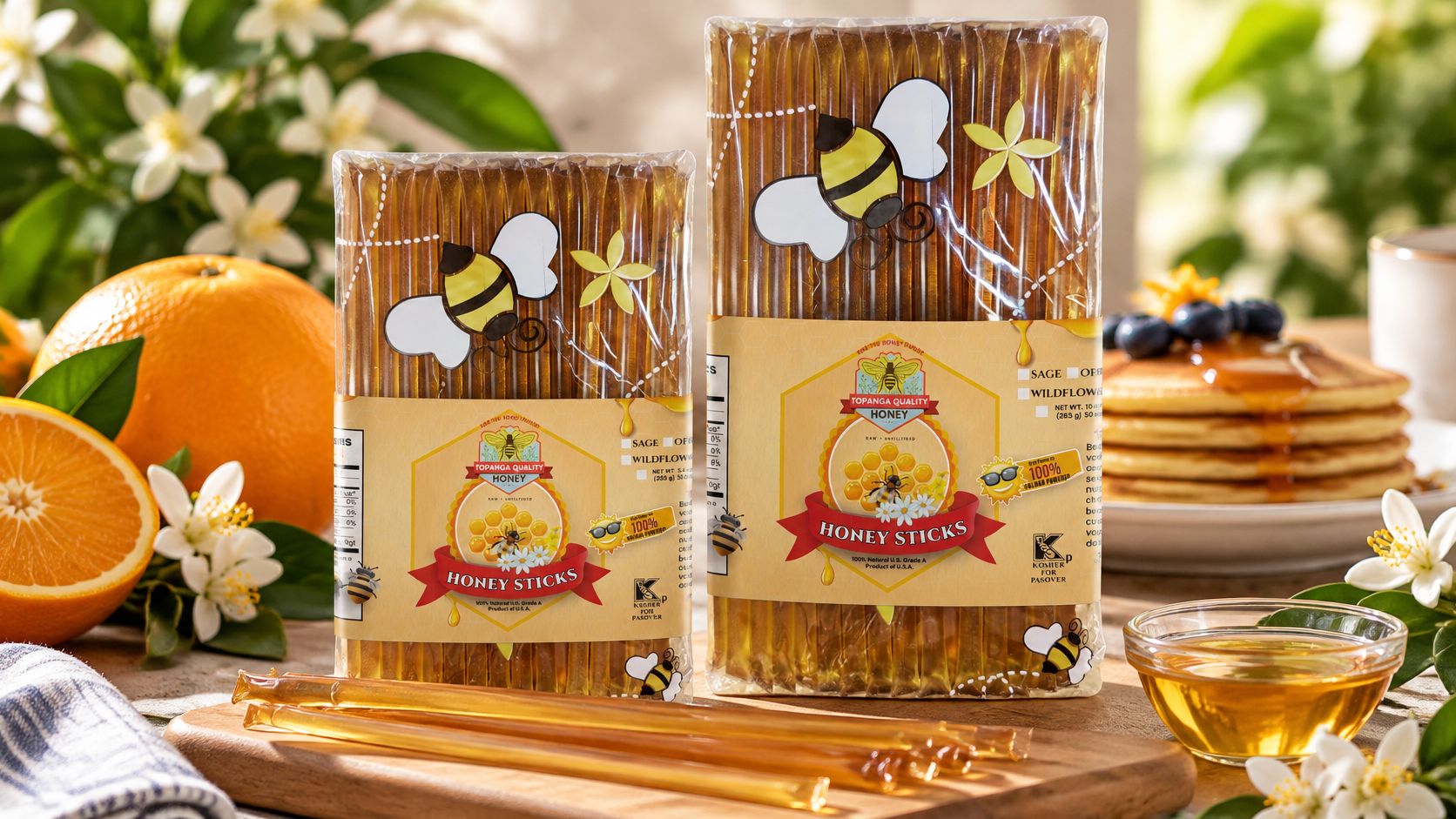
Orange Blossom Honey Sticks are made by bees working citrus groves in full bloom. They have a smooth, silky body. The stick format is handy when carrying a jar is impractical.
For a gift or a chance to compare varieties, The Honey Gift Set includes three 12 oz honey bears. You can choose any three 12 oz honeys from the range for $59.65.
Orders of $50 or more ship free to the continental United States. Orders below $50 have a $9.95 flat shipping rate.
Start with the 1 lb jar of orange blossom if this is your first citrus honey. A small spoonful can flavor tea, and the jar will leave enough for a carrot glaze later in the week.
Do not feed honey to infants under 12 months old.
Topanga Quality Honey is a family-owned California beekeeping company. If you want orange blossom honey for tea, dressings or weeknight glazes, visit Topanga Quality Honey to choose a jar or Orange Blossom Honey Sticks.