

Why Is Honey So Expensive? the Real Costs Behind Every Jar
A 12-ounce jar of Super Honey, raw honey blended with bee pollen, propolis and royal jelly, sells for $61.96. Part of that figure is what the honey costs to produce. Another part is what it costs to prove the jar holds what its label claims, and those two costs behave very differently.
U.S. honey production has been shrinking while the average price per pound keeps climbing. Honey is expensive because each colony yields a variable amount, keeping colonies alive is a fixed cost, and raw, traceable honey carries handling and testing on top.
Why so much more than a bag of sugar? Sugar is a manufactured commodity with a predictable yield. Honey is a biological surplus whose cost base does not shrink when the season goes badly. A beekeeper pays for bees, feed, medication, fuel, labor and equipment whether or not the flowers cooperate.
A higher price alone still cannot prove a honey is pure, organic or single-origin.
Table of Contents
- The Five Cost Stages Behind Every Jar
- Why Weather and Colony Losses Shrink the Harvest
- How Floral Source Limits Supply and Lifts Prices
- What Raw, Organic and Kosher Labels Add to Cost
- Why a Higher Price Does Not Prove Purity
- How to Judge a Honey Price Before You Buy
- Choose the Honey Whose Price You Can Justify
The Five Cost Stages Behind Every Jar
Honey looks like one ingredient with one price. In practice it carries five separate costs before it reaches a shelf, and each behaves differently when a season goes wrong. Split them apart and the price stops looking arbitrary.
| Cost stage | What it covers | How it raises the price |
|---|---|---|
| Colony care | Queens, feed, medication, replacing lost colonies, winter survival | Every colony costs money whether or not it makes a surplus |
| Harvest | Nectar flow, moving hives to bloom, weather and forage | A poor season spreads fixed costs over less honey |
| Extraction and processing | Uncapping, spinning, straining, moisture control, bottling | Labor and equipment scale with the honey collected |
| Testing and traceability | Lot separation, origin records, laboratory analysis | Adds cost per batch that low-cost blends skip |
| Packaging and shipping | Jars, bears, sticks, labels, freight | Smaller formats and delivery add cost per ounce |
Read that table from the top down and a pattern appears. The first two rows are paid before a single pound exists. The last three are paid per pound after it does. When the harvest shrinks, the early rows don't get cheaper.
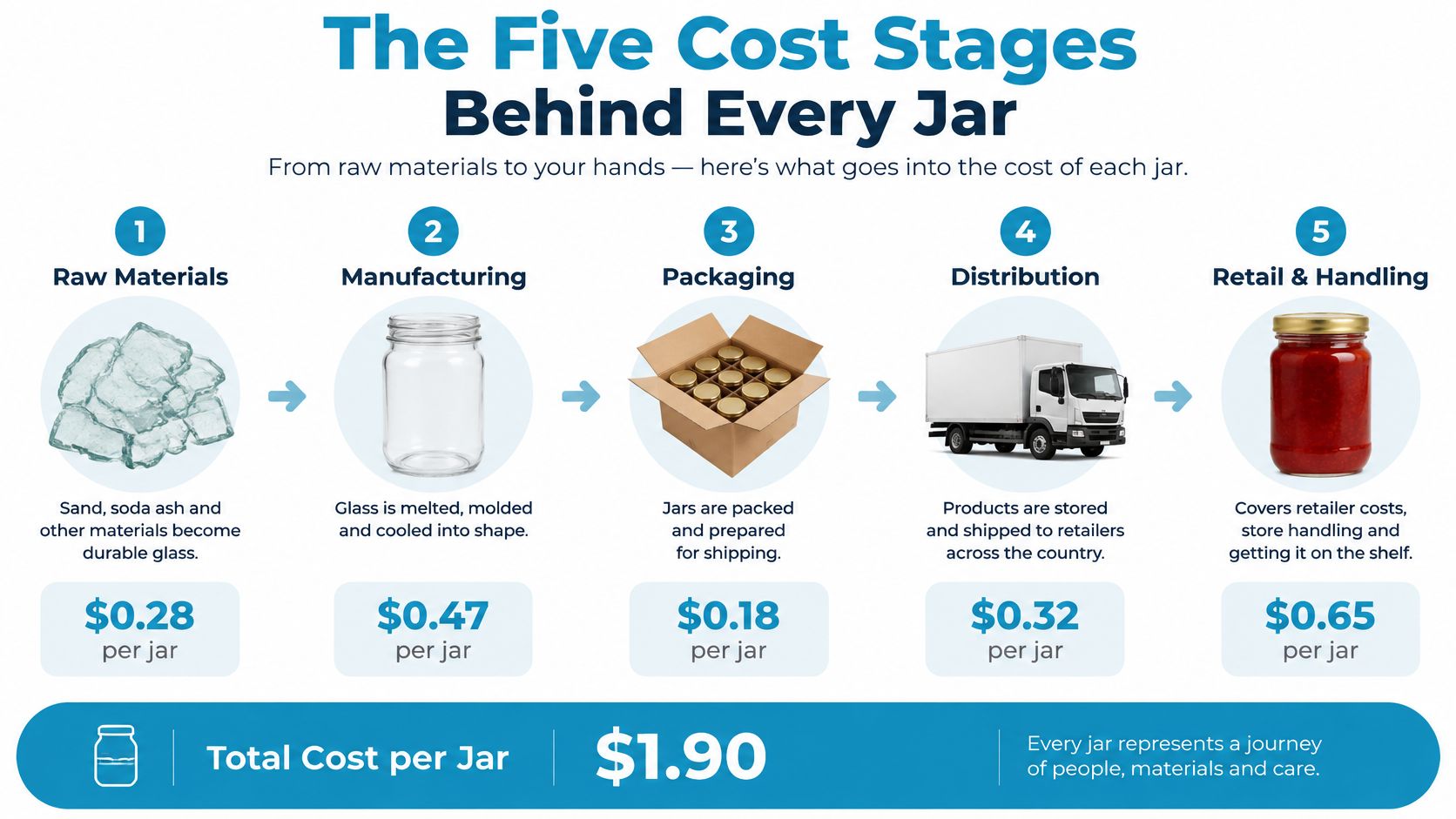
Take a 1 lb jar as a worked example. The colony that filled it was fed, treated and wintered whether the nectar flow was strong or weak, and that overhead sits in the first two rows. If the season ran short, the same hive costs spread across fewer pounds, so each jar absorbs more of them. Rows three through five then attach per pound: extraction labor, lot records and testing if the beekeeper pays for them, and finally the jar, label and freight.
Real products show how differently the stages can load. A 1 lb Raw Honeycomb at $37.09 skips the spinning step but pays more at packaging, because cut comb has to be handled and boxed without crushing. A 12 oz Super Honey at $61.96 carries its weight earlier: raw honey blended with bee pollen, propolis and royal jelly costs more at the processing stage before a jar is even filled.
A useful test: when a jar looks expensive, ask which stage the price reflects. A cheap blend usually skips the fourth row, not the first.
Anyone who has priced a product for a living knows the same lesson. Fixed costs set your floor, and variable volume decides whether you clear it, which is why budgeting for business software purchases starts with the recurring line items rather than the one-time extras. A honey house runs on the same arithmetic.
One practical note before you compare jars. A larger container is not automatically the better buy per ounce, because format, packaging and the variety inside all shift the math. The Honey Gift Set of three 1 lb jars at $72.22 prices the same five stages differently than three singles bought apart. Divide before you decide.
Why Weather and Colony Losses Shrink the Harvest
Honey is a surplus a living colony makes after it has fed itself, and that surplus disappears when the colony is sick, hungry or sitting in a place that has not bloomed.
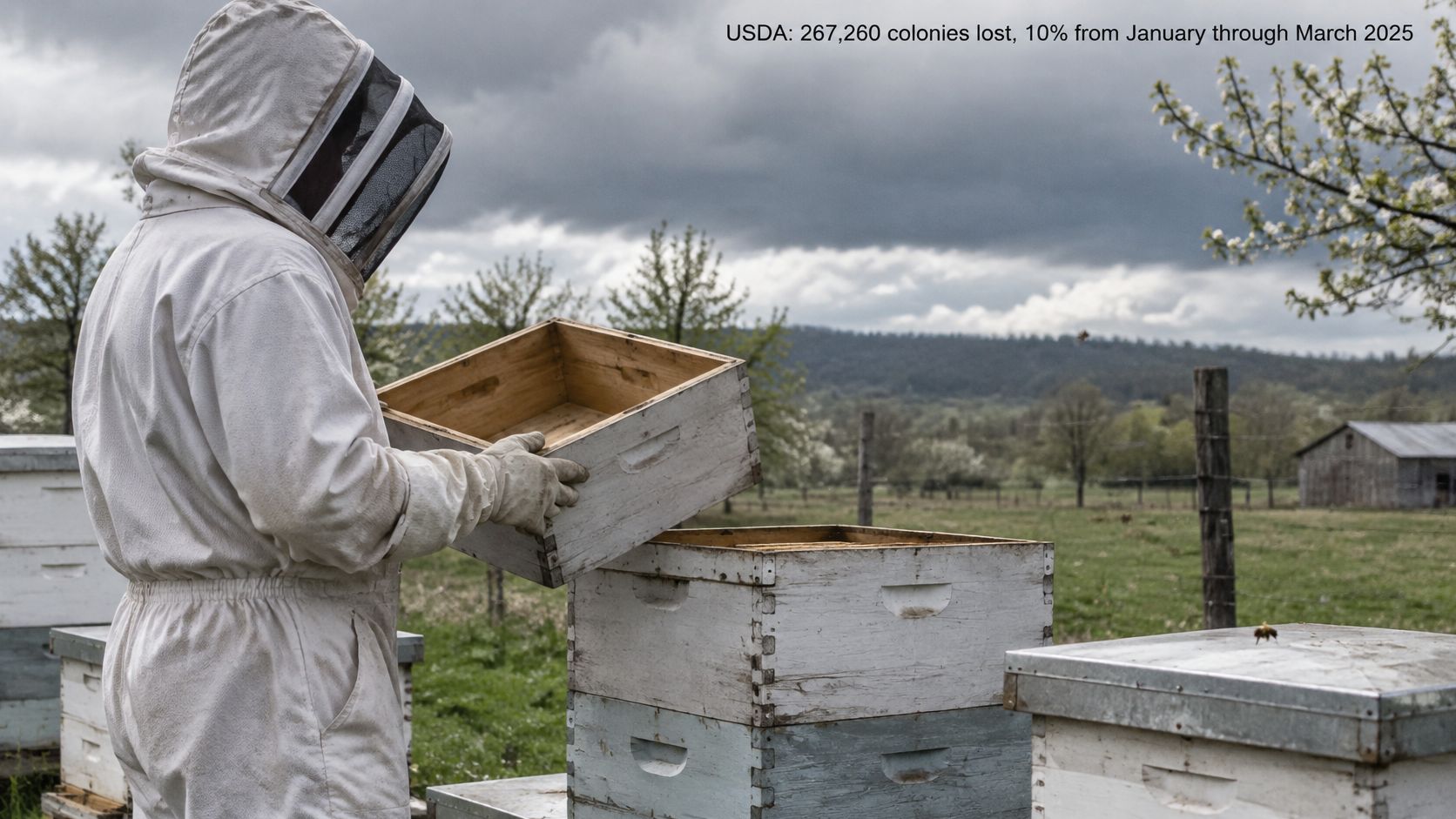
Colony loss is a routine line item in a beekeeping budget. U.S. beekeeping operations lost 267,260 colonies, or 10%, from January through March 2025, and lost another 292,630 colonies, or 10%, from April through June 2025, according to the USDA National Agricultural Statistics Service. Replacing each one means buying a package or nucleus colony, installing a queen, and feeding syrup until the bees build enough strength to forage. A beekeeper who loses a large share of the yard faces a harder choice: split the strongest survivors into new colonies and give up their honey crop for the season, or buy replacements outright and pay for the queen, the bees and the feed. Either way, the apiary produces less while the bills stay the same.
Placement changes yield as much as weather does. A Food and Agriculture Organization beekeeping reference reports that, under very sunny conditions, colonies protected by solid shade can produce 50% more honey than colonies left exposed to the sun. That single variable explains why serious beekeepers move hives to orchards, farms and wildflower ranges instead of leaving them in one spot. The truck and the fuel are the price of getting yield.
Those moves cost real money, and they keep climbing. USDA reports flag colony-management and transportation costs on the California run as rising, which squeezes operations that depend on pollination season to carry the year.
Why a smaller harvest costs more per jar
Feeding, mite treatment, wintering, equipment repair and the setup at the extractor do not shrink when the flow is poor. They spread across fewer pounds. A beekeeper with the same yard and the same bills has fewer jars to carry those costs, and the price per jar moves to cover the gap.
The national production series shows the squeeze in figures. The 2016 and 2024 columns come from the earlier annual honey report, and the 2025 column comes from the 2025 USDA honey report.
| Measure | 2016 | 2024 | 2025 |
|---|---|---|---|
| U.S. honey production (million lb) | 162 | 134 | 116 |
| Honey-producing colonies (million) | 2.78 | 2.60 | 2.41 |
| Average yield per colony (lb) | 58.3 | 51.7 | 48.0 |
| Average honey price per lb | Not reported in this series | $2.69 | $3.05 |
When the flow is on, this is what a harvest day looks like.
A tight season shows up in the market before anyone explains it. Three signals give it away:
- Fewer colonies working: beekeepers rebuild from losses instead of expanding, so the base that produces honey shrinks.
- Lower yield per colony: the same hives bring in less, and the standing costs land on fewer jars.
- A late or short bloom: a missed window cannot be recovered later in the year, no matter how strong the hives are.
To understand what beekeepers watch for inside the hive before those pressures reach a shelf price, Honeybee Health insights from HearSmart covers the warning signs.
How Floral Source Limits Supply and Lifts Prices
Floral source is production cost before it is marketing. A multi-bloom jar can be assembled from several flows across a season. A named-variety jar rides on one plant, one season and one weather break, so scarcity is built into the supply before a label ever enters the discussion.
Start with sage. Our Raw Sage Honey comes off one California bloom window, and a short or weak bloom leaves less to sell that year. There's no lever to pull. You can't stretch sage honey without changing what it is.
Avocado honey is tied to orchards managed for fruit first, so the beekeeper gets the bloom the crop and weather allow. Raw Cactus Honey leaves even less room to substitute when its bloom fails. Raw Buckwheat Honey follows its own bloom period in the USA, and the buckwheat honey in the USA guide explains how that window shapes the crop.
Blackberry, eucalyptus and Brazilian wildflower each carry their own window too. Once the flowers are gone, that variety cannot be backfilled until the next season. The risk stays in the jar.
California wildflower and blends work differently. A wildflower jar can pull from many sources, so a weak week in one spot can be covered by a stronger one elsewhere. That flexibility is production slack, and it is why an honest blend can cost less.
Narrow floral supply raises the cost of making the jar. By itself, a higher price still cannot prove purity, organic status or a single origin.
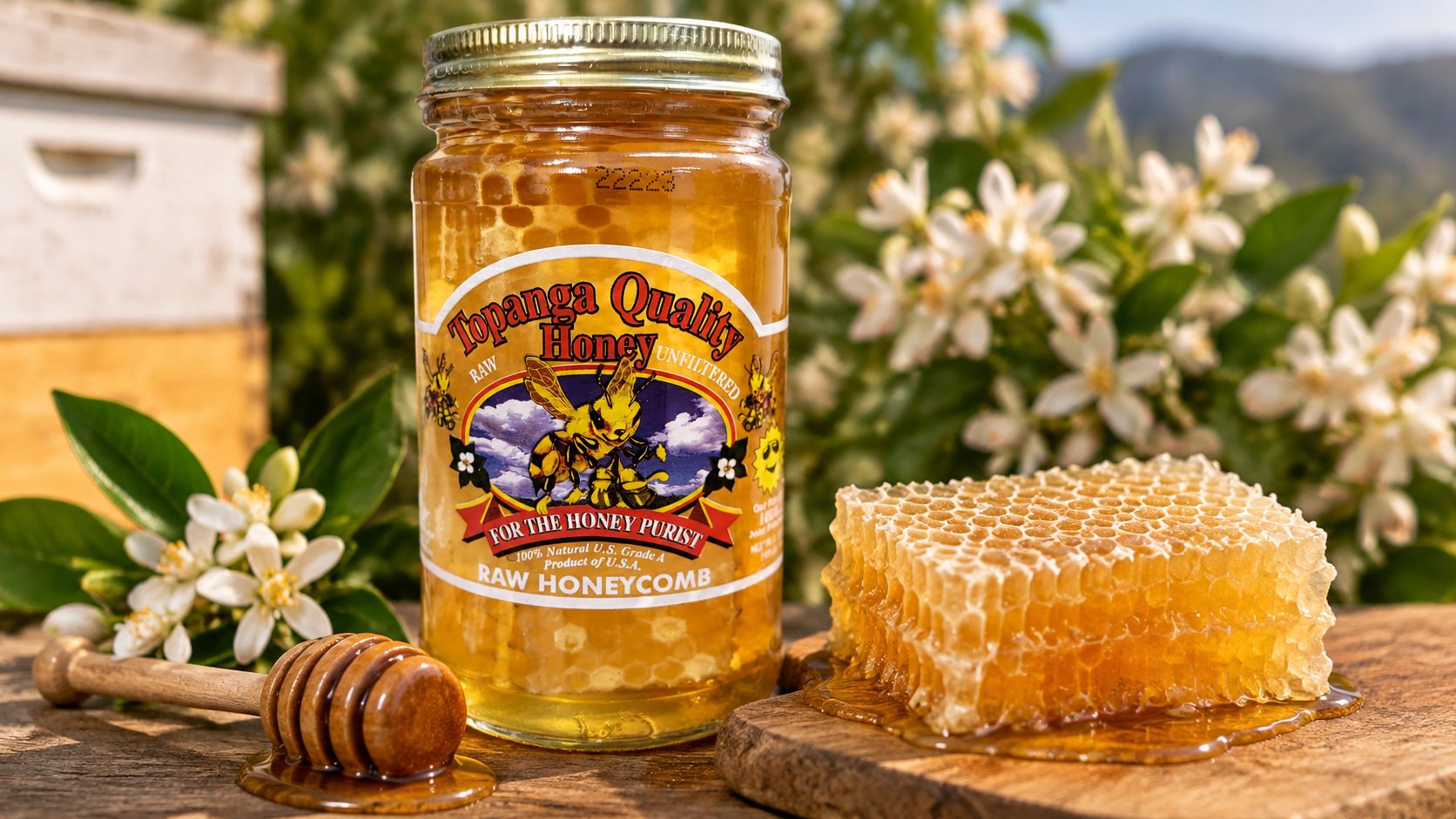
If you want to see how little processing changes a honey, Raw Honeycomb, 1 lb is honey exactly as the bees made it, still sealed in its beeswax comb. There is no blending tank behind a comb. Cut a piece and the honey runs out of the cells, with soft, chewable wax around it, ready for a cheese board, warm toast or eating on its own.
What Raw, Organic and Kosher Labels Add to Cost
Raw means the honey was never pasteurized and never ultra-filtered. No heat treatment means no shortcut to a uniform product, so the beekeeper handles each batch carefully and accepts that two harvests of the same variety may differ in color and body.
It also means raw honey may crystallize naturally. That's normal, and the honey is still good. To re-liquefy it, set the jar in warm water, not boiling, and give it time.
Organic and kosher status work differently. Both are documented requirements, which means records, oversight and separation of lots rather than a one-time decision. They add cost even when the honey inside is identical to a jar without them. If you want to see what certification asks of a producer, what organic certification really means walks through the paperwork side, and our own comparison of organic honey vs regular honey covers what changes on the label.
Reading the label in three questions
Label language matters more than most shoppers expect, because "nothing added" only applies to single-variety honeys. Pomegranate honey sticks are honey blended with pomegranate, and Super Honey is honey blended with bee pollen, propolis and royal jelly. Those are blended products, and the label should say so.
- Is it raw? Look for never pasteurized and never ultra-filtered, not just a picture of a flower.
- Is the floral source named? Sage, orange blossom, buckwheat and cactus each tell you something specific. "Honey" alone tells you nothing.
- Is it single-variety or a blend? Blends are legitimate products, including our pomegranate sticks and Super Honey, but they shouldn't be priced or read as single-origin honey.
Why a Higher Price Does Not Prove Purity
A high price is a floor test, not a receipt. It rules out the jar that's too cheap to be what it claims, and it earns the next question rather than answering it. Cheap syrups can add volume at a fraction of the cost of nectar, which undercuts anyone paying for apiary labor, extraction, moisture control and testing.
This is a measured problem, not a rumor. In an FDA assignment covering January 2021 through March 2022, the agency tested 144 imported honey samples from bulk and retail shipments representing 32 countries and found 14 violative samples, or 10%, involving undeclared cheaper sweeteners such as cane or corn syrups, per the FDA's sampling report. The FDA used stable carbon isotope ratio analysis to check whether a sample's composition matched authentic honey, and violative shipments could be refused entry.
The picture isn't uniform, which is exactly why price can't carry the whole burden. A later FDA assignment tested 102 domestic and imported samples for undeclared cheaper sweeteners and found four violations, two domestic and two imported, according to the FDA's 2025 sampling results. Meanwhile the European Commission's 2021 to 2022 coordinated action suspected noncompliance in 46% of 320 imported samples, and its honey fraud control summary names the price gap between genuine honey and syrups as the incentive.
What to check instead of the price tag
Traceability costs money: lot separation, origin records, laboratory screening, documentation and compliant labeling. Those costs are part of why verified honey sells for more, and they're also why price alone tells you so little. A fraudulent jar can carry any number on it.
Look for a named floral source, a stated origin, a clear label and a producer who can explain how the honey was tracked and tested. Our guide to how to check if your honey is real goes through the signs a buyer can see. Then ask the question directly. A beekeeper who knows the supply chain answers it in plain language.
How to Judge a Honey Price Before You Buy
Six checks tell you more about a jar than shelf position or label design. Each one has a reason behind it, and the reason is usually where the money went.
- Divide the price by the ounces. Packaging influences the price as much as the contents do. The Honey Gift Set (3 x 1 lb) at $72.22 works out near $1.50 an ounce, while a 3 lb jar of Gallberry at $70.40 comes to about $1.47. The bigger jar saves only a few cents an ounce, so the main question is how much honey you'll go through.
- Give comb honey its own math. Bees burn honey to build wax, the comb can't go through an extractor, and every piece is cut and packed by hand. A 1 lb raw honeycomb at $37.09 comes to about $2.32 an ounce; the 11 oz honeycomb square at $45.08 comes to about $4.10. The difference buys wax and labor.
- Compare blends with blends and varieties with varieties. Super Honey is raw honey blended with bee pollen, propolis and royal jelly, thicker and more textured than plain honey, and a 12 oz jar lists at $61.96. Single-variety jars such as clover, sage, buckwheat and blackberry list at $50.40. The gap pays for added hive ingredients, so measure it against other blended products.
- Run the set math before buying singles. The two-jar 3 lb gift set lists at $64.68, less than the $70.40 on a single 3 lb Gallberry jar. The Honey Super Set covers any five products for $159.13, where five jars at the $66.40 avocado or eucalyptus level would total $332. Sets look like gifts; the arithmetic often makes them the cheaper way to stock a pantry.
- Treat sticks as a convenience buy. Honey sticks start at $41.81 and pack single servings for pockets and lunchboxes. Per ounce they're the dearest way to buy honey, so buy them when portability is the point and pour from a jar the rest of the time.
- Match the size to your appetite. Raw honey crystallizes in time, which is normal and reversible, but a 3 lb jar only saves money if it gets finished. I'd take two smaller jars of varieties you'll reach for over one large jar that sits.
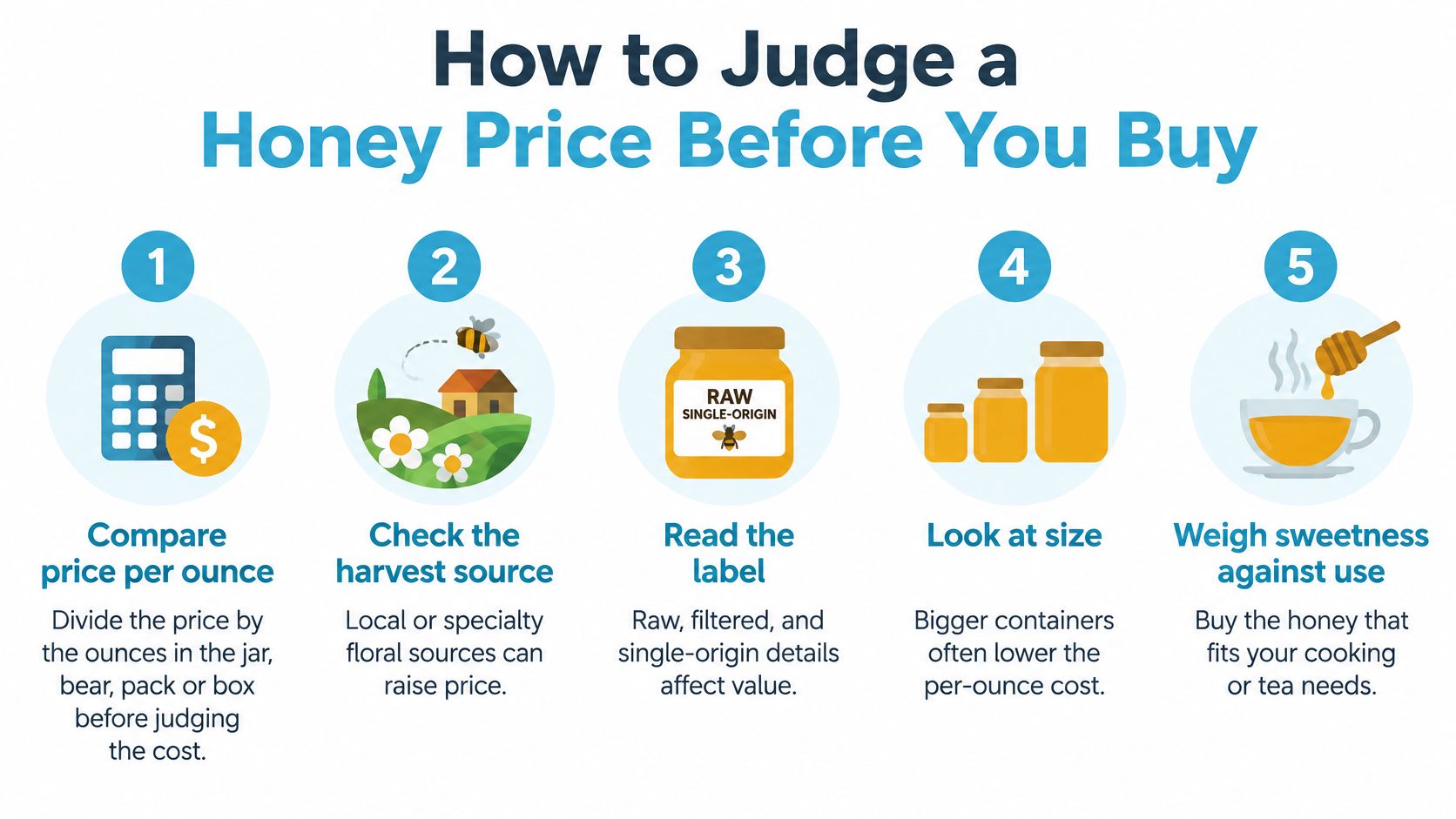
None of these checks proves a jar is pure. They tell you whether the price has a cost behind it: wax, hand labor, added hive ingredients or a format built for convenience. A high tag can reflect all of that, or it can reflect a seller's confidence that you won't do the division. The math is the quickest way to tell which jar you're holding.
Choose the Honey Whose Price You Can Justify
The right honey is the one you'll finish, so match the jar to the job before you match it to the budget. For baking, glazes and strong coffee, the dark, malty varieties earn their keep: our raw avocado honey, at $66.40, stands up to molasses and dark chocolate without disappearing into the batter. For tea and gentle drizzling, the pale, mild honeys justify their price the other way around, because you taste the tea first and the honey second.
If you'd rather sample before committing to a full jar, the Honey Gift Set (3 x 12 oz) costs $59.65 and lets you choose any three 12 oz honey bears from the range at a set price. Three small bears teach you more about your own taste than one large jar bought on a guess.
Shipping is free on orders of $50 or more to the continental US, with a $9.95 flat rate below that. Run the numbers before you check out: an order that lands a few dollars under the threshold can cost more once the flat rate applies than one that crosses it.
My rule at the shelf is simple: pay for a cost you can name. Floral source, stated origin, raw handling and careful packing are real costs with a harvest behind them. A high number with none of those attached buys you a nice jar and nothing else. Pick the variety whose label explains its price, in the size you'll use up.
Topanga Quality Honey is a family-owned California beekeeping company, so the hives, the harvest and the packing are all part of what sets the price on the jar. Our honey is raw, unfiltered, organic and kosher, and every variety is named by floral source so you know exactly what you're paying for. Visit Topanga Quality Honey to compare varieties by use and pick the one you'll finish.
Do not feed honey to infants under 12 months old.