

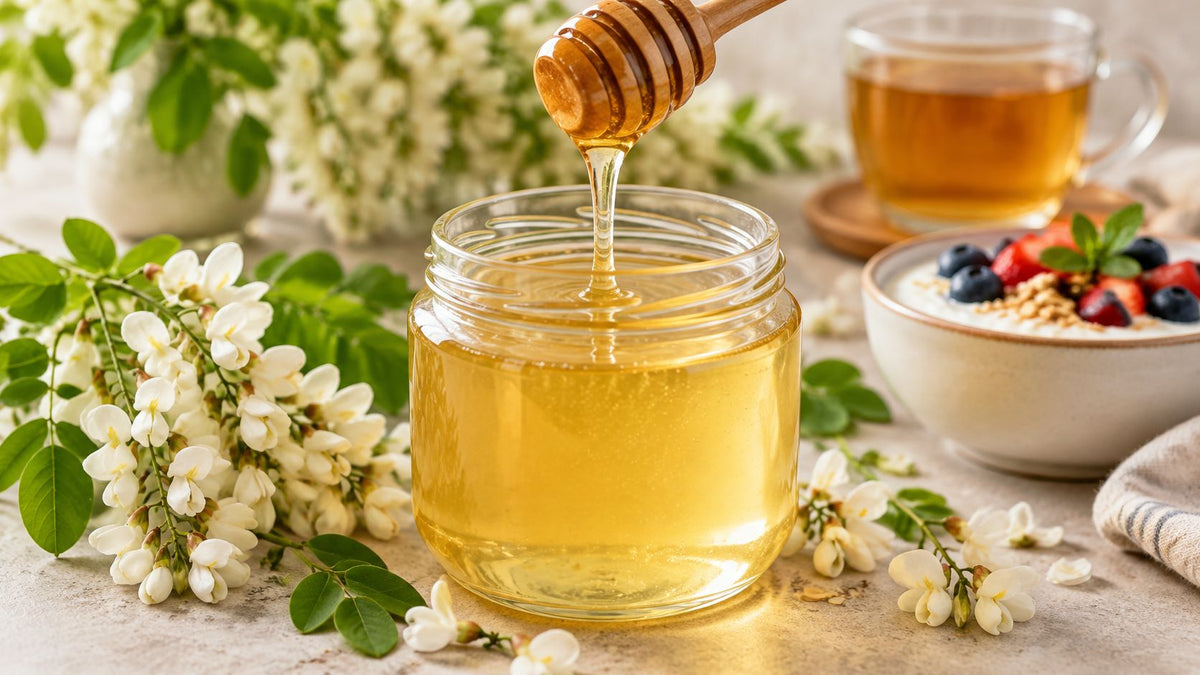
What Is Acacia Honey? Flavor, Source and Uses
What makes acacia honey stay liquid longer than many other honeys? Its relatively high fructose-to-glucose ratio slows crystallization, so it can remain clear and pourable for longer.
The name can be confusing: acacia honey is made mainly from black locust (Robinia pseudoacacia) nectar. The label names the honey's floral source as it is commonly known in the trade, but the word “acacia” alone does not identify the plant's botanical genus. That distinction also matters when interpreting the jar's pale color or thin texture: neither proves the honey's source.
Table of Contents
- What Acacia Honey Is and Where It Comes From
- How Acacia Honey Tastes, Looks and Feels
- How to Soften Acacia Honey That Has Crystallized
- How to Use Acacia Honey in Everyday Cooking
- What a Label Can Show and How to Check the Jar
- Choose the Honey That Fits Your Kitchen
What Acacia Honey Is and Where It Comes From
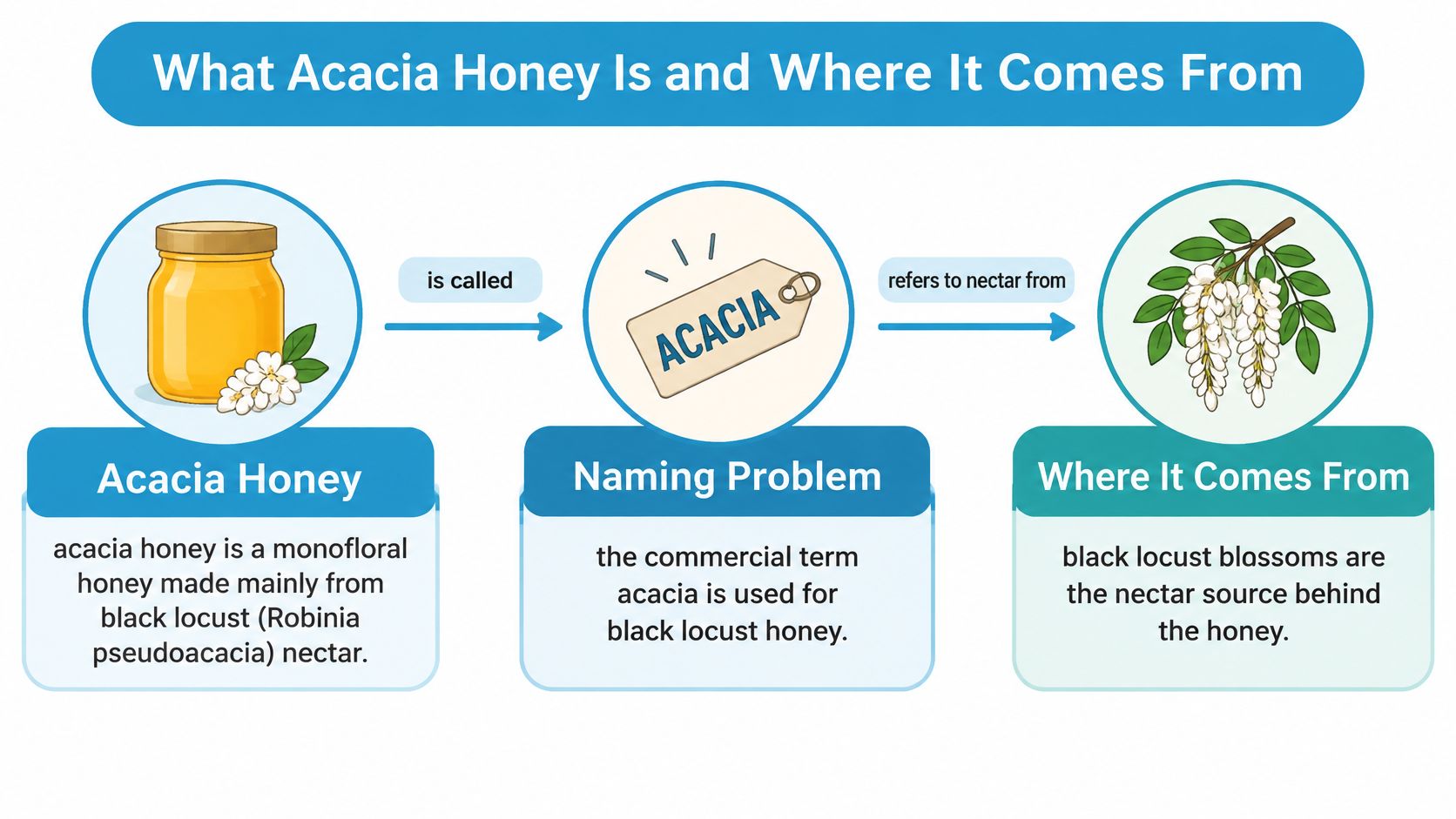
Why does honey called acacia often come from a tree that is not botanically an acacia? In many markets, the name commonly refers to honey made mainly from black locust (Robinia pseudoacacia) nectar. The botanical Acacia genus is a separate group of plants, and many African trees commonly called acacias have been reassigned to the genera Vachellia and Senegalia.
Why the name stuck
Black locust spread through Europe, and its honey became known in trade as acacia honey. The familiar name persisted even though it does not match the tree's botanical classification. It works as a market name, but it does not identify the plant with complete precision.
What the bees do with the nectar
During the flowering period, bees collect nectar and carry it back to the hive. There, they pass it between bees and fan air across the combs, reducing its water content as the nectar becomes honey. The finished honey also contains plant-derived compounds, including aromatic ones.
This origin matters because “acacia” on a jar is a name, not proof of its contents. A pale color cannot confirm which flowers the bees visited, either.
The check that actually helps
One Romanian study counted samples as acacia honey when they contained more than 45% Robinia pollen. That kind of pollen analysis can help assess floral origin; appearance alone cannot.
Ask this before you buy: which plant does the seller mean by acacia, and can they confirm it? A seller who names Robinia pseudoacacia and states an origin gives you more specific information than a label that says only acacia.
How Acacia Honey Tastes, Looks and Feels
The reputation of this honey rests on a handful of numbers, and those numbers explain the look and the feel better than any adjective.
| Measure | Figure | What it means |
|---|---|---|
| Fructose in one analysis | about 39.9% | Main sugar; sweet and slow to grain |
| Glucose in that analysis | about 30.07% | Sugar most likely to crystallize |
| Fructose-to-glucose ratio | often above 1.3; about 1.64 in Romanian samples; range 1.02 to 1.65 | Higher ratios stay fluid longer |
| Reducing sugars | near 70 g per 100 g | Concentrated sweetness |
| Combined fructose and glucose minimum | 60 g per 100 g | International blossom-honey floor |
| Moisture | 14.36% to 18.40% in a commercial survey; limit 20% | Within the usual blossom-honey cap |
| Acidity limit | below 50 milliequivalents per kilogram | Same core standard as other blossom honeys |
A comparative characterization of acacia honey found it had the highest fructose-to-glucose ratio among the honeys tested, with correspondingly low crystallization risk. That's the mechanism behind a clear jar. Glucose is the sugar that grains first, and acacia keeps less of it in proportion to fructose.
One physicochemical analysis of acacia honey explains the practical side of that balance: ratios above about 1.3 keep honey liquid longer, while ratios under 1.0 push it toward faster crystallization. Samples of this variety have ranged from 1.02 to 1.65, so two jars from the same shelf can behave differently over a winter.
What the standards behind the label ask for
International blossom-honey limits sit behind those figures. A review of commercial acacia honey reports a minimum combined fructose and glucose content of 60 g per 100 g, a moisture ceiling of 20%, and acidity below 50 milliequivalents per kilogram. Its survey of samples found moisture between 14.36% and 18.40%, comfortably inside the cap.
Color, sweetness and pour
In the glass, acacia honey usually runs from nearly clear to light gold. The flavor is mild and gently floral, sweet in a clean way rather than a heavy one, and the body is thin enough to drizzle without dragging. A squeeze bear suits it, and so does a spoon over yogurt.
Treat what you taste as supporting evidence rather than a verdict. If you want to sharpen your palate on the difference between a delicate honey and a bold one, tasting honey side by side teaches more in ten minutes than a paragraph of description.
How to Soften Acacia Honey That Has Crystallized
This variety holds out longer than most, but it isn't immune. Cool storage, a little extra moisture, or a floral mix that leans less heavily on locust can all coax crystals out of a jar that stayed clear for a year. When it happens, the honey is still good. Nothing has spoiled.
Warm it gently and the crystals loosen.
- Keep the lid on so no water finds its way in while the jar warms.
- Set the jar in a bowl of warm, not boiling, water. The water should feel hot to your hand but never steam.
- Wait until the crystals loosen, and replace the water if it cools before the honey clears.
- Stir once it flows. A slow stir distributes the heat evenly.
- Take the jar out and let it cool before you put it back in the cupboard.
Temperature rule: warm water, never boiling. Heat that high drives off the aroma you paid for and darkens the honey, and there's no way to put either back.
A fluid jar is the one you drizzle over yogurt or stir into iced tea. A grainy jar is still the one you spoon into oatmeal or warm milk, where it melts into the bowl anyway. If you want the longer explanation of why honey hardens in the first place, this piece on why honey can be hard covers the crystal chemistry in plain terms.
A long liquid life is a handling trait, though, not a certificate of origin. Plenty of blended honey stays soft, and plenty of genuine single-floral honey eventually grains.
How to Use Acacia Honey in Everyday Cooking
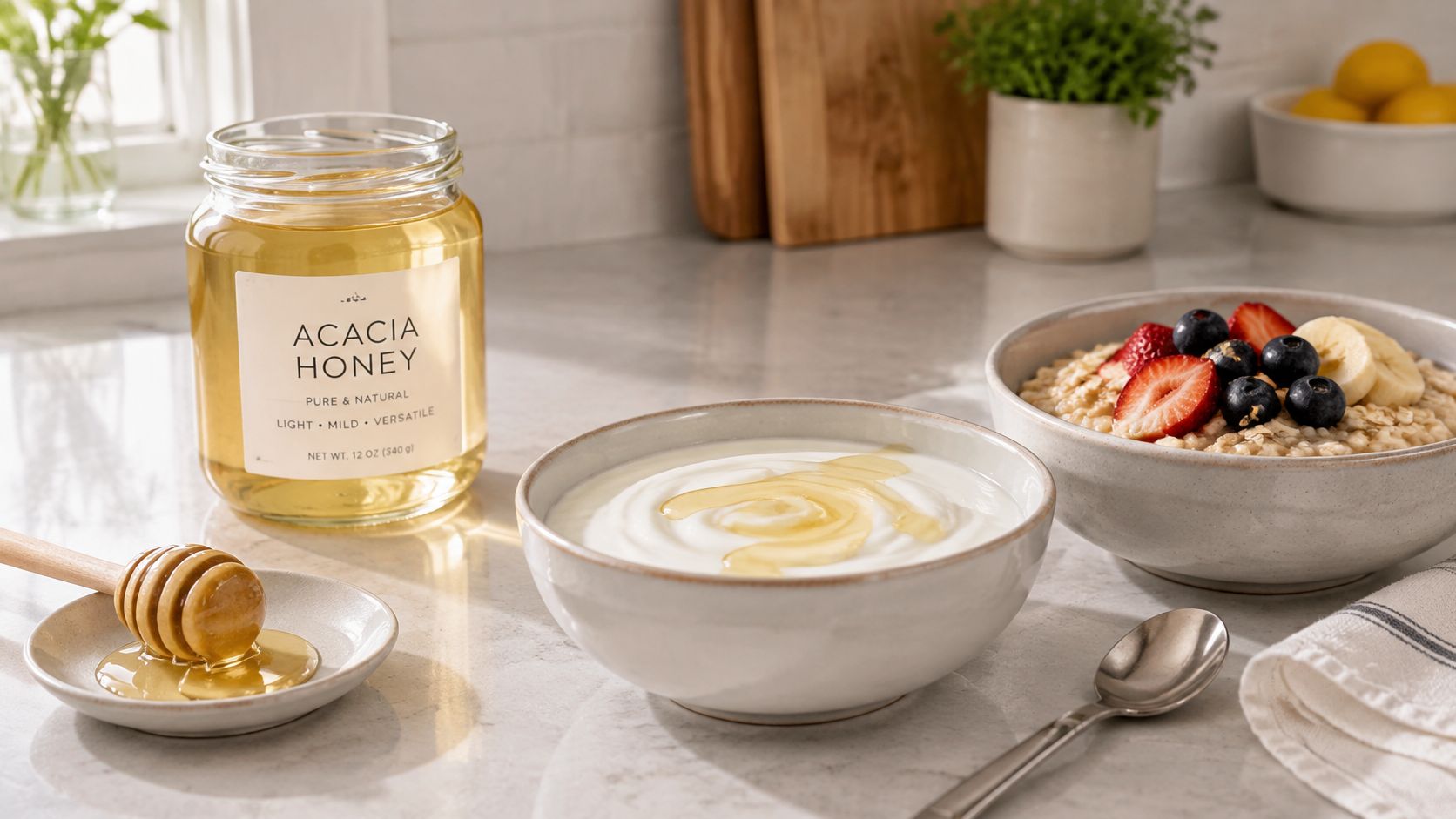
A spoonful of honey in yogurt, a little in tea, or a brush over roasting carrots: acacia honey suits dishes where you want sweetness without a strong honey flavor. Its mild taste is easy to pair, and its fluid texture stirs readily into food.
Try it in:
- Plain yogurt, oatmeal and cut fruit. Drizzle it over the top so you can adjust the sweetness bite by bite.
- Tea and warm milk. Stir it in after the drink has cooled enough to sip.
- Light vinaigrette and lemon dressing. Whisk 1 tablespoon of honey, about 21 g, with 1 tablespoon lemon juice and 2 tablespoons oil. Taste, then adjust the honey or lemon to suit the greens.
- Roasted chicken or carrots. Brush on a thin layer during the last few minutes of cooking to reduce the chance of the sugars burning.
- Soft cheese and toast. A small drizzle over ricotta or brie adds sweetness without masking the cheese.
When a darker jar is the better call
A mild honey can fade into rye bread, gingerbread or a bold glaze, where spices and dark flour bring stronger flavors. A more pronounced honey can hold its own. For example, dark honeys such as avocado, buckwheat and eucalyptus are suited to baking, marinades and cheese boards.
For a dish where you want the honey itself to stand out, add it near the end of cooking. In baking, remember that honey contributes both sweetness and liquid, so replacing another sweetener may call for adjustments to the other ingredients. These agave replacement ratios for baking offer a starting point for comparing sweeteners, but they are not a direct honey conversion.
Try a small drizzle over breakfast, whisk some into a simple dressing, or brush it onto carrots near the end of roasting.
What a Label Can Show and How to Check the Jar
Three separate claims hide behind one word on the front of a jar. What plant the bees worked, where the honey came from, and whether anything was added to it are three different questions, and a label often answers only the first.
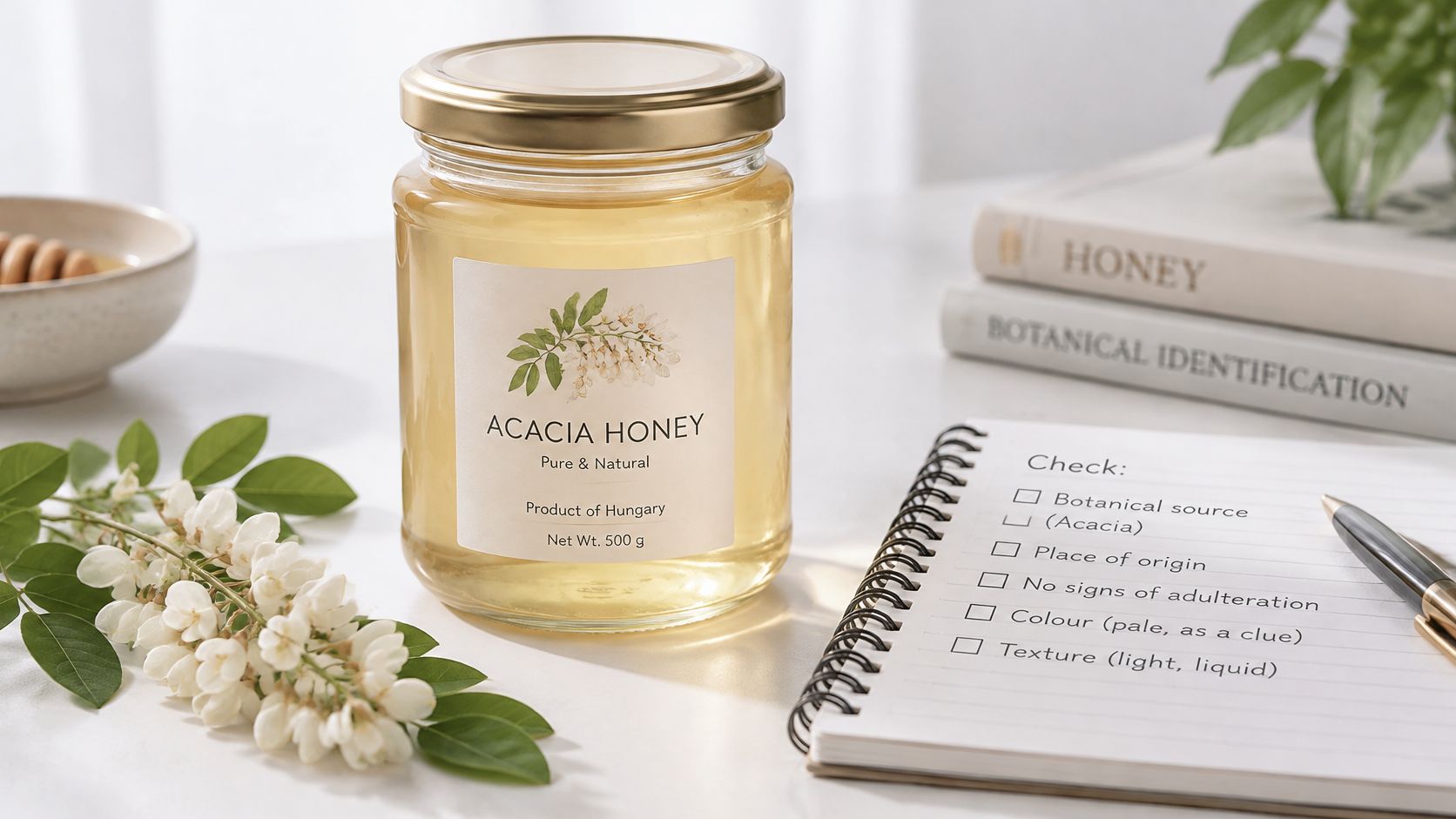
A jar of pale honey photographed beside blossoms makes the source look obvious. The styling is marketing. The pollen inside is evidence.
What testing actually found
Authenticity research using DNA-based pollen analysis confirmed only 6 of 10 tested honey samples as labeled, and reclassified the other four. One sample sold as robinia or acacia honey couldn't be confirmed because Robinia pollen made up just 1% of the nectar-source taxa it carried, well under the 15% reference threshold the study cites.
That result isn't a reason to distrust every jar on the shelf. It's a reason to understand what a test can and can't do. Pollen abundance doesn't always track how much nectar a plant contributed, which is why melissopalynology, DNA metabarcoding and chemical fingerprinting each carry limits. Newer analytical work points to hesperetin and pinocembrin as promising markers for separating natural acacia honey from commercial versions, and reports real differences in phenols, flavonoids, proline and enzyme activity between them.
Four checks worth doing before you pay
- Look for the plant name. Black locust or Robinia pseudoacacia tells you more than the single word acacia.
- Read the processing words. Raw means never pasteurized. Unfiltered means not ultra-filtered. Neither one says anything about floral source.
- Find the origin and the packer. A country or state plus the name of who packed it is the minimum for judging freshness and traceability.
- Ask about testing. For a monofloral claim, ask whether the seller has pollen analysis or other compositional testing. A refusal to answer is itself an answer.
The useful split: the front label describes a floral style. The fine print and the seller describe a supply chain. Judge them separately.
None of this makes the word useless. It narrows the shelf to a style of honey you may want. Just don't let it carry weight it can't hold. A floral designation is not the same as single-origin geography, raw processing, organic certification, or freedom from adulteration, and each of those has to be earned somewhere on the label or in the paperwork. If you want a longer walkthrough, this guide to checking whether your honey is real takes the same four checks further.
Choose the Honey That Fits Your Kitchen
Choose by flavor first, then by format. A mild honey suits tea, yogurt, fresh fruit and light dressings, where a stronger flavor might take over.
For dark glazes, rye bread and gingerbread, try a more assertive honey. Raw buckwheat honey is very dark, almost black in the jar, with a malty, molasses-like flavor that holds up in baked goods.
If you want a California honey with a gently floral taste, raw sage honey is one option. For a distinctively rich flavor, raw avocado honey comes in 1 lb and 3 lb jars, as well as 12 oz honey bears. Honey sticks offer another way to enjoy honey in single servings.
For help comparing flavors and textures, browse the honey varieties guide.
Topanga Quality Honey is a family-owned California beekeeping company. Its honey is raw, unfiltered, organic and kosher, and packed in California. The range includes honeys from different floral sources and origins, along with honeycomb and blended specialty products.
Choose a honey that suits the way you cook. Topanga Quality Honey's raw avocado honey is available in several formats, and its range offers plenty of other varieties to explore. Visit Topanga Quality Honey to browse the selection. Do not feed honey to infants under 12 months old.