

How to Soften Hardened Honey: A Safe Step-by-Step Guide
The advice you'll find most often for how to soften hardened honey is to microwave the jar in short bursts until it moves. It works, and it's the method I'd put last. A microwave pushes part of the jar far hotter than the part you can feel through the glass, and raw honey doesn't need much heat to lose the floral character you bought it for. The fix that protects flavor is slower and looks almost boring: a basin of warm water, a thermometer, and a stop point you honor. Before any of that, you need to know whether your jar has crystallized or whether something has gone wrong inside it, because those two situations call for opposite responses.
Table of Contents
- Why Honey Hardens and Why It Is Still Good
- Soften Honey in a Warm Water Bath Step by Step
- Fixing Grainy Honey and Keeping It Pourable
- Using Softened Honey in Recipes
- Choose the Right Honey for Tea, Spreads and Baking
Why Honey Hardens and Why It Is Still Good
A firm jar is usually a healthy jar. Crystallization is honey's sugars separating from the little water it holds and settling into small crystals, and Purdue Extension's honey guidance states it plainly: crystallized honey has not spoiled. Nothing is wrong with the batch, and nothing was added to it. This is a texture change in a raw, unpasteurized product, and it happens on its own schedule.
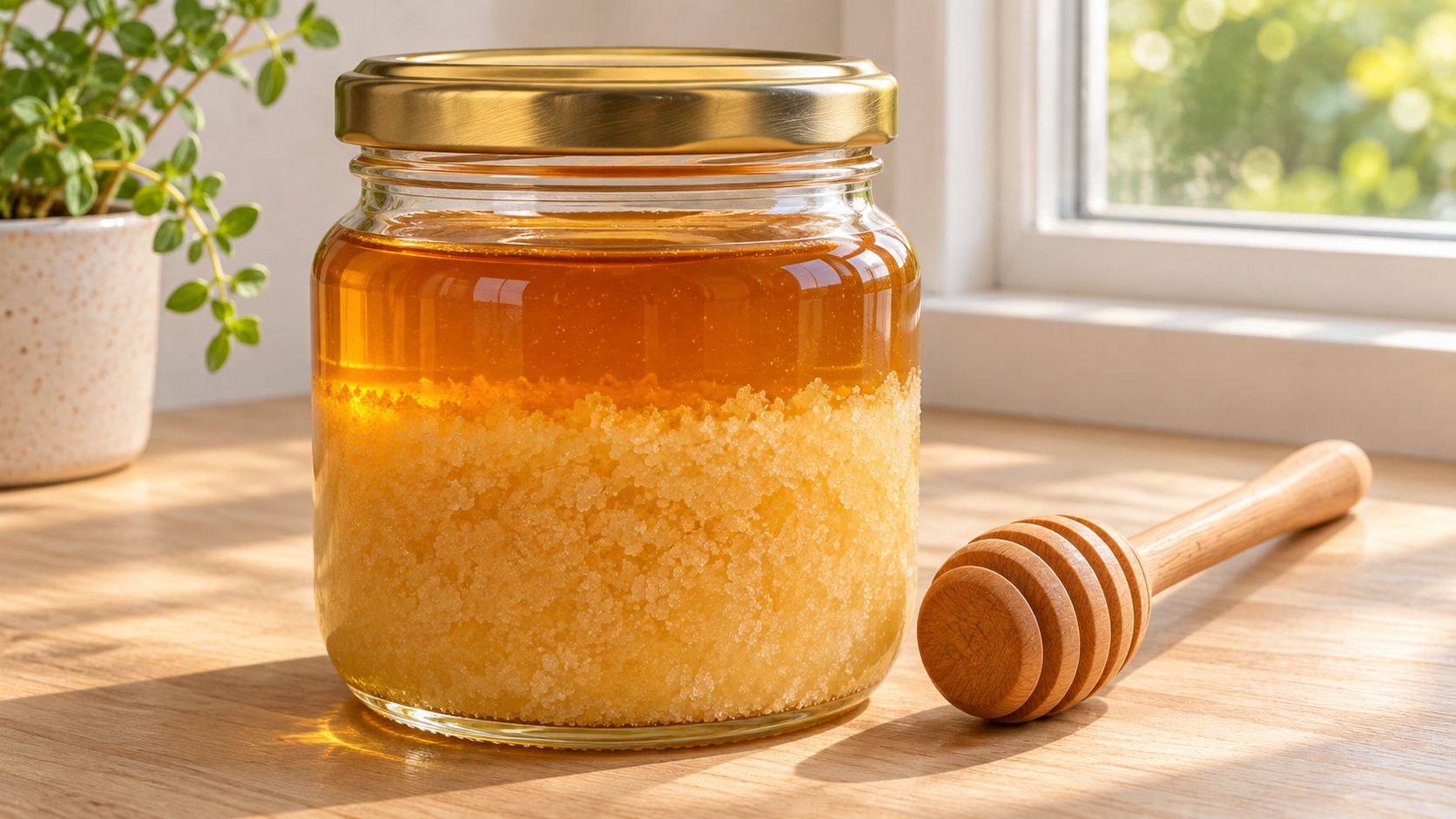
Honey starts out holding more dissolved sugar than its water can comfortably carry. Glucose is the less soluble of the two main sugars, so it lets go first and builds glucose-monohydrate crystals while fructose stays liquid longer. A 2018 crystallization study in the Brazilian Journal of Food Technology followed samples holding 5% fine crystals at 14 °C (57.2 °F) until they set completely, and it reports the fastest crystal growth between roughly 13 °C and 15.5 °C (55.4 °F-59.9 °F), with temperatures above 20 °C (68 °F) sharply reducing the conditions that start new crystals. That's why the refrigerator and a cool pantry shelf firm honey faster than a room-temperature cupboard. The ratio of glucose to fructose, the moisture level and any crystals already present all shift the timing from one variety to the next.
Before you warm anything, run three checks. Smell the open jar: it should read floral, grassy or malty, whatever that variety does, and never sour, yeasty or like fermenting fruit. Look at the surface for foam, bubbles or a lid that has domed upward. Taste a small spoonful; clean sweetness is fine, a lingering yeast bite is not.
Rule of thumb: crystals are a texture problem, and fermentation is a food-safety problem. Only one of them is worth fixing.
If you see foam, bubbling or smell something sour, stop. Warming won't rescue that jar, so discard it. Our guide to what bad honey looks like walks through the visual and smell cues in more detail than a paragraph here can.
Soften Honey in a Warm Water Bath Step by Step
The goal is pourable honey at the lowest temperature that melts the crystals. Heat is the tool, time is the safety margin, and every method below trades one for the other.
Softening methods by honey temperature and quality trade-off
| Method | Honey temperature | Timing | Quality trade-off |
|---|---|---|---|
| Warm water bath (recommended) | 38 to 45 °C (100 to 113 °F) | 20 to 40 minutes, stirred every 10 to 15 minutes | Gentlest; best for keeping raw character |
| Near-boiling water removed from heat | Above bath range, easy to overshoot | One short soak, checked every few minutes | Faster, but carryover heat keeps working |
| Microwave in original jar, short bursts | Hot spots, often above bath range | 10 to 20 second bursts, stirred between | Uneven heat; aroma and antioxidant damage risk |
| Direct stovetop or boiling | Uncontrolled | Continuous, with no stop point | Avoid; no reliable temperature control |
Why the Warm Bath Wins
A bath you can hold your hand in warms the honey slowly and evenly, and it gives you a stop point you can see and smell. Raw honey needs that, because the aroma compounds and enzymes that make it interesting are the first things heat takes. A published study of heat treatment and honey quality found that holding honey at 40 °C (104 °F) for as long as 95 hours produced no significant HMF increase or diastase loss, while higher temperatures accelerated deterioration. That is the case for modest water and enough patience to stir.
Hotter water looks efficient because the crystals clear sooner, but the jar does not stop warming when the basin leaves the stove. Heat keeps moving inward, and the center can coast past the point where the aroma starts thinning. I would rather give a firm jar two gentle baths than one aggressive soak that leaves the honey flat.
Microwave bursts are the least even option of all. A peer-reviewed study of microwave liquefaction found tested samples reaching 76 to 89 °C (169 to 192 °F), with phenolic compounds down by an average of 31.1 to 35.5% at the power levels tested, and heating to 80 °C caused roughly 30 to 40% losses in tested antioxidant compounds. A pot on the stove has no ceiling at all.
A video version of the method, for anyone who'd rather watch it once:
The Bath, Step by Step
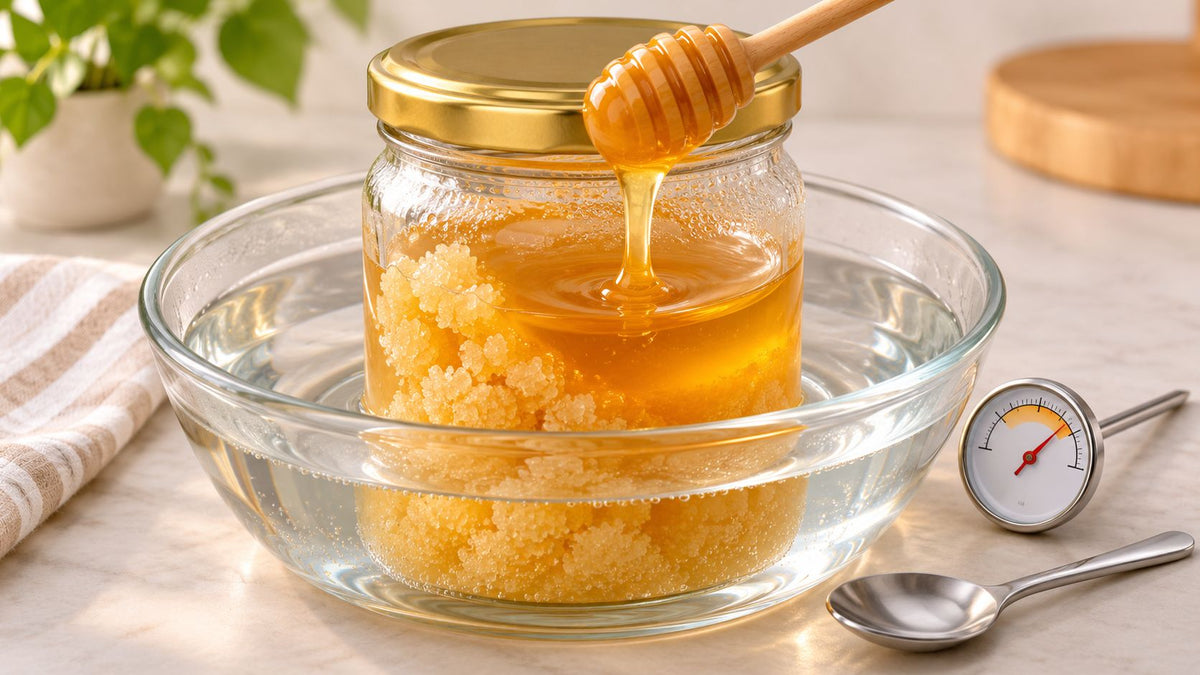
- Dry the jar and check the lid. Wipe the outside first, and make sure the seal is snug. Water that reaches the honey raises its moisture and can start trouble later.
- Fill a basin with warm water at 38 to 45 °C (100 to 113 °F). Confirm it with a thermometer rather than your wrist. Boiling water is out.
- Stand the closed jar in the bath, water below the lid. A squeeze bear stays upright with its spout clear of the waterline so nothing sips back in.
- Stir every 10 to 15 minutes with a clean, dry spoon. Heat reaches the middle of the jar only when you move the honey around.
- Put a food thermometer in the honey and stop at 71 °C (160 °F). USDA Agricultural Research Service guidance sets 71 °C (160 °F) as the maximum temperature honey should be heated to, and a gentle bath normally finishes far below it.
- Pull the jar once the crystals are gone and the honey pours. If grit remains, give it another short bath instead of one long hot one.
- Dry the outside and cool it with the lid closed. Condensation on the glass stays on the glass, where it belongs.
What a Good Result Looks Like
The honey pours off a spoon in a steady ribbon and smells like it did when you opened it the first time. Very small specks may survive, and they'll dissolve on their own the next time you warm the jar briefly.
If you can't measure the temperature, go slower. Use the coolest water you can stand, stir more often, and stop earlier. Being patient with honey has never ruined a jar.
Fixing Grainy Honey and Keeping It Pourable
A grainy jar splits into two kinds of trouble: the kind a little more gentle heat fixes, and the kind no amount of heat will. Read the symptom before you reach for the thermometer, because pourability is the target and warmth is only how you get there.
Honey symptoms, likely causes and fixes
| Symptom | Likely cause | Fix |
|---|---|---|
| Crystals return within days | Stored cool or in the fridge | Move to room temperature, away from drafts |
| Still grainy after the bath | Water too cool or stopped too early | Warm again at 38-45 °C and stir longer |
| Scorched smell or darker color | Overheated | Lower the bath temperature and stop at 71 °C next time |
| Bubbling, foam or sour smell | Moisture or fermentation | Do not eat; discard the jar |
| Crystals clog the squeeze bear tip | Cooled spout | Warm the bear gently in lukewarm water, cap on, never submerged |
Fast-returning crystals mean the jar is sitting somewhere too cold. Move it to a cupboard shelf at a steady room temperature, away from drafts and exterior walls, and it will hold its liquid state longer. Honey that is still grainy right after a bath met water that was too cool or came out too soon, so warm it again in the same gentle range and give it more time rather than more degrees.
The problems that end a jar are the ones heat makes worse. A scorched smell or a color darker than the jar started with means the honey ran over temperature, so lower the bath next time. Foam under the lid and a sour, yeasty note mean moisture got in and fermentation began, and warming that jar will not make it safe again.
Keeping a Jar Pourable
Four habits do most of the work between baths.
- Store at a steady room temperature. A closed jar in a cupboard away from the stove, direct sun and cold exterior walls holds its liquid state far longer than one parked in the refrigerator door.
- Treat moisture as a permanent concern. The dry-spoon and snug-lid habits from the warming steps apply every single day, since water in the jar is the one ingredient fermentation needs.
- Soften at the first firming. Ten minutes in a warm bath now beats an hour of coaxing later.
- Let the jar report back. Honey that firms again within days is telling you the storage spot runs cold, so change the shelf before you change the water.
Variety choice buys you margin too. Our Raw Sage Honey pours pale gold and stays liquid longer than most raw honeys, and gallberry is similarly slow to crystallize, which keeps both workable in a busy kitchen. Dark honeys such as buckwheat tend to firm sooner and will ask for the bath more often, so plan on that instead of being caught out. The honey varieties guide covers how each one behaves, and if the storage side is what you want to nail down, how to store honey correctly for long-lasting flavor and freshness goes deeper.
Pour is the goal, heat is the tool. Lift a spoonful and let it fall. Honey that drops in lumps needs another ten minutes of gentle warmth at the same temperature; honey that pours is done.
Using Softened Honey in Recipes
A jar you've just brought back to liquid is the easy one to cook with, because it measures and blends instead of clumping. Keep one conversion in your head and the rest follows: 1 tablespoon of honey weighs about 21 g, so 2 tablespoons is about 42 g. From there, three ways to put a freshly softened jar to work.
Honey-lemon tea. Stir 1 tablespoon of honey (about 21 g) into a mug of warm, not boiling, tea, then add lemon to taste. Warm tea dissolves the honey evenly so it doesn't sit at the bottom of the mug, and stopping short of a boil keeps the citrus and the honey's floral notes bright.
Roasted carrot glaze. Whisk 2 tablespoons of honey (about 42 g) with olive oil, a pinch of salt and a squeeze of lemon juice, then brush the mixture over carrots during the last 10 minutes of roasting. Honey that's already liquid emulsifies into the oil, which is what gives you a glaze instead of a puddle.
Warm honey dressing. Whisk 1 tablespoon of honey (about 21 g) into a vinaigrette off the heat, straight from the softened jar. It sweetens the dressing and helps the oil and vinegar hold together without any warming at all.
One rule ties these together: when honey goes into a warm dish, keep the dish below a boil. Flavor and texture both hold better that way, and you're not asking the honey to do anything it wasn't already doing in the jar.
Choose the Right Honey for Tea, Spreads and Baking
The jar you reach for should fit the job. A light honey suits tea and toast because it sweetens without taking over. A darker honey works better in baking, marinades and cheese boards, where its color and flavor need to read through other ingredients. Three checks make the choice easier before you buy or rewarm a jar.
- Match the honey to the job. Everyday tea and spreads want something mild. Baking, marinades and cheese boards want a honey with weight and color.
- Buy a size you will finish. A 1 lb jar that gets used up beats a 3 lb jar that sits at the back of the cupboard for a year.
- Treat a firm jar as normal. Raw and unfiltered honey crystallizes, and a warm bath brings it back without changing what is in the jar.
For everyday tea and spreads, sage honey is the one I would hand most kitchens first. It pours pale gold, tastes gently floral with a soft herbal finish, and stays liquid longer than most raw honeys. That makes it useful when you want sweetness without a strong honey flavor. Clover is another steady choice for coffee, tea, salad dressings, sauces and straight from the spoon. A guide to the best honey for tea sorts varieties by how they behave in a mug.
For baking, glazes and any dish where the honey should announce itself, Raw Buckwheat Honey is very dark, almost black in the jar, with a malty, molasses-like flavor that is less sweet than lighter honeys. Dark honeys such as avocado, buckwheat and eucalyptus suit baking, marinades and cheese boards.
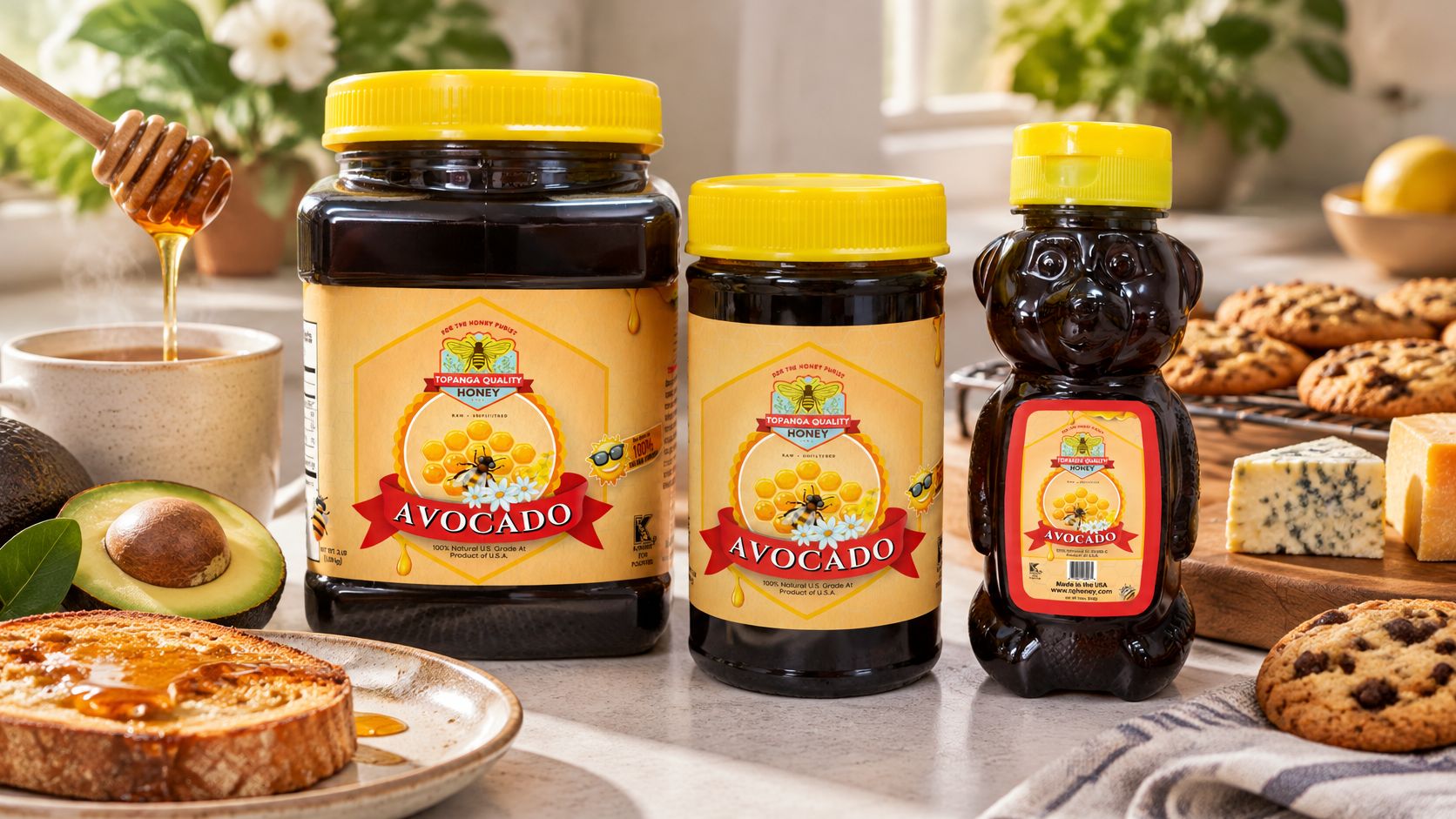
Raw Avocado Honey sits between those everyday and darker choices. Use it in baking, spoon it into coffee, glaze roasted vegetables, or pair it with aged cheddar and blue cheese. It is raw and unfiltered, never pasteurized, so each honey keeps the natural character of the flowers it came from. It also comes in 1 lb and 3 lb jars, plus 12 oz and 24 oz honey bears. Topanga Quality Honey is a family-owned California beekeeping company, and its honey is raw, unfiltered, organic and kosher, with packing carried out in California.
Do not feed honey to infants under 12 months old.