

Filtered vs Unfiltered Honey: Differences That Matter
Does a cloudy jar prove honey is more genuine than a clear one? Not by itself. When you compare filtered vs unfiltered honey, you're mostly comparing how much suspended material remains after extraction, not whether bees made the honey.
That distinction makes shopping easier. A label can tell you something useful about handling, but it can't answer every question about flavor, origin or authenticity.
Table of Contents
- Filtered and Unfiltered Honey at a Glance
- How Honey Gets Filtered, Step by Step
- What Filtering Changes Inside the Jar
- How Crystallization Differs Between the Two
- Storing Filtered and Unfiltered Honey Well
- Which Style Fits Baking, Drinks and Gifts
- Choose the Right Honey for Your Next Jar
Filtered and Unfiltered Honey at a Glance
Filtered and unfiltered honey are both honey. Filtering removes pollen and fine particles to improve clarity. Unfiltered honey retains more of that naturally suspended material.
The USDA's voluntary grading framework defines filtered honey as honey with all or most fine particles, pollen grains, air bubbles and other suspended material removed. It distinguishes that from strained honey, where larger debris is removed but pollen, small bubbles and very fine particles normally remain.
That middle category causes plenty of confusion. Straining isn't the same as fine filtration. A beekeeper can remove pieces of wax without removing most of the pollen.
Raw answers a different question. It describes heat treatment and handling, rather than how much suspended material was removed. Raw honey isn't pasteurized, so a honey can be raw and unfiltered, or raw and filtered.
Unfiltered and filtered honey compared
| Feature | Unfiltered | Filtered |
|---|---|---|
| What is removed | Wax and large debris through straining | Fine particles, pollen grains and air bubbles, all or most |
| Pollen | Mostly retained | Largely removed |
| Appearance | Often cloudy or slightly opaque | Clearer and more uniform |
| Crystallization pace | Can start sooner because particles and bubbles seed crystals | Often slower to start |
| Enzyme activity | Closer to the native profile when gently handled | Can be reduced, more substantially with membrane filtration |
| Ultra-filtration | Not used | Possible in industrial processing, but not implied by the word filtered |
These are processing differences, not quality rankings. Neither a clear appearance nor a cloudy one tells you everything about a jar's history.
The enzyme comparison also needs that handling qualification. Unfiltered honey doesn't automatically retain its original enzyme activity if someone has overheated it.
Read your jar without guessing
Make these simple checks before deciding what you have:
- Find the processing word. Look for filtered, strained or unfiltered rather than relying on the picture.
- Check for raw. Treat that as a separate statement about handling.
- Notice room-temperature clarity. Cloudiness can support what the label says, but it can't confirm processing on its own.
If the jar says raw and unfiltered, you can name both characteristics. If it only says honey, appearance alone won't fill in the missing information.
How Honey Gets Filtered, Step by Step
Filtering happens after bees have made and stored the honey. What separates one jar from another is how far the producer keeps processing it after extraction.
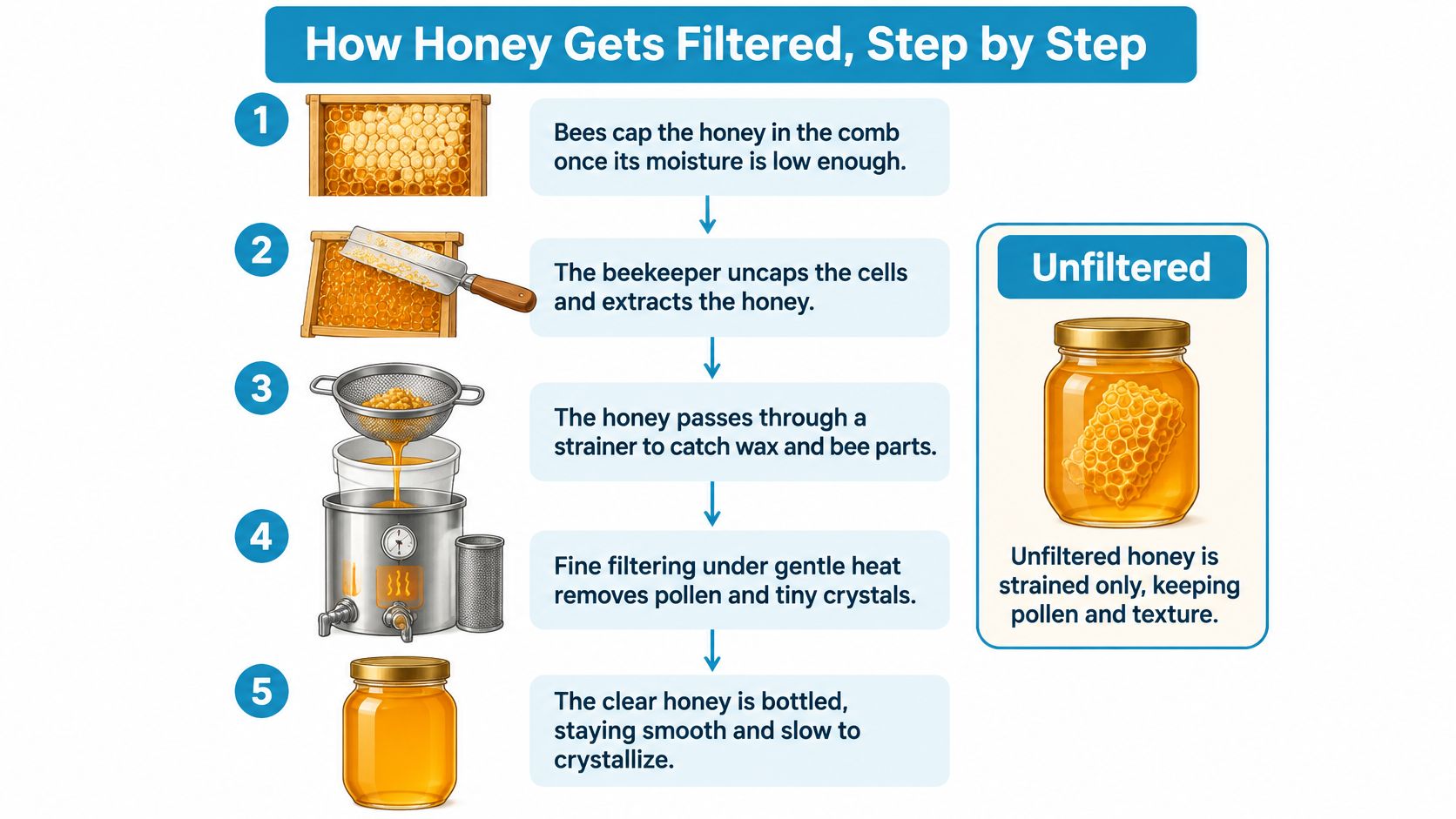
The illustration below shows where ordinary straining and finer filtration part ways.
From capped comb to the jar
- Bees cap the honey. Once its moisture is low enough, bees seal the filled cells with wax. Those caps protect the honey inside the comb.
- The beekeeper uncaps and extracts it. An uncapping tool opens the cells, and a spinner usually draws the honey out of the frames. Wax fragments can enter the honey during this work.
- A coarse strainer catches larger material. Mesh removes wax and other large debris. Processing for unfiltered honey generally stops here.
- Finer filtration removes smaller suspended material. Honey intended for a clearer finish passes through finer filters. Producers may warm it so it flows more easily; filtration and pasteurization aren't interchangeable terms, even though both can involve heat.
- Some industrial processes use membranes. These can remove more than ordinary filters, including naturally occurring enzymes. A membrane system works on a far finer scale than the coarse mesh used to catch wax.
Heat deserves its own question
Heat often shapes what remains in the jar more than the filter itself. In a production-handling study, a 0.15 mm filter reduced diastase activity by an average of 11.1% and invertase by 11.3%, while heating honey to 75 °C for 10 minutes reduced them by 69.7% and 81.0%, respectively, and increased HMF by 79.1%.
HMF, short for hydroxymethylfurfural, helps gauge heat exposure and aging. Enzyme activity indicates handling severity rather than offering a health score.
Practical rule: Ask about heat and handling, not just the filter.
Gentle filtration at low temperature can leave most of a honey's natural character intact. An unfiltered label, on the other hand, cannot undo damage from overheating or poor storage.
The useful questions are “Is it raw?” and “How was it handled after extraction?” At Topanga Quality Honey, every honey we sell is raw, unfiltered, organic and kosher, packed in California. We strain to remove wax, never pasteurize and never ultra-filter, so the membrane step has no place in our jars.
What Filtering Changes Inside the Jar
Laboratory comparisons offer a calmer picture than the labels sometimes suggest. Filtering changes clarity and pollen content most of all, and leaves much of the honey's basic chemistry broadly similar.
A comparative scientific paper describes two investigations together: 42 honey samples from different botanical and geographic origins showed differences in pollen and in diastase and sucrase activity but no change in protein content, and 84 samples showed no detectable differences in most tested characteristics beyond pollen spectra, enzyme activities and HMF.
What lab studies measured in filtered and unfiltered honey
| Measure | Unfiltered | Filtered | Study result |
|---|---|---|---|
| Pollen | Present | Absent in the tested filtered samples | Expected, a principal compositional difference |
| Diastase and sucrase enzymes | Higher activity in the comparison | Lower activity in the comparison | Differences detected in one study |
| Protein | Similar | Similar | No change in one study |
| HMF | Comparison baseline | Different measured content | Differed between groups in the characterization study |
| Chemical fingerprint | Similar | Similar | Not significantly altered by filtration |
The enzyme and HMF figures behind those rows appear in the step-by-step filtering walk-through earlier. The HMF row deliberately avoids a universal higher or lower value, because a difference between tested groups can't predict every jar once heating and storage enter the picture.
A chemical fingerprint works like a signature: two jars can share a signature and still differ in aroma, texture and day-to-day handling.
What those measurements don't prove
Detecting more enzyme activity or retained botanical material describes composition and handling. Nutritional quality is a separate question those numbers don't settle.
Pollen still has a useful role. An analysis of honey authenticity methods explains why pollen microscopy helps assess botanical and geographic origin, and why removing pollen can make that assessment much harder or impossible.
That makes pollen a traceability tool. It can point investigators toward the flowers and region behind a jar, which is real information a single label word can't supply.
Retained pollen can help someone investigate a honey's origin, one piece of evidence among several.
For a household buyer, the sensible approach is to weigh floral source, stated origin and testing transparency together. No single processing word on the label proves a honey is genuine, and no single word proves it isn't.
Taste is a separate part of choosing well. Our guide to tasting honey helps you compare aroma, flavor and finish, the characteristics you'll notice in tea, on toast or in a glaze.
How Crystallization Differs Between the Two
A jar that was liquid when you opened it may gradually become grainy, opaque or firm. That change is crystallization, and it's a normal physical change in honey.
Glucose separates from the liquid and forms solid crystals. Suspended particles and fine air bubbles give those crystals places to begin, which helps explain why unfiltered honey can start granulating sooner.
A consumer explanation drawing on USDA terminology and National Honey Board information describes how removing wax fragments, pollen and air pockets can help filtered honey remain liquid longer. It also explains why crystallization alone doesn't establish spoilage or added sugar.
Read texture separately from color
Color and firmness answer different questions. A very dark honey isn't necessarily crystallized, and a pale honey isn't necessarily filtered.
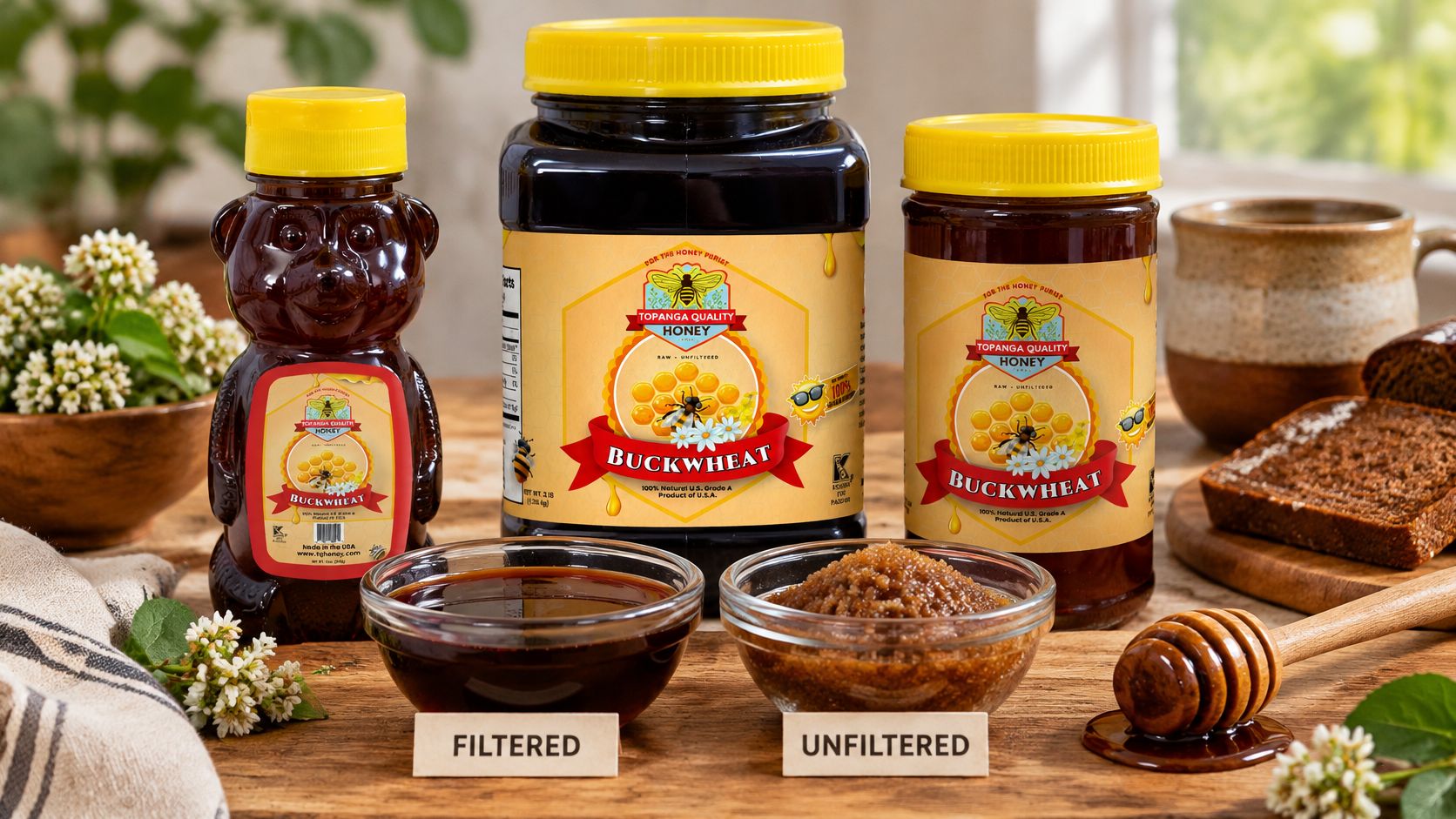
Raw Buckwheat Honey, for example, is almost black in the jar, with a malty, molasses-like flavor that tastes less sweet than lighter honeys. Its dark appearance is a variety characteristic, not a sign that it has gone bad.
This image shows that naturally dark appearance.
For a lighter, pourable example, Raw Sage Honey pours pale gold, tastes gently floral with a soft herbal finish and stays liquid longer than most raw honeys. It works well in tea when you want sweetness without a forceful flavor.
When a firm jar needs attention
- Graininess alone is normal. Raw honey may crystallize naturally and is still good.
- Crystals aren't proof of added sugar. Don't use texture as a home authenticity test.
- A sour or fermented smell is different. Don't assume an unusual-smelling jar is fine just because crystallization is normal.
Our explanation of why honey can become hard offers more help distinguishing a normal texture change from an unexpected problem. You can use crystallized honey as a spread or gently return it to liquid, depending on how you plan to serve it.
Storing Filtered and Unfiltered Honey Well
Keep honey sealed, dry and at cool room temperature, away from direct sun and heat. Don't store it in the refrigerator, where cold encourages crystallization.
Both styles need the same basic care. A filter can change how a jar looks and when crystals begin, but it doesn't replace a clean lid, dry utensils or sensible pantry storage.
Storage situations and what to do
| Situation | What you may see | What to do |
|---|---|---|
| Unfiltered jar in the pantry | Cloudy liquid that may firm up over time | Keep sealed and dry; warm gently if you want it runny |
| Unfiltered jar that has crystallized | Grainy or fully solid texture | Set the jar in warm, not boiling, water and stir until liquid; crystallized honey is still good |
| Filtered jar in the pantry | Clear liquid that often stays pourable longer | Keep sealed and away from heat and sunlight |
| Sealed honey sticks | Single servings remain sealed in the straw | Keep unopened sticks in the pantry until use |
Choose a cupboard rather than a sunny windowsill or a shelf beside the stove. Use a clean, dry spoon instead of one that's just been rinsed or dipped into tea.
How to gently re-liquefy a jar
- Remove the lid and keep water out. Choose a bowl or pan that lets the jar stand securely with its opening above the waterline.
- Set the jar in warm water, not boiling water. Don't put it over direct heat.
- Let the honey loosen, stirring occasionally with a clean, dry utensil. Replace cooling water with fresh warm water when needed.
- Dry the outside and wipe the rim before replacing the lid.
You don't need to liquefy the whole jar if you enjoy the thicker texture. Spoon what you need onto toast or into a recipe that already calls for honey.
Pantry habit: Put the lid back on after serving, not after the meal.
Individual portions need little preparation. Each sage honey stick is a single serving sealed in a straw, opened by snipping or biting the end and squeezing; keep unopened sticks in the pantry until use.
For more practical detail, use our honey storage guide. Whatever the format, keep moisture and dust out, and reseal jars after every use.
Which Style Fits Baking, Drinks and Gifts
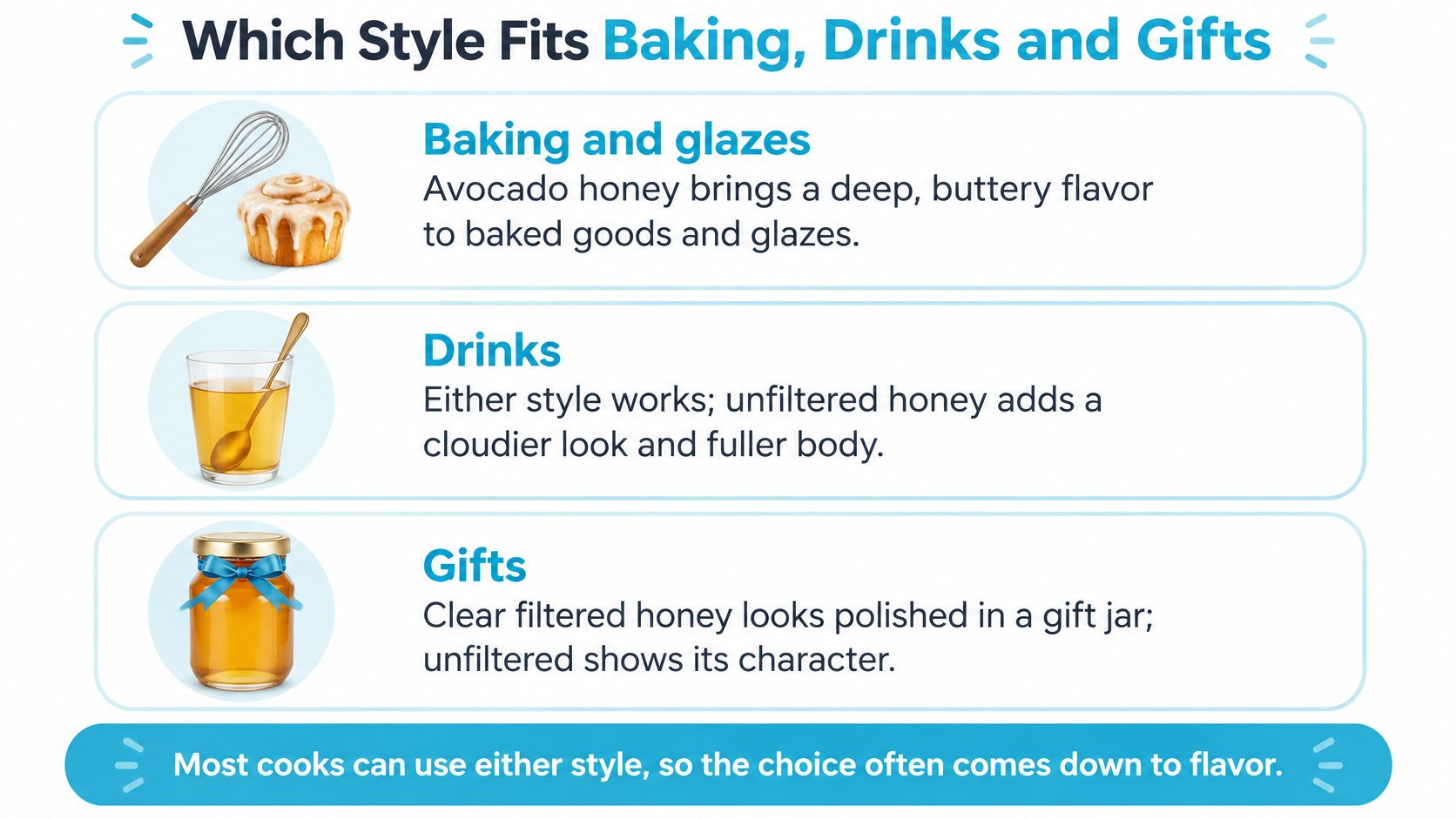
In the kitchen, the flower matters more than the filter. Once honey disappears into a batter, a marinade or a glaze, filtered and unfiltered behave the same way, so let flavor make the call. Filtering changes clarity and pollen content in the jar, and a processing word on the label says nothing about how a honey will taste on the plate.
Match the bloom to the food
- Baking and glazes. Raw Avocado Honey is raw and never pasteurized, so it keeps the natural aroma of the flowers it came from, and it does not taste like avocado. Use it in cakes or whisk it into a glaze for roasted vegetables.
- Tea and coffee. Gently floral sage adds a delicate note to tea, while a deeper honey stands up to strong coffee.
- Bold, malty baking. Choose a dark, molasses-like profile for gingerbread, rye bread or a savory marinade, where a light honey would get lost. Pick recipes written for honey rather than treating it as a straight swap for sugar.
- A single-variety wildcard. Raw Cactus Honey is raw, unfiltered and never pasteurized, so like every honey in the range it keeps the character of its own bloom.
- Lunch boxes and travel. Each stick seals a single serving in a straw that opens with a snip or a bite and a squeeze. Options include sage and orange blossom honey sticks.
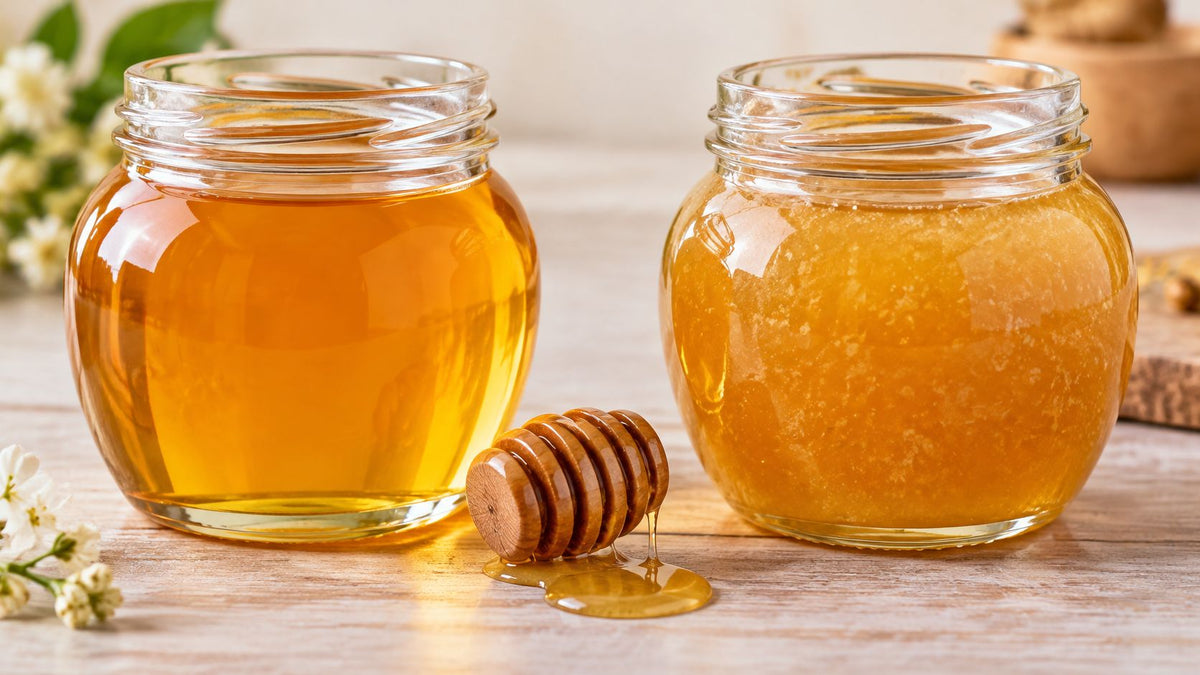
Seeing the two styles poured side by side makes the clarity difference obvious: the filtered jar runs bright and transparent, while the unfiltered jar looks softly hazy.
Choose a format for the occasion
Raw Clover Honey covers most everyday needs, sold as a 1 lb jar, a 3 lb jar, or a 12 oz or 24 oz honey bear for easy squeezing over cereal or toast.
Tasting gift sets group two or three varieties side by side, so the recipient can compare light and dark honeys in one box. Super Honey, a 12 oz blend of raw honey with bee pollen, propolis and royal jelly, makes a thicker, more textured gift for a curious eater. Raw Honeycomb, sold as a 1 lb portion, is honey still sealed in its soft, chewable beeswax comb, and a wedge on a cheese board shows what minimal handling looks like.
Choose the Right Honey for Your Next Jar
Start with the job the jar needs to do. Filtered honey suits a clear, uniform table jar or a drink where appearance matters. Unfiltered honey suits buyers who want retained botanical material and accept more variation from jar to jar.
For baking and cooking, let flavor lead. A delicate tea and a dark gingerbread call for different jars even when the processing words match.
Run a quick buying check
- Appearance. Choose filtered for a polished look; choose unfiltered when cloudiness and pollen are welcome.
- Ingredients. Pick a single-variety honey when you want honey alone, or a clearly labeled blend when you want more in the jar.
- Use at home. Match the texture to how you serve it, keep the jar closed at room temperature, and do not feed honey to infants under 12 months old.
- Order details. For Topanga Quality Honey orders, continental US shipping is free at $50 or more and $9.95 below $50; discounts are offered to visitors who subscribe by email.
Label words still have limits. Filtration status can describe clarity and suspended material, yet it cannot certify freedom from added sweeteners. In its fiscal-year 2025 honey sampling assignment, the FDA tested 102 domestic and imported samples and found four violations involving undeclared added sweeteners, using stable-carbon-isotope analysis rather than pollen presence.
Honey naturally contains sugars. A label that says no sugar, syrups or preservatives is describing what was left out during blending and packing, and organic status or floral origin need their own signals on the label or product page.
Know what's in our jars
Topanga Quality Honey is a family-owned California beekeeping company. Every honey we sell is raw, unfiltered, organic and kosher, packed in California. Our unfiltered honey is strained to remove wax and is never ultra-filtered, and our raw honey is never pasteurized, so each variety keeps the character of the flowers it came from.
Single-variety honeys contain no sugar, syrups or preservatives. Super Honey is built differently: raw honey blended with bee pollen, propolis and royal jelly, thicker and more textured than plain honey. Packing location and floral origin are separate details, so choose by the origin listed for the variety.
Explore our raw honey collection to choose by floral source, flavor and the format you'll use most. Visit Topanga Quality Honey for raw, unfiltered options, from everyday jars to side-by-side tasting gifts, without treating clarity as a shortcut for quality.