

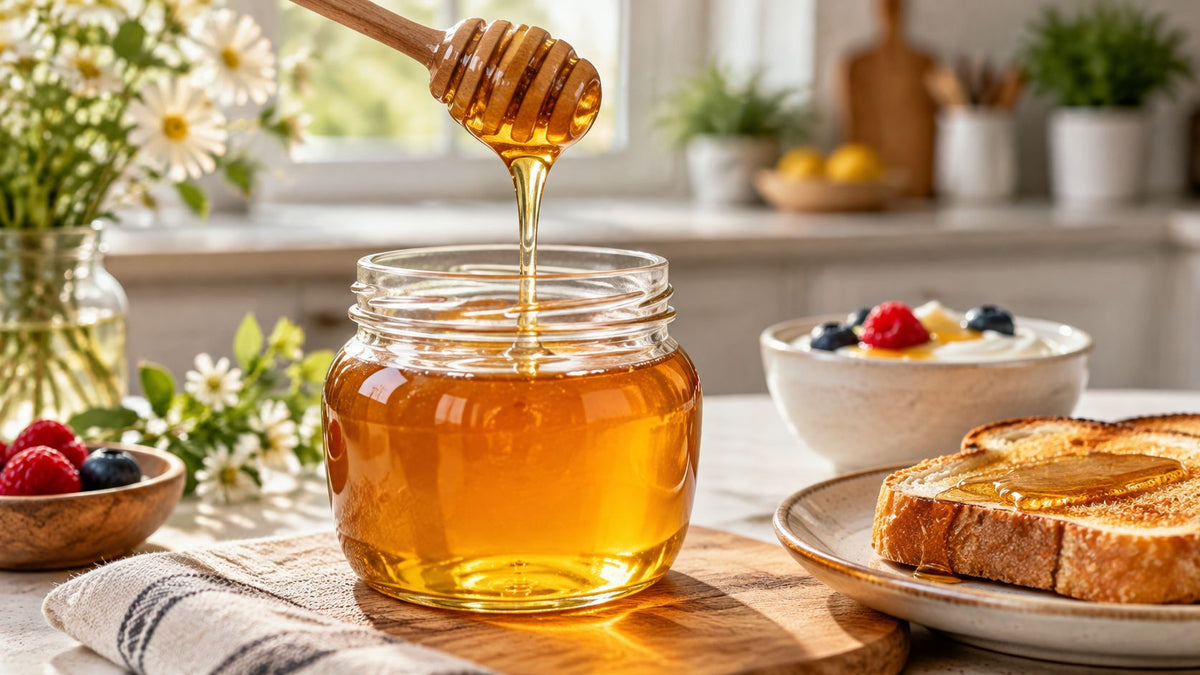
Glass Honey Jar and Dipper: How to Choose and Use
The toast is ready, but the spoon leaves a thread of honey between the jar and your plate. You turn it, catch another drip, and reach for a towel. A glass honey jar and dipper can make that breakfast routine neater, provided the honey is soft enough to load and you turn the dipper instead of carrying it like a spoon.
Table of Contents
- A Glass Honey Jar and Dipper at the Table
- Which Jar Size and Dipper Fit Your Table
- Why Clear Glass Protects Flavor and Color
- How to Load and Serve with a Honey Dipper
- When Honey Crystallizes in the Jar
- Honeys That Pour Well from a Dipper
- Choose a Jar You Will Keep Using
A Glass Honey Jar and Dipper at the Table
The jar and dipper have separate jobs. The jar stores the honey and lets you see what's inside. The dipper collects a ribbon of honey in its grooves, then releases it onto toast, yogurt, biscuits, or into tea.
That distinction matters when you're choosing kitchen tools. A dipper doesn't filter, heat, or change honey. It's a server for honey that flows, not a tool for digging through a firm, crystallized jar.
What you can see through the glass
Clear glass lets you check color, cloudiness, fill level, and developing crystals before opening the lid. Pale honey and dark amber honey won't look alike, and an unfiltered jar doesn't have to look perfectly clear.
Our explanation of filtered and unfiltered honey separates two terms that often get confused: raw describes heat treatment, while unfiltered describes how suspended materials are handled. Honey can be raw and filtered, or raw and unfiltered.
At Topanga Quality Honey, we're a family-owned California beekeeping company. We are the beekeepers, and our hives move with the seasons to orchards, farms, and wildflower ranges. All our honey is packed in California.
At the table: Match the utensil to the honey's texture, not just the appearance of the serving set.
Our honey is raw, never pasteurized, unfiltered, never ultra-filtered, organic, and kosher. Unfiltered honey retains natural particles such as pollen rather than having them stripped away by fine filtration. Nothing is added to our single-variety honeys.
A squeeze bear makes more sense when you want a quick squeeze without washing a utensil. A honey stick fits a lunch box. A dipper belongs beside an open jar when you're sitting down to eat.
Which Jar Size and Dipper Fit Your Table
Honey formats and whether a dipper belongs
| Format | Amount | Use a dipper | Best when |
|---|---|---|---|
| Glass jar | 1 lb | Yes | Daily table honey for one or two people |
| Glass jar | 3 lb | Yes if the mouth is wide; otherwise refill a 1 lb jar | A household that uses honey often |
| Squeeze honey bear | 12 oz | No | Tea, toast, and coffee with no utensil |
| Honey sticks | Packs of 50 or 100 | No | Single servings, lunch boxes, and small gifts |
| Raw honeycomb | 1 lb | No | Chewing or cutting comb with the wax |
| Honeycomb square | 11 oz, boxed | No | A cheese board or a ready-to-give box |
| Gift set of jars | 3 x 1 lb or 2 x 3 lb | Yes | Comparing varieties at the table |
| Gift set of bears | 3 x 12 oz | No | Gifts for people who want squeeze bottles |
| Super Set | Any 5 products | Only for jars in the set | One box with several ways to serve honey |
Check the mouth before choosing the dipper
A 1 lb jar is a practical everyday table size. Before pairing it with a dipper, check that the grooved head passes through the opening without scraping the rim. The handle should reach comfortably into the honey while leaving enough room for your fingers above the jar.
A 3 lb jar suits frequent use, but jar capacity alone doesn't tell you whether a dipper fits. A narrow opening or a short handle can make serving awkward as the honey level drops. In that case, keep the larger jar in the cupboard and refill a clean, completely dry smaller jar.
Don't assume the dipper should stay inside between meals. A standard lid needs to close fully, and a handle trapped under it leaves an opening.
- For an open jar: Choose a head that clears the mouth and a handle that reaches the bottom.
- For a squeeze bear: Skip the dipper and use the bottle's opening.
- For honeycomb: Use a knife or spoon to portion the comb, including its soft, chewable wax.
Formats that don't need dipping
Honey sticks come in packs of 50 or 100 in sage, orange blossom, California wildflower, and pomegranate. Snip or bite the end and squeeze out the serving. Pomegranate sticks are honey blended with pomegranate, not single-variety honey.
Blackberry, cactus, and Brazilian wildflower come in jars only, without a honey bear option. Raw honeycomb stays in its beeswax cells, while the boxed honeycomb square is convenient for a cheese board or gift.
For comparing varieties, the Honey Gift Set, 2 x 3 lb lets you choose two jars at a set price and specify the honeys when ordering. If you use one dipper for a tasting, wash and dry it between varieties so the flavors stay separate.
Why Clear Glass Protects Flavor and Color
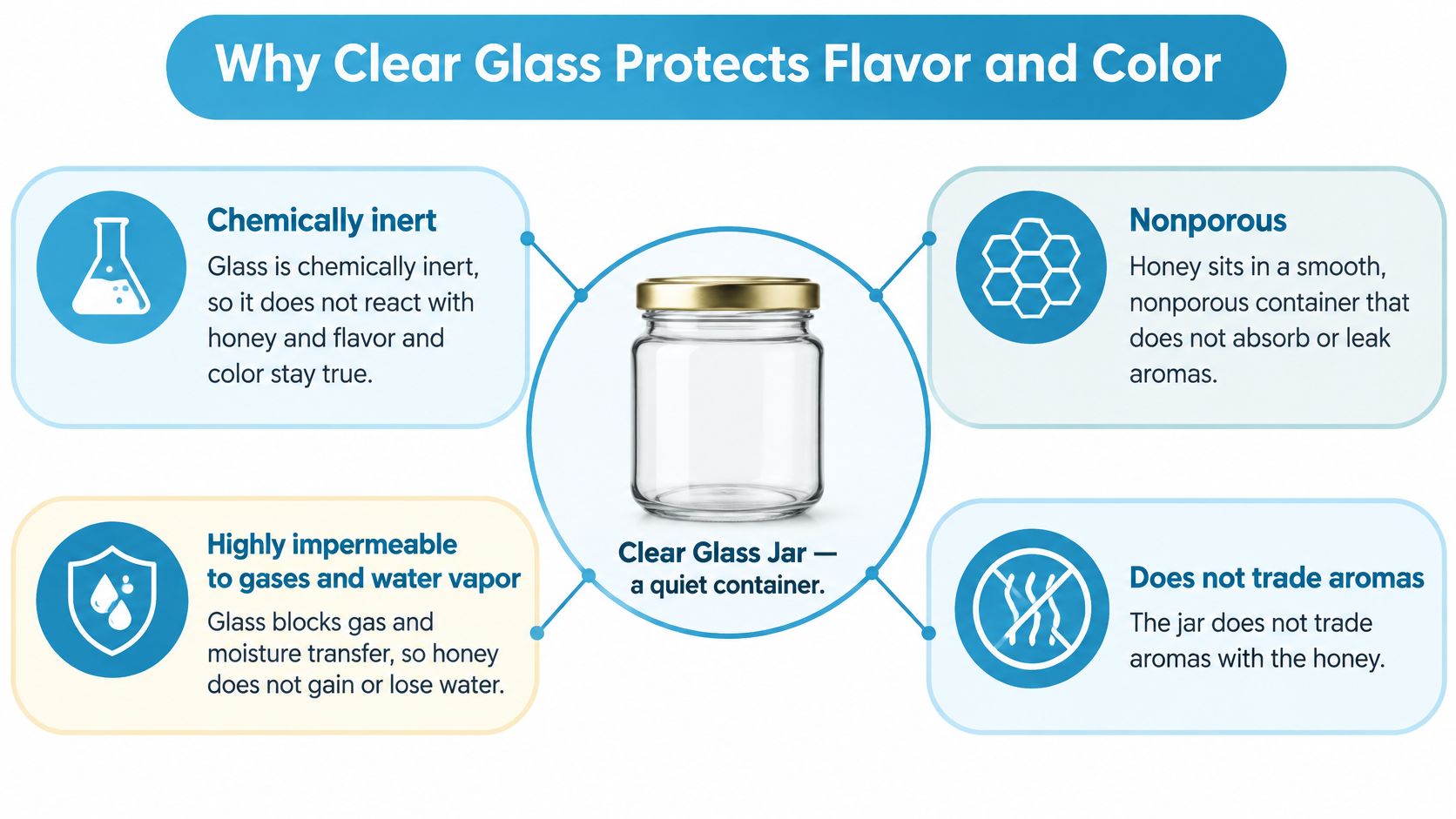
Glass is a quiet container. It doesn't need to contribute flavor, absorb aroma, or interact with the honey to do its job.
The NIFTEM honey-packaging guide describes glass as chemically inert, nonporous, and highly impermeable to gases and water vapor. Those properties limit contact between honey and the surrounding air and moisture, while reducing aroma transfer through the container.
The main benefits are shown below.
A good barrier still needs a good lid
The glass body is only part of the package. Choose a lid with a compatible food-contact liner, keep the threads clean, and close it securely after serving. A decorative lid that sits loosely on top isn't the same as an airtight closure.
The transparent sides also make inspection simple. You can see a fill line, sediment, or crystals developing along the bottom. Set dark amber avocado honey beside pale gold sage honey and the difference is easy to see without opening either jar.
Clarity isn't a purity test, though. Use the view to understand the honey's condition, not to decide that clear honey is better than cloudy honey.
Glass protects against exchange through the container. It doesn't protect honey from careless storage.
Keep heat and sunlight out of the routine
A 2024 comparison of light-colored glass, dark-colored glass, and tin containers found that packaging type didn't significantly affect the honey quality measures examined, while storage time could change several indicators. The storage guidance cited in that study recommends a cool, dry place, ideally below 20°C (68°F), away from moisture and direct sunlight.
That means a cupboard is a better home than a sunny kitchen windowsill. Our honey storage guide explains how to make that routine work in an everyday kitchen.
Ordinary food glass can crack under thermal shock, so don't move a cold jar straight into very hot water or pour boiling liquid into it. Start with a room-temperature jar when gentle warming is needed.
Glass is also heavy and breakable. That's the practical trade for a stable container you can inspect, wash, and use again.
How to Load and Serve with a Honey Dipper
A dipper works best when you treat it as a rotating server. The grooves collect honey, but your hand controls when and where it leaves them.
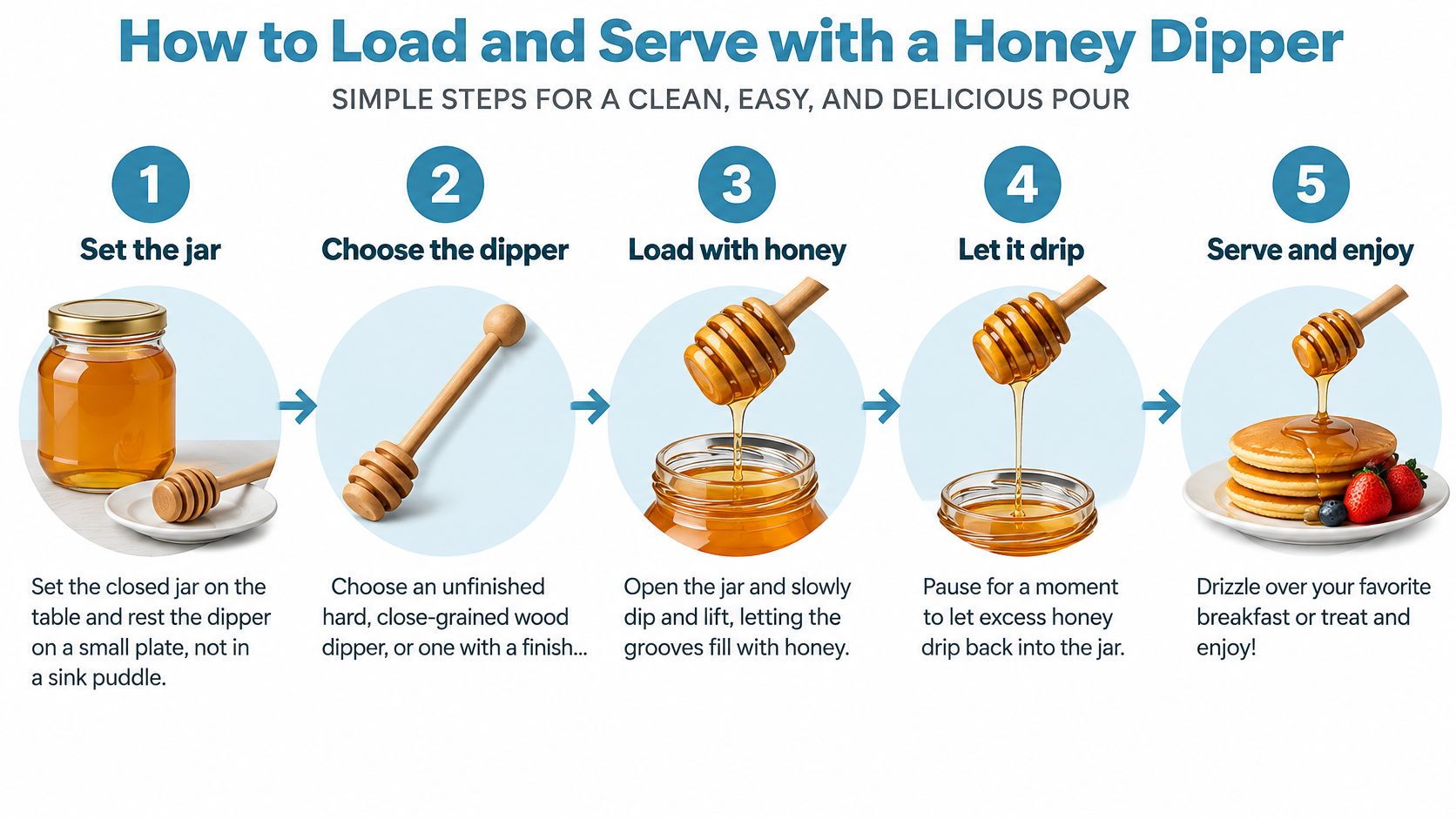
Use this sequence to keep the movement short and controlled.
Set up and load
- Set the closed jar beside your food. Put a small clean plate next to it for the dipper. Keep the handle off a wet counter or sink edge.
- Choose an unfinished, hard, close-grained wooden dipper, or one with a fully cured finish specifically labeled for food contact. Skip any utensil that smells of soap, perfume, or old food.
- Open the jar and check the texture. Honey should yield to the dipper without forcing it. If it's stiff or partly solid, soften the closed jar in warm water before trying to serve.
- Slide the grooved head into the honey and rotate it horizontally so the grooves fill. Keep that gentle turning motion as you bring it toward the opening. Don't lift it straight up and carry it across the counter like a loaded spoon.
- Pause over the jar while the excess ribbon falls back inside. Keeping the jar near your plate means there's less distance for a stray drip to travel.
Transfer and keep it clean
- Move over the food and turn the dipper to release the honey. Let the ribbon fall onto toast or into a bowl rather than touching the dipper to the food. For tea, hold it above the cup instead of dipping the wooden head into the drink.
- Return the dipper to the jar only if it's still clean and dry. Butter, yogurt, toast crumbs, and water don't belong in the honey. If the head touches food or liquid, set it on its plate and use a clean utensil for another serving.
- Wash after the meal and dry fully. Rinse away the honey with warm water, wash with mild dish soap, rinse thoroughly, and let the dipper air-dry. Don't leave a wooden dipper soaking in the sink.
The wooden honey dipper guide describes honey as very viscous and mildly shear-thinning, with a reported flow-behavior index of 0.95, and explains that viscosity decreases as temperature rises. In kitchen terms, warmer honey moves more readily; cold or crystallizing honey stays caught between the ridges.
Gentle warmth gives you control. A microwave or boiling-water bath isn't the default fix for a reluctant dipper, and adding water to the honey can increase spoilage risk.
Measure separately when cooking
A dipper isn't a measuring spoon. When a recipe needs a measured amount, use a spoon or kitchen scale; a tablespoon of honey is about 21 g.
For a visual demonstration of the loading and turning motion, watch the dipper in use.
Clean-plate habit: During the meal, rest the dipper beside the jar. Afterward, wash it rather than leaving it buried in the honey.
When Honey Crystallizes in the Jar
Crystallized honey isn't spoiled. It's still good to eat. The grainy or firm texture is a physical change, not evidence that the glass jar damaged the honey.
The World Beekeeper honey guide explains that glucose content and temperature drive crystallization, while retained particles can give crystals places to begin forming. It also identifies sage as a honey that tends to remain liquid longer and clover as one that generally crystallizes faster.
Match the routine to the texture
Honey crystallizes fastest around 10–15°C (50–59°F), according to the BJCP guide to honey crystallization. Warmer storage can delay crystals, but deliberately heating a cupboard or leaving a jar in a hot car isn't a sensible storage method.
A cool pantry may leave you with spreadable honey rather than pourable honey. That's fine if you like spreading it on toast. It's less useful when you want a thin ribbon from a dipper.
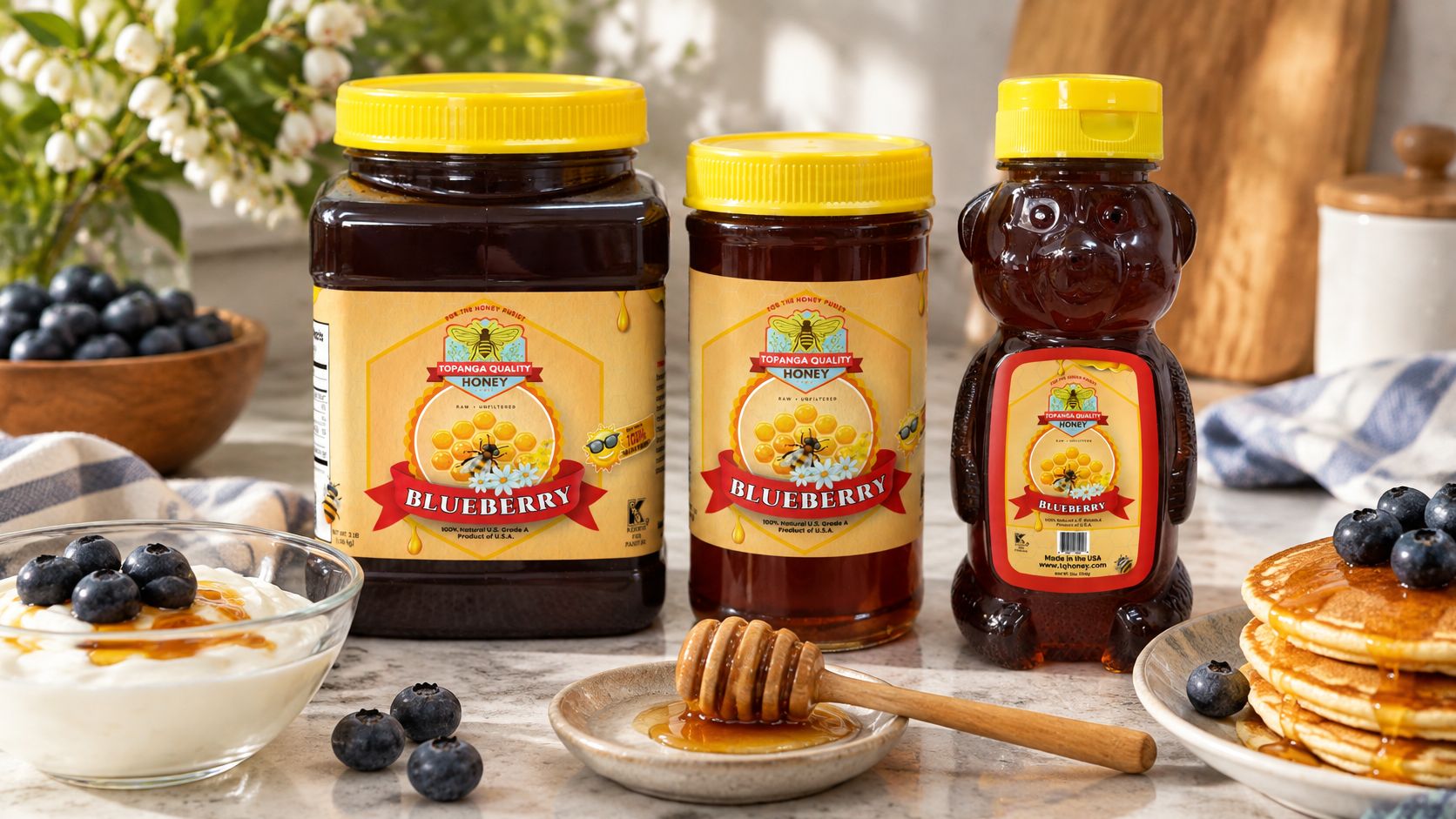
For another jar-and-dipper option, Raw Blueberry Blossom Honey is light amber, with a soft fruity aroma and a gently tart, buttery finish. It works over pancakes, waffles, or Greek yogurt when its texture is fluid enough to drizzle.
Soften the jar without adding water
Keep the lid on and stand the jar in warm, not boiling, water, with the water below the lid. Let the honey soften gradually, then remove and dry the jar before opening it. Stir with a clean, dry utensil once the honey yields easily.
Don't microwave the jar. Don't pour water into the honey to thin it. Our explanation of why honey can become hard helps distinguish an ordinary texture change from the need to change your serving method.
What to do when the jar will not dip
| What you see | Why it happens | What to do |
|---|---|---|
| Sage honey still pours | Sage tends to stay liquid longer | Keep the normal dipper routine |
| Clover honey turns grainy sooner | Clover generally crystallizes faster | Warm the closed jar before serving |
| Jar sits near 50–59°F | Crystals form fastest in that band | Move it to a stable cupboard away from cold drafts |
| Honey is solid but smells normal | Natural crystallization, not spoilage | Lid on, warm not boiling water, then dip |
| Dipper is wet or has food on it | Water and crumbs do not belong in the jar | Wash and dry it; never return it wet |
A wooden dipper that has absorbed odors needs cleaning and complete drying before reuse. A glass dipper is inert and easy to inspect, but the same no-water rule applies. Neither material belongs in the jar while wet.
Honeys That Pour Well from a Dipper
Set a small bowl of plain yogurt beside the jar and you've got a simple way to compare honeys. Use the same food for each taste so you can notice the honey rather than changing several ingredients at once.
Start with California sage honey. It pours pale gold, tastes gently floral, and finishes with a soft herbal note. Its tendency to stay liquid makes it a practical default for the dipper beside your breakfast plate.
Light flavors for a gentle drizzle
California orange blossom honey has a smooth, silky body that suits tea, yogurt, and fruit. Stir a spoonful into plain yogurt, then taste before adding more. You want enough honey to notice its character without losing the yogurt's tang.
Cactus honey comes from cardón cactus in Mexico and sits toward the lighter end of the color range. Its jar-only format works naturally with a dipper. Set it beside a dark honey when you want to see how much floral varieties can differ.
- For a mild starting point: Choose sage when you want honey that won't dominate the food.
- For fruit and yogurt: Try orange blossom and keep the serving small enough to taste both ingredients.
- For another variety comparison: Our explanation of acacia honey offers context for choosing among lighter honeys.
Darker honey for stronger food
California avocado honey is dark, rich, and buttery, with molasses and caramel notes. It doesn't taste like avocado. Drizzle it onto toast, stir it into strong coffee, or use it as the honey ingredient in a glaze.
USA buckwheat honey is very dark, malty, and less sweet-tasting. Try a little on gingerbread, rye toast, or sharp cheese rather than starting with a heavy pour.
The honey varieties guide also covers clover and blueberry blossom from the USA, blackberry from Oregon, California wildflower, Brazilian wildflower from Brazil, and eucalyptus from California, South Africa, Australia, and Brazil. Blackberry and Brazilian wildflower are jar-only options.
Super Honey is different from these single-variety comparisons. It's honey blended with bee pollen, propolis, and royal jelly, with a thicker texture and slightly tangy flavor. Use a spoon when its consistency doesn't suit a dipper.
Choose a Jar You Will Keep Using
For honey on the table most mornings, start with a 1 lb sage jar and a wooden dipper that fits its opening. Add a larger refill jar when your household uses honey often. Choose bears or sticks when portability and quick dispensing matter more than the dipping routine.
The environmental case for glass gets stronger when you reuse it. A sustainable-packaging analysis discussing a 2024 life-cycle assessment of reusable honey jars reports that reuse could reduce packaging-related environmental burdens by roughly 16% to 70% over five years, depending on the reuse rate (sustainable honey-packaging analysis).
Give the empty jar another job
Remove the label, wash the jar, and dry it completely before filling it with dry goods or more honey. Inspect the rim and body first, and don't reuse a cracked jar for food.
- Keep sound jars: Reuse containers whose lids still fit securely.
- Check local collection rules: Don't put damaged glass into a recycling stream that won't accept it.
- Avoid unnecessary shipping: Heavy glass and oversized packaging can work against the benefit of reuse.
Our shipping is free on orders of $50 or more to the continental US, with a $9.95 flat rate under $50. Alaska and Hawaii shipping is calculated at checkout. Buying 2 or more eligible jars, honey bears, honey sticks, or honeycomb applies 10% off automatically.
The Honey Super Set is our largest bundle, with any five Topanga Quality Honey products in one box. For help choosing formats, call 818.937.3437 or email orders@topangaqualityhoney.com.
Topanga Quality Honey offers raw, unfiltered, organic, and kosher honey for a table routine built around flavor and texture. Visit Topanga Quality Honey to browse the raw honey collection, starting with a sage jar if you want a honey that tends to stay liquid for dipping. Do not feed honey to infants under 12 months old.