

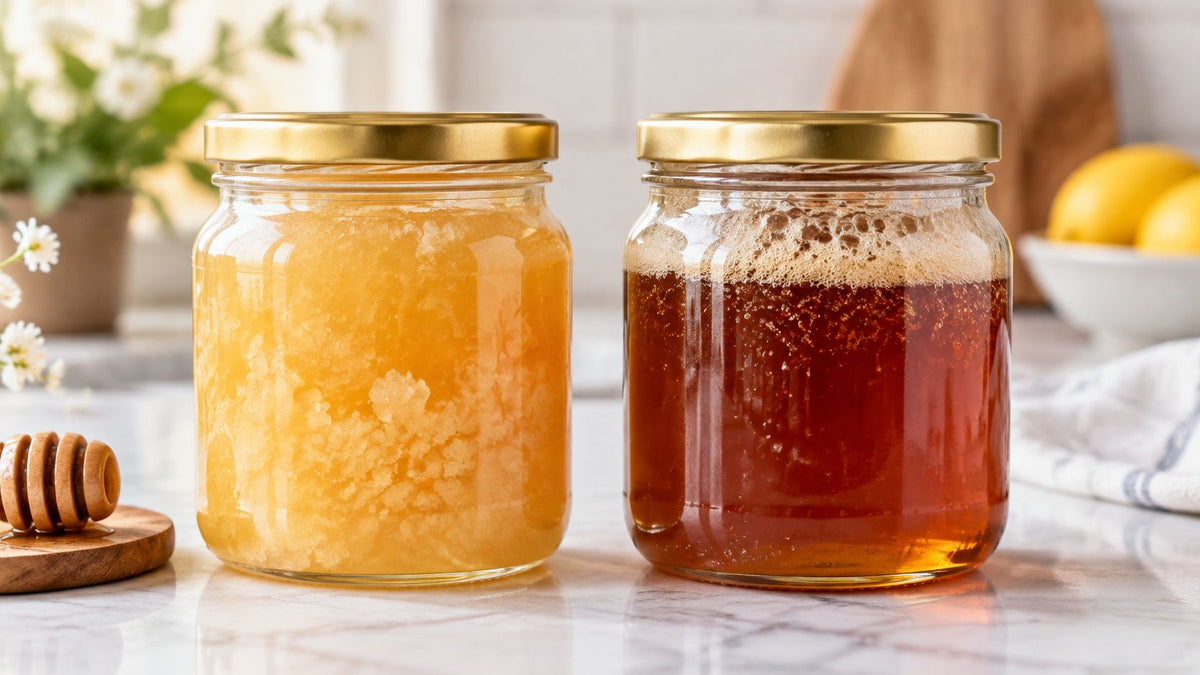
What Does Bad Honey Look Like? Signs to Check
If a jar turns cloudy, dark, or solid, does that mean it's spoiled? For most foods, a big change in looks is a warning. Honey confuses people because some of its biggest changes are normal, while a jar that looks perfect can still hide a problem you can't see.
That's the gap in how people judge honey. Learning what bad honey looks like starts with separating natural change from fermentation and contamination. We'll walk through that distinction step by step, so you don't throw away good honey or keep a jar you should discard.
Table of Contents
- Signs of Bad Honey at a Glance
- Crystallized Honey Is Not Spoiled Honey
- Fermentation Signs Include Foam, Gas and Smell
- Color and Texture Change by Flower
- Why Appearance Cannot Prove Honey Is Real
- What to Do With a Jar That Looks Off
Signs of Bad Honey at a Glance
The short answer is reassuring. Most visible changes in honey are normal, and only a handful of signs point to spoilage. A single cloudy or dark jar is rarely a problem.
Use this table as your first lookup. Each row covers one sign on its own, and the checks below show you how to read them in the right order.
| Sign | Usually Normal | Spoilage Concern |
|---|---|---|
| Crystals, graininess or cloudiness | Natural glucose crystallization | Only a concern when paired with foam, gas or a sour smell |
| Darker color | Normal for the floral source and with age | Not a spoilage test on its own |
| A few bubbles after stirring or filling | Harmless trapped air | Concern only if bubbles keep re-forming |
| Persistent foam or fizzing | Not normal | Likely fermentation; discard |
| Thin, watery texture or liquid layer on top | Thinner than usual but still viscous | Possible added moisture and fermentation; discard if foam or a sour smell follows |
| Sour, alcoholic, yeasty or vinegar-like smell | Not normal | Strong sign of fermentation; discard |
| Bulging, leaking or spurting lid | Not normal | Gas pressure inside the container; discard |
| Visible mold, especially near the lid or rim | Not normal | Contamination; discard |
A Simple First-Check Order
Start with what matters most and work down. Look at the lid for bulging, leakage, or residue. Look at the surface for foam that keeps forming after the jar sits still. Smell the honey before you judge color or thickness.
Only after those three checks should you compare texture and color with what you expect for that variety. A jar can be grainy and still fine. A jar that fizzes and smells beery is telling a different story.
Practical rule: If any row in the spoilage column applies to your jar, discard it. Never taste-test honey to decide whether it is safe.
One mild change, on its own, usually isn't a verdict. Each row works like a single symptom: harmless by itself, meaningful in combination. A grainy jar with a normal smell and a flat lid is fine, while that same jar with foam rising and a sour edge in the smell has crossed into spoilage.
Crystallized Honey Is Not Spoiled Honey
Open a kitchen cabinet in winter and the jar you bought clear may look pale, cloudy, or firm enough to hold a spoon upright. That sight sends plenty of good honey to the trash.
Crystallization is a natural physical change. Honey holds more dissolved sugar than it can keep stable over time, so glucose separates from the water and forms crystals. The U.S. Department of Agriculture explains that most honey naturally granulates, that the rate depends on the honey's fructose-to-glucose ratio, foreign material, and storage temperature, and that granulated honey has not been adulterated because it crystallized.
Why Some Jars Set Faster
Floral source matters because it changes the balance of sugars in the honey. Sage honey, for example, stays liquid longer than most raw honeys, while other varieties firm up within weeks of harvest. For perspective on why different sugars behave differently in storage and cooking, a closer look at dietary sugar breaks down the science in plain terms.
- Fructose-to-glucose ratio: A higher share of glucose relative to fructose generally means faster crystal growth.
- Pollen particles: Tiny particles in raw honey give crystals a surface to start forming on.
- Seed crystals: Even a few crystals already in the jar encourage more to form around them.
- Storage temperature: Cool storage speeds setting for many varieties.
Crystals can feel fine and smooth or coarse and sugar-like. Both textures are normal. The same settling process explains why honey can turn hard in the jar while remaining perfectly good to eat, and crystallized raw honey still spreads well right out of the jar. If you prefer it liquid, warm it gently.
How to Re-liquefy It Gently
- Remove the lid and keep water out of the honey itself.
- Set the closed jar in a bowl of warm water, well below boiling.
- Check every few minutes and stir gently once it softens.
- Use it once it turns liquid, without overheating, since high heat can damage flavor.
Crystals change how honey looks and spreads, nothing more. Cloudy honey, grainy honey, and fully set honey are all the same food they were on the day you bought them.
Fermentation Signs Include Foam, Gas and Smell
Fermentation starts when sugar-tolerant yeasts find enough available water in honey and begin turning sugars into carbon dioxide and alcohol. The gas shows up as bubbles, foam, pressure, or a lid that looks lifted. The alcohol can later be oxidized by bacteria into vinegar-like acids, which is why a spoiled jar can smell sharp, sour, yeasty, or solvent-like.
Water is the controlling factor. The Southern Cross University honey-fermentation fact sheet identifies moisture below 18% as the ideal range for minimizing fermentation risk, while honey above 18% has greater risk, especially when yeast spores and humidity are high. That sheet also describes fermented honey as strong and sharp smelling, often unusually runny, and sometimes foamy.
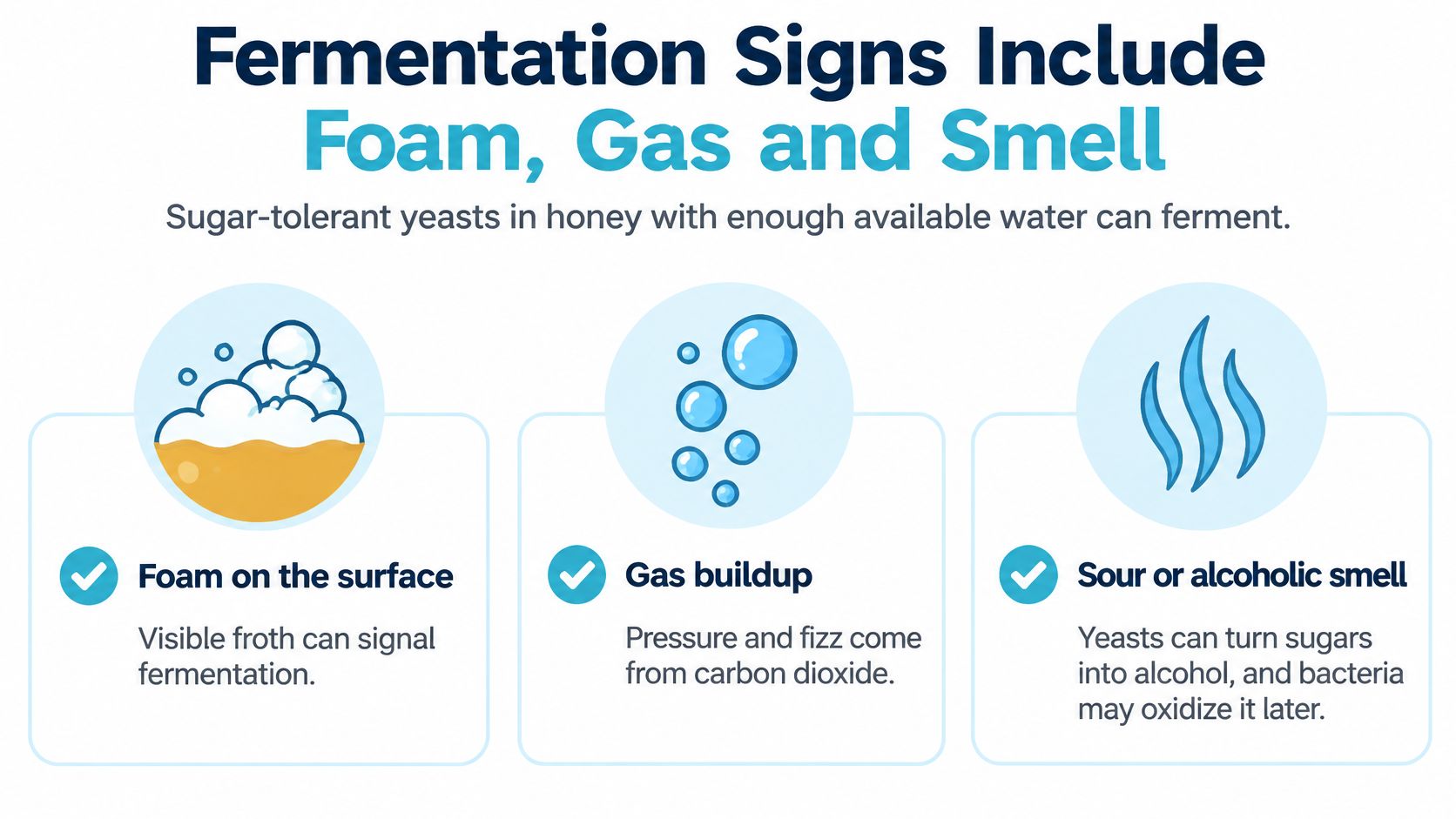
A practical week-at-room-temperature example makes the pattern clearer: a jar that began with a few harmless bubbles can develop a renewing bead of foam at the surface, a slight dome under the lid, a thin pour, and a smell that moves from floral to beer-like or pickle-sharp. That progression matters more than any single bubble, because it means gas is still being produced.
Two Checks Beyond the Quick Glance
- Open the lid slowly: Pressure, a hiss, spurting honey, or a bulged lid points to trapped carbon dioxide.
- Inspect the outside and the comb: Sticky trails down the jar can follow expanding gas, and honeycomb can leak from cells when pressure pushes honey out.
Moisture usually enters through small moments: a wet spoon, steam drifting over an open jar, or condensation under a loose lid. The wettest area is often near the top, so foam can appear there before the bottom looks different. Judge the pattern across surface, pour, lid pressure, smell, and leakage.
A jar with mold, active bubbling, pressure, or a sour fermented smell belongs in the trash. Do not taste it to check, because appearance can miss risk and a sweet look cannot prove a jar is safe or genuine.
Color and Texture Change by Flower
Honey color starts with the flower. Some honeys pour pale gold, and others look almost black straight from the hive. Honey also darkens slowly with age and warmth, so a darker jar can reflect storage time. Color alone never settles the question.
Compare your jar with the usual look for its variety first. That simple step prevents most false alarms.
| Variety | Typical Color | Typical Texture | What to Expect |
|---|---|---|---|
| Clover | Light, pale gold | Smooth and mild | Classic light, gently floral honey |
| Sage | Pale gold | Stays liquid longer than most raw honeys | Slow to crystallize |
| Cactus | Nearly white | Thick and creamy | Mild, delicate sweetness |
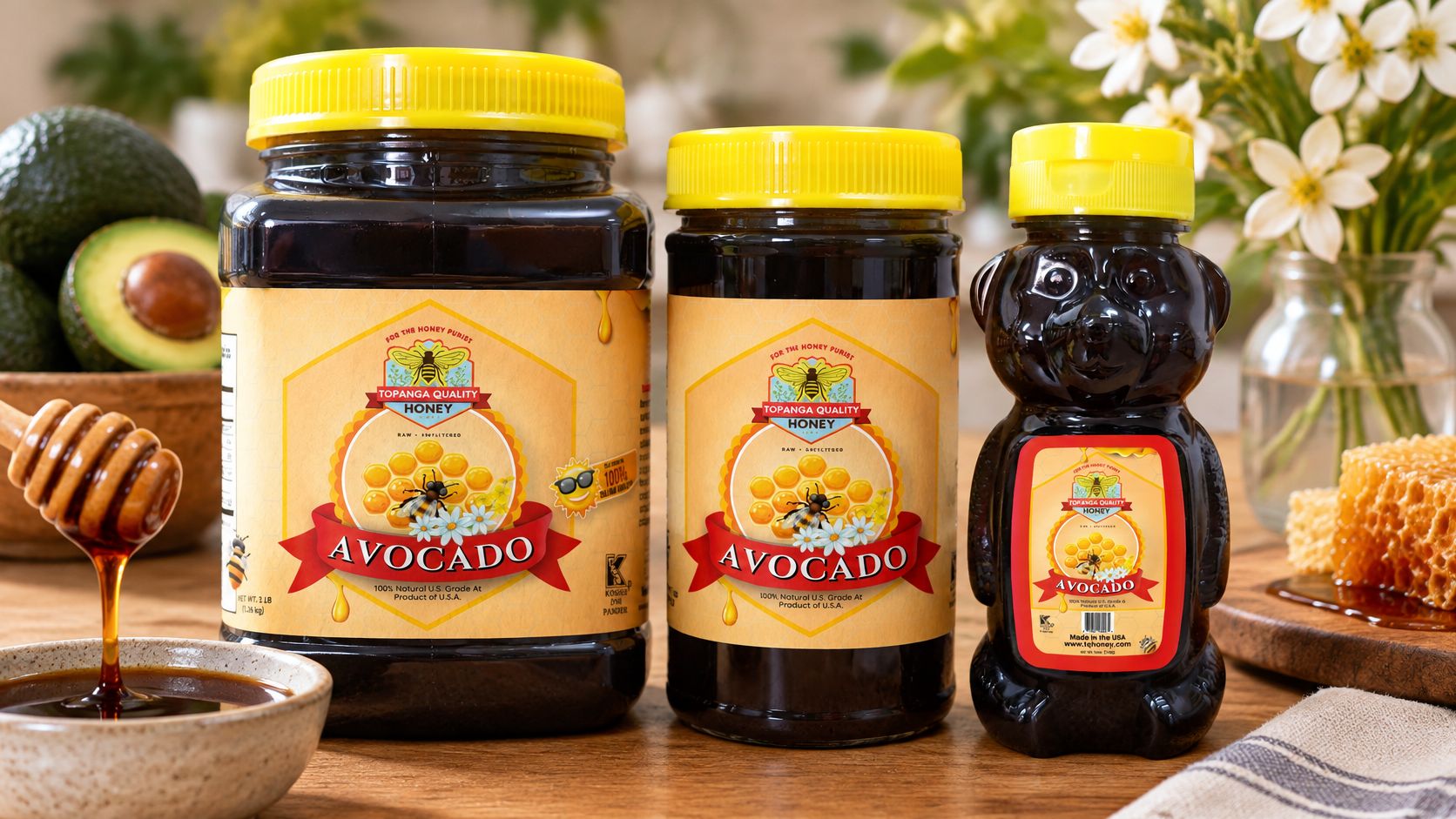
| Avocado | Dark amber | Rich and buttery | Deep molasses and caramel notes |
| Buckwheat | Very dark, almost black | Thick, malty | Naturally dark even in a fresh jar |
Cactus looks nearly white and creamy, which surprises people expecting gold. At the dark end, buckwheat is naturally very dark, so a nearly black jar is expected. Even within one variety, a jar can shift a shade or two. A clover honey that has moved from pale gold toward light amber has usually just spent time on a warm shelf, so read color as a starting point rather than a verdict.
Our Raw Avocado Honey is gathered from avocado orchards in bloom and has a rich, buttery taste with notes of molasses and caramel. Despite the name, its flavor runs deeper and rounder than lighter honeys, which suits baking, coffee, glazes, and aged cheese.
Use our honey varieties guide to check the normal color for the name on your label. If the color differs from what you remember yet the smell is normal and there is no foam or gas, the jar is usually fine. A jar that looks very different and shows foam, gas, or a sour smell deserves concern.
Dark honeys such as avocado and buckwheat work especially well in baking, marinades, and glazes, where their stronger flavor holds up to heat and spices.
Why Appearance Cannot Prove Honey Is Real
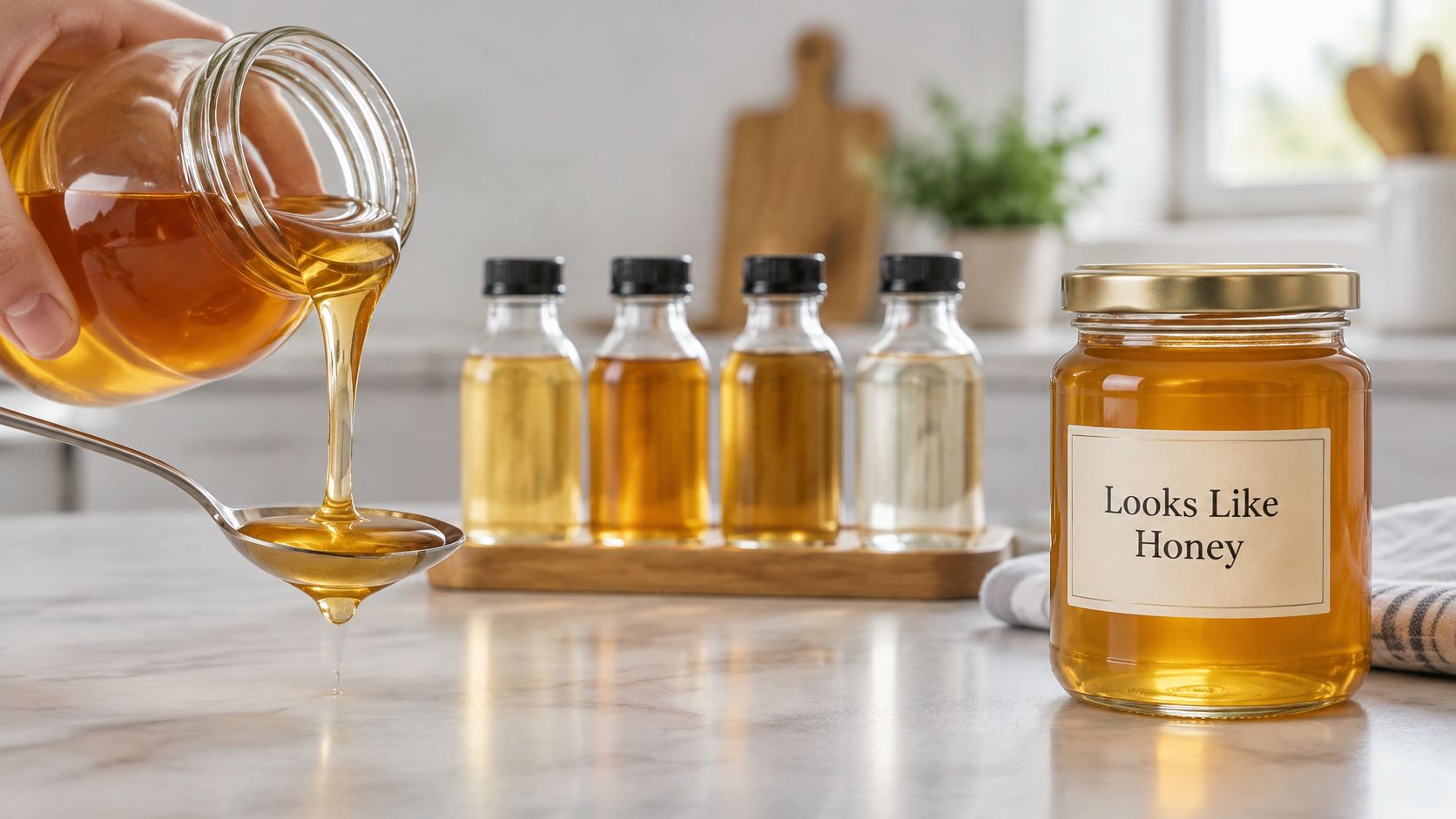
A jar can look, pour, and taste like honey and still contain cheaper sweeteners. Corn, cane, rice, and sugar-beet syrups are chosen for adulteration precisely because they mimic honey's color and sweetness, which is why fraud stays invisible in the jar.
Regulators catch what eyes cannot. One FDA sampling initiative on economically motivated adulteration in honey reported that 14 imported samples, or 10%, were violative, while a later collection found four samples with undeclared sweeteners among 102 tested, roughly 4%. Sampling methods and product pools differ between sweeps, so read those figures as snapshots of specific collections rather than a market-wide rate.
Can You Spot Fake Honey at Home
Generally, no. Water, flame, thumb, and bread tests all measure thickness, moisture, or how a blob behaves under heat, and genuine honeys vary widely on every one of those traits. A thick raw buckwheat and a slow-pouring crystallized jar can both be perfectly pure, so a kitchen trick that passes one and fails the other describes texture rather than purity.
The video below shows honey being handled and sampled. Visual checks like this are useful for spoilage questions; purity calls for laboratory testing.
What you can check at home is the label, and our guide on how to check if your honey is real walks through the details.
- Read the ingredient statement: Check whether any added sweeteners are listed.
- Check for blend language: A honey blended with bee pollen, propolis, and royal jelly names those additions openly, which is a different thing from an undeclared sweetener.
- Treat clues as caution, not proof: Unexplained separation, excessive thinness, or unusually low pricing are reasons to pause, not proof of fraud.
Keep the two questions separate. A jar can look cloudy and be perfectly fine, or look clear and golden and be mislabeled.
What to Do With a Jar That Looks Off
Start with the discard rule, then work through the jar calmly. You don't need to taste anything to decide.
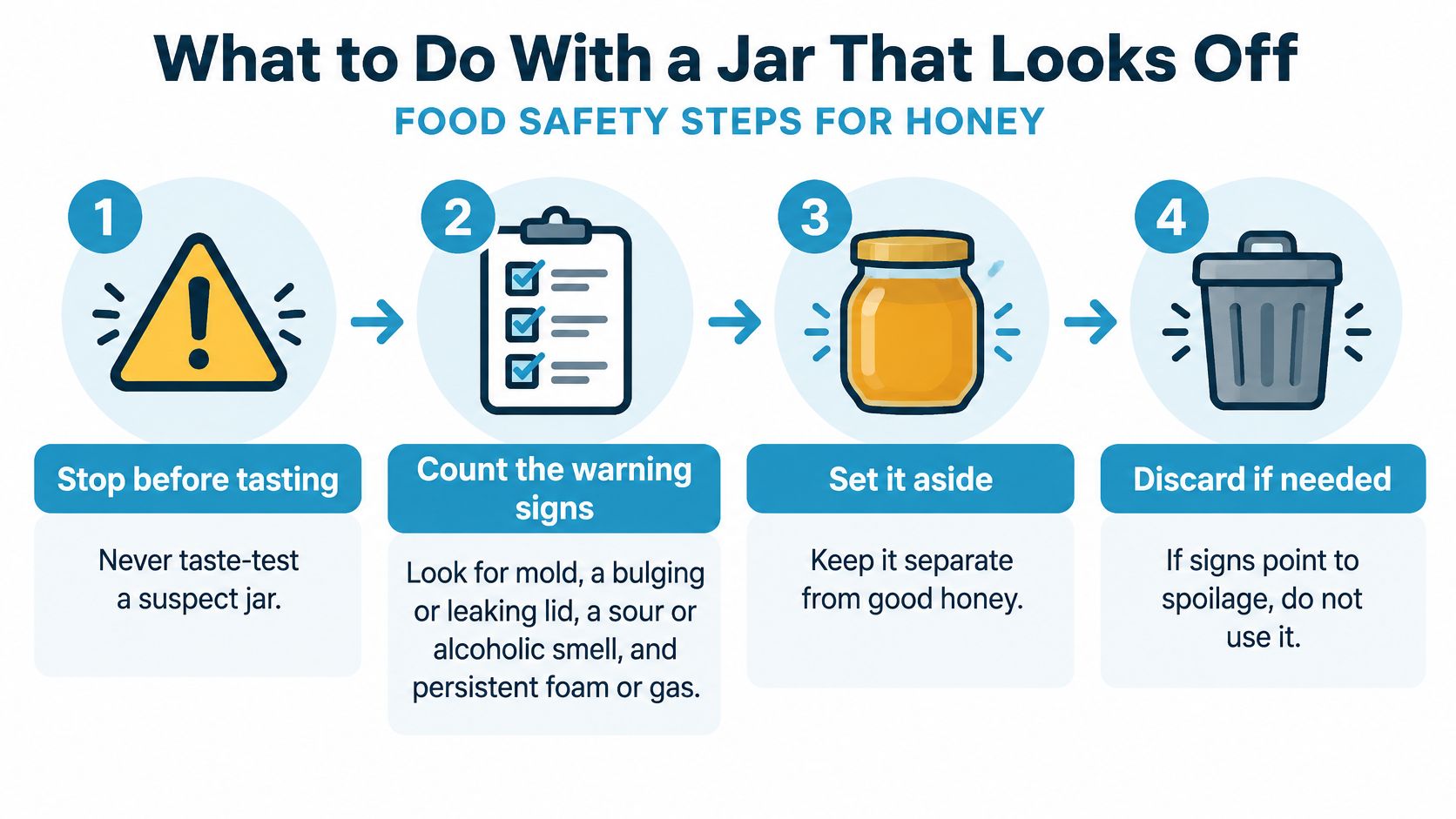
Five Steps for a Suspect Jar
- Stop before tasting: Never taste-test a suspect jar to settle the question.
- Count the warning signs: Note mold, a bulging or leaking lid, a sour or alcoholic smell, and persistent foam or gas.
- Discard when the serious signs appear: If mold, gas pressure, or a sour, alcoholic or vinegar-like smell is present, discard the jar.
- Don't try to rescue it with heat: Heating fermented honey may change quality without reliably addressing contamination.
- Keep it if only texture or color changed: If the only change is crystallization or darker color with a normal smell, the honey is usually fine. Rewarm it gently in warm water or use it as is.
Say you open a jar and see coarse crystals but smell the usual floral aroma. That's a keep and rewarm situation. Now picture the opposite jar: foam that returns after sitting, a lid pushed up by pressure. That jar gets discarded, even if the color looks normal. The decision rests on smell and signs of gas, never on appearance alone.
When mold or gas is present, disposal is safer than trying to fix the jar.
Storage Habits That Prevent Trouble
Good storage protects honey's low-moisture barrier. Water and condensation are what let yeast and mold get started, so every habit below controls the same thing: how much water reaches the honey.
- Close the lid tightly: Wipe the rim first so sticky honey doesn't break the seal.
- Use only dry utensils: Keep wet spoons, crumbs, and other foods out of the jar.
- Keep it away from steam: Don't hold an open jar over a kettle or a steaming pot.
- Store at room temperature: Refrigeration speeds crystallization and makes honey hard to scoop.
Our notes on how to store honey correctly cover shelf placement in more detail. If you compare storage notes across specialty foods, you can also review chocolate food safety details to see how makers handle moisture and clean handling for a different pantry product.
Every honey we sell is raw, unfiltered, organic and kosher, and it's packed in California, so you can compare jars on the same basis. If you want a pale single-variety honey where changes are easy to judge, explore our raw sage honey. It pours pale gold, tastes gently floral, and stays liquid longer than most raw honeys, which makes normal versus unusual changes simpler to spot. Shipping is free on orders of $50 or more to the continental US, with a $9.95 flat rate under $50.
Do not feed honey to infants under 12 months old.
Topanga Quality Honey offers raw, unfiltered, organic and kosher honeys in pale and dark varieties, packed in California in 1 lb and 3 lb jars, 12 oz squeeze honey bears, honey sticks, honeycomb, and gift sets. Knowing what's normal for each variety makes it easier to enjoy a crystallized jar and spot the rare jar you should discard. Visit Topanga Quality Honey to choose a variety by its natural color, flavor, and best use in your kitchen.