

Wooden Honey Sticks: What They Are and How to Use Them
Your toast is ready, but the honey is still hanging from the spoon in a slow, sticky rope. You turn your wrist, catch a drip on the jar rim, and wonder whether that grooved wooden tool would make breakfast a little tidier. Wooden honey sticks can help control a drizzle, but they work best when you understand the honey, the tool, and what should happen after serving.
Table of Contents
- What Wooden Honey Sticks Are and Where They Came From
- How to Serve Honey With a Wooden Stick, Step by Step
- Storing Wooden Sticks and Honey Between Uses
- Food Safety and Disposal After Each Use
- Honey Varieties to Pair With Your Wooden Stick
- Choose a Honey for Your Wooden Stick Today
What Wooden Honey Sticks Are and Where They Came From
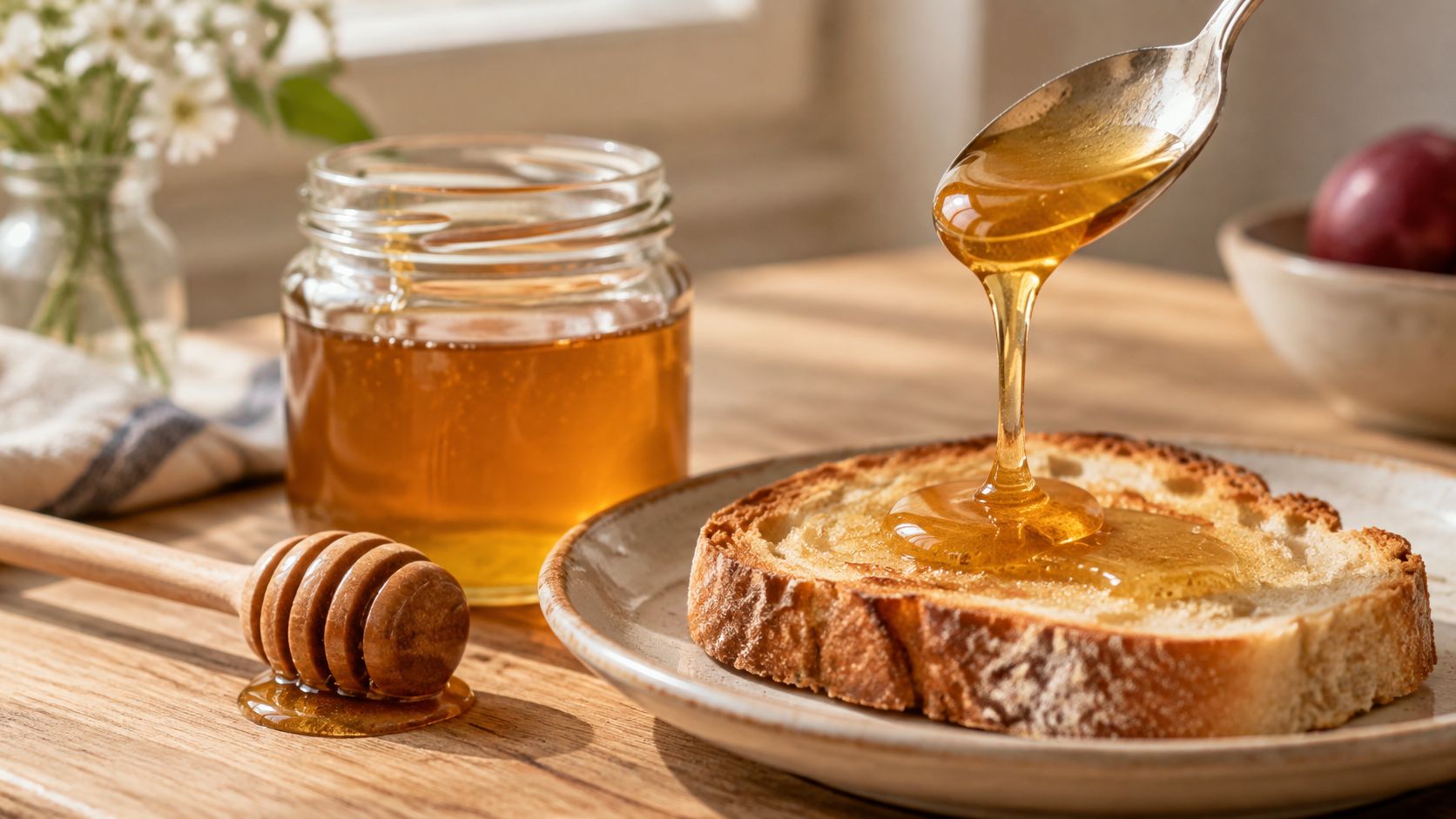
A wooden honey stick is a grooved wooden serving tool that lifts honey and releases it gradually. Dip its head into liquid honey, lift it carefully, and guide the flow onto your toast instead of tipping the whole jar.
The grooves increase the surface area available for honey to cling to. Honey's viscosity helps it stay on the head while you move it, although the tool won't stop every drip or measure an exact portion.
That slow rope of honey is easier to manage when your plate is close to the jar.
A Familiar Tool With Several Names
You'll see related tools called honey dippers, honey wands, honey drizzlers, honey drippers, and honey spoons. Historical Folk Toys' honey dipper history describes these names and the traditional practice of keeping a dipper in a honey pot.
Grooved dipper-like tools appear among ancient Egyptian artifacts discussed by the American Bee Journal. Bone and metal versions were also used in medieval kitchens, showing that controlled honey serving wasn't limited to wood.
A Dipper Isn't a Honey-Filled Straw
A single-serve honey stick is different: it's honey sealed inside a tube that you open and squeeze. The wooden tool contains no packaged serving, and its grooves don't tell you how much honey you've taken.
Choose a dipper for a controlled ribbon of honey. Choose a measuring spoon when the amount matters.
This guide focuses on the wooden serving tool. For a disposable wooden stick, storage and disposal deserve the same attention as drizzling; for a purpose-made reusable dipper, follow its documented care instructions rather than assuming all wooden products are interchangeable.
How to Serve Honey With a Wooden Stick, Step by Step
Put the honey jar beside your plate and keep a clean saucer close. The shorter the trip from jar to food, the less honey ends up on the table. Wooden tools are useful because they hold a ribbon of honey without tipping a spoon, but they still need a landing place between passes. That practical detail matters more than appearance.
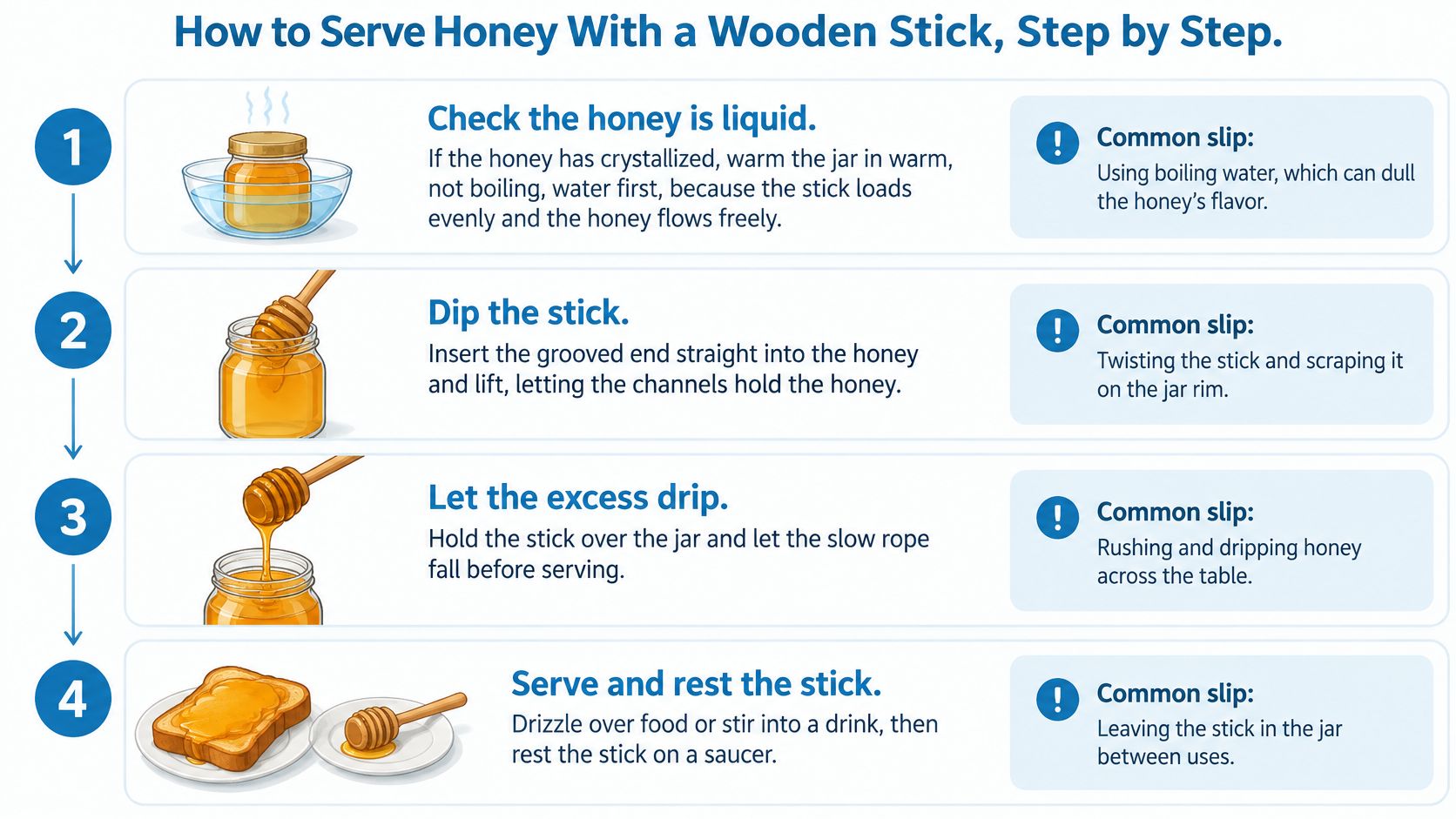
The visual guide shows the serving sequence.
Load, Lift, and Drizzle
- Check that the honey is liquid. Raw honey may crystallize naturally, and it's still good; set the jar in warm, not boiling, water to re-liquefy it. Hard honey won't fill the grooves evenly, so don't force the head into a firm jarful.
- Lower the grooved end into the honey and give it a gentle turn so the channels fill. A shallow dip loads only the tip and often produces a thin, uneven trail. There's no need to scrape the head against the rim.
- Lift slowly and pause over the jar. Let the loose excess fall back before moving over your plate, because a quick lift and sideways swing can scatter honey onto the counter. Keep the handle angled so honey doesn't creep toward your fingers.
- Guide the drizzle over toast, yogurt, or fruit, moving in small circles where you want an even covering. For tea, let the honey fall into the cup and use a separate clean spoon to stir if you intend to load the dipper again. Holding the head too high stretches the ribbon and makes placement less predictable.
- Rest the stick on a clean saucer between drizzles. Don't balance it on the jar rim, where honey can run down the outside and make the lid sticky. Keep the grooved head away from crumbs, butter, and other food.
- Let the remaining honey drain until the grooves are mostly clear, then wipe away surface drips with a clean disposable towel before another dip during that serving. A quick wipe isn't cleaning or sanitizing; if the head has touched food or a drink, stop using it in the shared jar. Don't rinse a disposable stick and put it back into service.
Keep the Shared Jar Clean
A food-touched dipper shouldn't go back into a shared honey jar. Crumbs, drink droplets, and food residue belong on your plate, not in the honey everyone will use tomorrow. Pour some honey into a separate serving dish if you want more freedom at the table. That is the cleaner trade-off for toast, fruit, and tea, especially when several people are serving themselves.
A good drizzle is a steady, thin ribbon that finishes without running down the shaft. It isn't a calibrated serving, so use a measuring spoon or kitchen scale for recipes. The stick gives control over placement, not precision over quantity.
Our glass honey jar and dipper guide offers another look at arranging a serving setup. Watch the hand movement before trying it with a full load of honey.
Storing Wooden Sticks and Honey Between Uses
Keep storage simple:
- Unused wooden sticks: Leave them in their intact wrapper or a clean sealed bag.
- Dry location: Choose a cupboard away from sinks, dishwasher steam, and steaming pots.
- Honey jar: Close the lid firmly and keep it at room temperature, away from the stove and direct heat.
Wood and honey both respond to moisture, so a dry-looking cupboard beside a dishwasher isn't necessarily a good storage spot. Don't package damp wooden components and expect a sealed bag to dry them.
A Springer chapter on wooden packaging reports microbial-growth control under conditions of relative humidity below 45% and temperature below 20 °C. Those are conservative environmental targets for storing wooden materials, not a universal honey-stick shelf-life rule or a requirement to refrigerate honey.
Storage by Situation
| Situation | What to do | Reason |
|---|---|---|
| Unused wooden sticks | Keep sealed in wrapper or a sealed bag | Limits moisture exchange with the wood |
| Kitchen humidity | Store away from steam, sinks, and dishwashers | Keeps storage closer to the dry research benchmark above |
| Room temperature | Use the cool-storage benchmark above for wooden components; keep away from stoves | Warming softens honey and can cause leakage |
| Crystallized honey | Set jar in warm, not boiling, water | Raw honey crystallizes naturally and is still good |
| Damp or swollen wood | Discard the stick | Moisture changes the wood and can weaken the stick |
Temperature swings matter especially when honey is already in contact with wood or inside a wrapper. Warming can encourage honey to seep into pores or seams, while cooling afterward can produce condensation inside packaging.
For pantry placement and jar handling, use our guide to storing honey for lasting flavor and freshness.
Storage check: Discard a disposable stick with damp or swollen wood, a sour smell, a sticky wrapper, or a leaking seam.
Food Safety and Disposal After Each Use
Treat a disposable wooden honey stick as single-use food-contact material, not as a reusable utensil. That rule applies to products intended for one-time serving. A documented reusable wooden dipper is a different product, with its own cleaning and drying instructions.
Wood is porous and can absorb moisture and retain residue, which makes a casual rinse an unreliable way to prepare a disposable stick for another meal. But porosity alone doesn't make wood unsafe: a scientific review hosted by INRAE found that some wood species contain antimicrobial compounds and that hygienic performance requires more consideration than porosity alone.
Ask About the Finished Tool
Before buying wooden serving sticks, ask these questions:
- Wood species: What wood is used, and is it identified in the product documentation?
- Surface treatments: Are coatings, waxes, lacquers, adhesives, or preservatives present?
- Food-contact suitability: Is the finished stick documented for its intended contact with honey, including whether it's disposable or reusable?
The Finnish Food Authority's guidance on wood food-contact materials explains that common wood species are generally chemically safe for food contact, while waxes and lacquers can change the assessment. Natural isn't a compliance certificate.
Inspect the actual stick, too. Reject splintered heads, open cracks, rough grooves, and damaged packaging; an attractive finish doesn't compensate for a defective food-contact surface.
Disposal by Stick and Wrapper Material
| Stick or wrapper | Usual disposal route | What changes the answer |
|---|---|---|
| Clean, untreated wood stick | Compost if local rules accept wood | Honey residue can make some compost streams reject it |
| Coated, varnished, or waxed wood | Trash unless the supplier confirms otherwise | Coatings change the material's disposal status |
| Paper wrapper | Follow local paper recycling or compost rules | Greasy or honey-soaked paper may not be recyclable |
| Plastic wrapper | Recycle only where your area accepts that plastic | Individually wrapped sticks add packaging per gram of honey |
| Mixed-material pack | Separate parts if your area requires it | Bonded layers may prevent separation or recycling |
Local composting and recycling rules determine the practical route. Don't put a coated stick into compost just because its core is wood.
A wooden stick may replace some plastic, but the whole package matters. Individual wrapping, material combinations, and disposal access can outweigh a simple material swap. The National Honey Board's category review discusses sustainability alongside packaging convenience, a useful reminder that those goals aren't always the same.
Honey Varieties to Pair With Your Wooden Stick
Start with the food, not the stick. Light, mild honey suits a gentle drizzle over fruit, yogurt, or tea, while darker honey makes more sense when you want noticeable depth. A wooden stick gives you control over the amount, but it cannot make a strong honey subtle or a mild honey more complex.
Sage honey is gently floral and suits biscuits, yogurt, fruit, and tea. It is also practical when you want sweetness without a strong honey flavor, which is why it works well in tea or over fruit. Orange blossom honey comes from bees working citrus groves in full bloom and has a smooth, silky body. Its light floral character fits toast, tea, and fruit without taking over the plate.
Choose How Much Flavor You Want
Avocado honey has a richer profile with molasses and caramel notes. Use a small drizzle beside coffee or over food that can handle deeper flavor. For baking and glazes, measure it rather than judging the amount from the stick.
Buckwheat honey is dark, malty, earthy, and less sweet-tasting. It suits rye bread and cheese boards, while gingerbread and marinades give that stronger character room to work. Dark honeys such as avocado, buckwheat, and eucalyptus are useful for baking, marinades, and cheese boards because they bring depth instead of simple sweetness.
Pomegranate honey sticks need a different approach. They are honey blended with pomegranate, not a single-variety honey, so the fruit note is part of the pairing. The bright, fruity, slightly tart flavor works best where you want the honey to taste lively, such as yogurt or fruit.
Honey Varieties by Flavor and Drizzle Use
| Variety | Flavor | Good uses with a stick |
|---|---|---|
| Sage | Gently floral, mild enough for tea, fruit, yogurt, and biscuits | Tea, biscuits, yogurt, fruit |
| Orange blossom | Smooth and silky, light floral character from citrus bloom | Toast, tea, fruit |
| Avocado | Rich, buttery, molasses and caramel notes | Coffee, serving alongside baking, finished glazes |
| Buckwheat | Dark, malty, earthy, less sweet | Gingerbread, rye bread, marinades, cheese boards |
| Pomegranate | Bright, fruity, slightly tart blend | Yogurt, fruit, toast when a tart note is welcome |
The stick changes delivery, not the honey's underlying flavor. California wildflower honey sticks vary by harvest because they come from whatever is blooming across California's hills and valleys, so taste before committing them to a familiar dish.
Use our honey-tasting guide to compare aroma, texture, and flavor before covering a whole breakfast with a new variety.
Choose a Honey for Your Wooden Stick Today
Choose a jar if you want to serve honey with a wooden dipper at home. Choose sealed honey sticks if you want individual servings without carrying a jar and a separate tool. Those are different purchases, and we don't describe our honey-filled straws as wooden dippers.
Topanga Quality Honey is a family-owned California beekeeping company. We are the beekeepers. Our hives move with the seasons to orchards, farms, and wildflower ranges, and all honey is packed in California.
Match the Format to Your Kitchen
Our honey is raw, never pasteurized; unfiltered, never ultra-filtered; organic; and kosher. Available formats include:
- Everyday honey: 1 lb jars, 3 lb jars, and 12 oz squeeze honey bears. Blackberry, cactus, and Brazilian wildflower are available in jars only.
- Individual servings: Honey sticks in packs of 50 or 100, in sage, orange blossom, California wildflower, and pomegranate.
- Honeycomb: 1 lb raw honeycomb and 11 oz honeycomb squares.
- Side-by-side tasting: Gift sets in 3 x 1 lb, 2 x 3 lb, and 3 x 12 oz formats, plus the 5-item Super Set.
Gift sets let you choose varieties to compare. Super Honey is a separate blend containing bee pollen, propolis, and royal jelly, so the nothing-added description doesn't apply to it.
You receive automatic 10% off when buying 2 or more eligible jars, honey bears, honey sticks, or honeycomb. Shipping is free on orders of $50 or more to the continental US, with a $9.95 flat rate under $50; Alaska and Hawaii shipping is calculated at checkout.
For portable servings, choose from our honey sticks collection. For jar flavors, consult the honey varieties guide, or contact us at 818.937.3437 or orders@topangaqualityhoney.com.
Topanga Quality Honey offers honey in jars for your wooden dipper and sealed honey sticks for individual servings. Visit Topanga Quality Honey to choose the flavor and format that fit your breakfast table.
Do not feed honey to infants under 12 months old.