

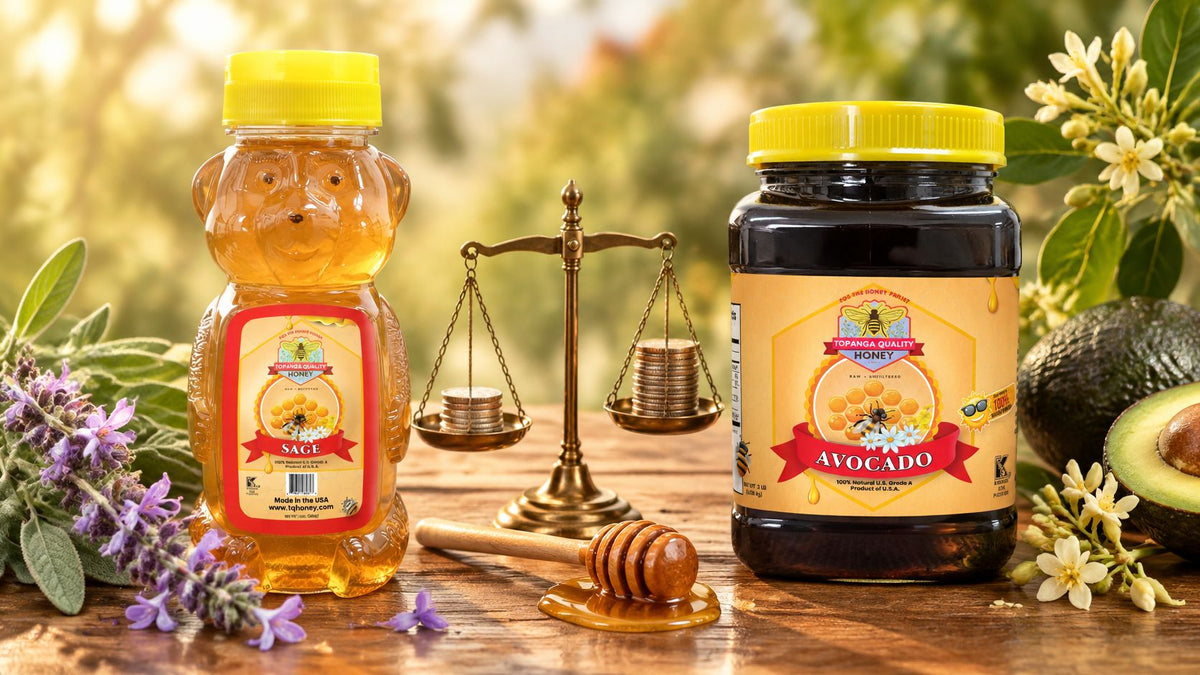
Raw Honey Price: What Drives the Cost of Each Jar
U.S. honey averaged $7.85 per pound in 2024, according to the National Honey Board's Nielsen Category Review. That's a useful reference, but it doesn't tell you what a particular jar, squeeze bear or piece of honeycomb should cost. A useful raw honey price comparison starts with the package weight, then separates the honey itself from the work of harvesting, packing and delivering it.
We're the beekeepers at Topanga Quality Honey, a family-owned California beekeeping company. The practical question isn't just whether one honey costs more than another. It's what you get for the difference, and whether that difference matters in your kitchen.
Table of Contents
- Raw Honey Prices by Variety at a Glance
- Price per Pound for Jars, Honeycomb and Gift Sets
- Why the Shelf Price Sits Far Above the Producer Price
- How Floral Variety Changes the Price
- Where the Honey Comes From and What Certification Adds
- How to Check Quality Before You Pay More
- Choose the Honey and Size That Fits Your Budget
Raw Honey Prices by Variety at a Glance
The listed prices range from $35.61 for Raw Blueberry Blossom Honey to $67.06 for Raw Cactus Honey. Package sizes differ, so these figures compare listing prices, not cost per pound.
| Product | Package or product details | Regular price |
|---|---|---|
| Raw Clover Honey | Available in 1 lb jar, 3 lb jar, 12 oz honey bear and 24 oz honey bear sizes | $50.40 |
| Raw Sage Honey | Honey | $50.40 |
| Raw Orange Blossom Honey | Honey | $50.40 |
| Raw California Wildflower Honey | Honey | $50.40 |
| Raw Buckwheat Honey | Honey | $50.40 |
| Raw Blackberry Honey | Honey | $50.40 |
| Raw Brazilian Wildflower Honey | Honey | $50.36 |
| Raw Blueberry Blossom Honey | Listed from | $35.61 |
| Raw Eucalyptus Honey | Honey | $66.40 |
| Raw Avocado Honey | Honey | $66.40 |
| Raw Cactus Honey | Bestseller | $61.76 |
| Super Honey | 12 oz, honey blended with bee pollen, propolis and royal jelly | $61.96 |
| Honey Sticks | Orange blossom, California wildflower and pomegranate varieties listed from $41.81; sage starts at $41.81 | From $41.81 |
Several varieties share a $50.40 listing price, while the listed prices for avocado and eucalyptus are $66.40. Cactus has two listed figures: $61.76 as a Bestseller and a regular price of $67.06. Check the selected product and size before comparing.
The table shows why package details matter. Clover honey, for example, comes in four listed sizes, while the blueberry blossom price is a starting price. A “from” price does not apply to every size or pack.
Super Honey is a blend, not a single-flower honey. Compare it with other blends by package size and ingredients, rather than treating its price as a direct measure of floral variety.
Price per Pound for Jars, Honeycomb and Gift Sets
Price per pound makes different package sizes easier to compare. Divide the package price by its total weight in pounds. These figures use regular prices before shipping.
| Format | Total honey or comb weight | Regular price | Price per pound |
|---|---|---|---|
| Raw Honeycomb, 1 lb | 1 lb, including comb | $37.09 | $37.09 |
| Raw Honeycomb Square, 11 oz | 0.6875 lb, including comb | $45.08 | $65.57 |
| Honey Gift Set, 3 x 12 oz honey bears | 2.25 lb | $59.65 | $26.51 |
| Honey Gift Set, 3 x 1 lb jars | 3 lb | $72.22 | $24.07 |
| Honey Gift Set, 2 x 3 lb jars | 6 lb | $64.68 | $10.78 |
The 2 x 3 lb gift set has the lowest per-pound price in this comparison. The smaller sets cost more per pound, but let you choose different honey bears or jars and divide them among kitchens or gift recipients.
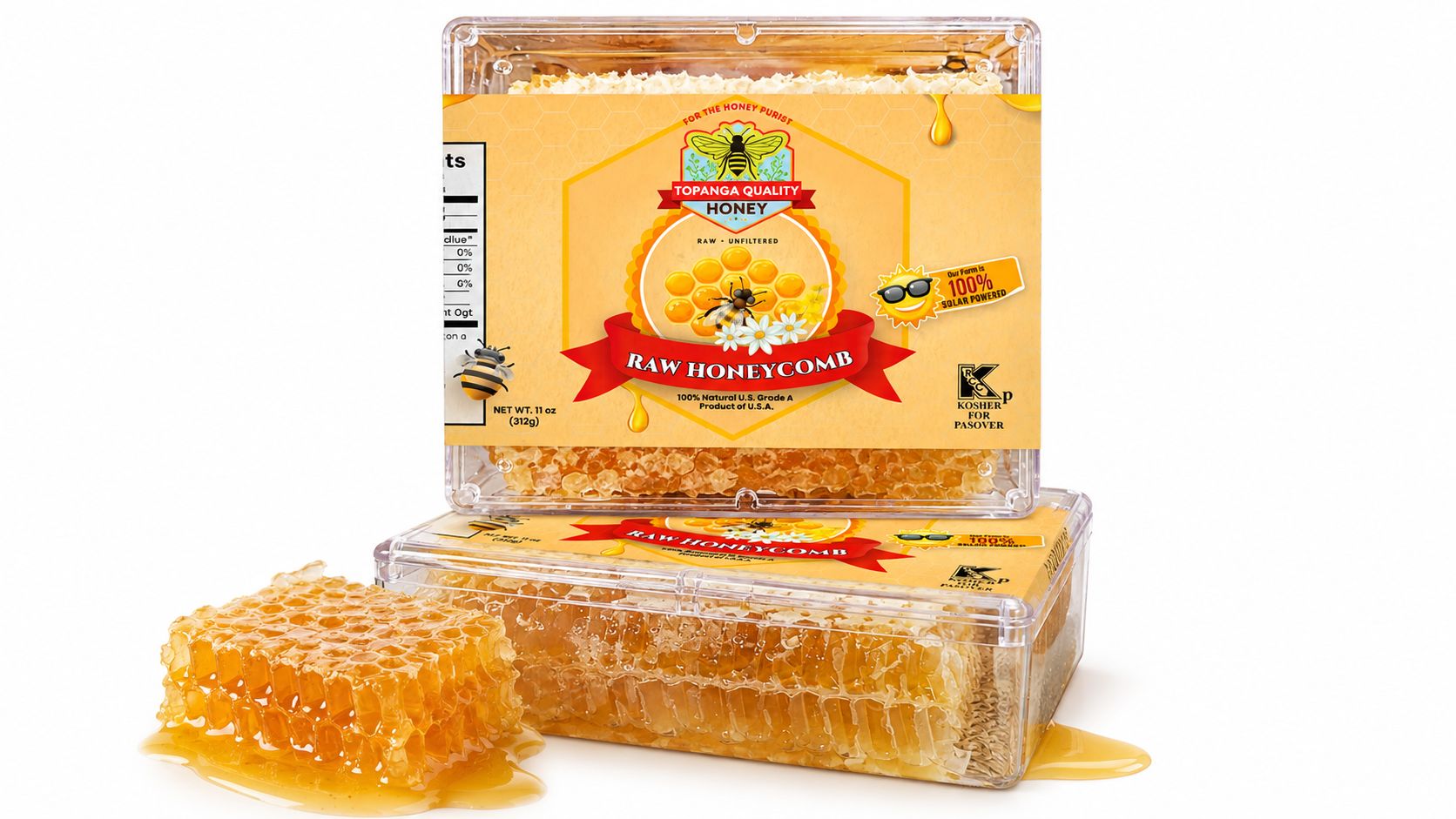
For honeycomb, the stated weight includes the beeswax cells as well as the honey. The 1 lb honeycomb remains sealed in its soft, chewable beeswax comb. The 11 oz square is another comb format, with a higher price per pound in this comparison.
Compare unpriced formats without guessing
For a 1 lb jar, the package price is the price per pound. For any other size, divide the package price by its weight in pounds. For example, divide a 3 lb jar's price by three, or a 12 oz honey bear's price by 0.75.
Honey sticks are single servings of honey sealed in straws. To compare their cost per pound, use the package's stated net weight along with its price. A serving count alone is not enough to calculate a reliable per-pound figure.
A gift set's per-pound cost can be calculated from the total weight of its contents. The Honey Gift Set lets you choose three 12 oz honey bears or three 1 lb jars at a set price; the 2 x 3 lb set lets you choose two 3 lb jars.
Include delivery in the calculation
Use the final checkout total to calculate delivered cost per pound. A larger order may spread delivery costs across more honey, but buying more only saves money if you will use it.
- Continental US orders of $50 or more: Free shipping.
- Continental US orders under $50: $9.95 flat-rate shipping.
Why the Shelf Price Sits Far Above the Producer Price
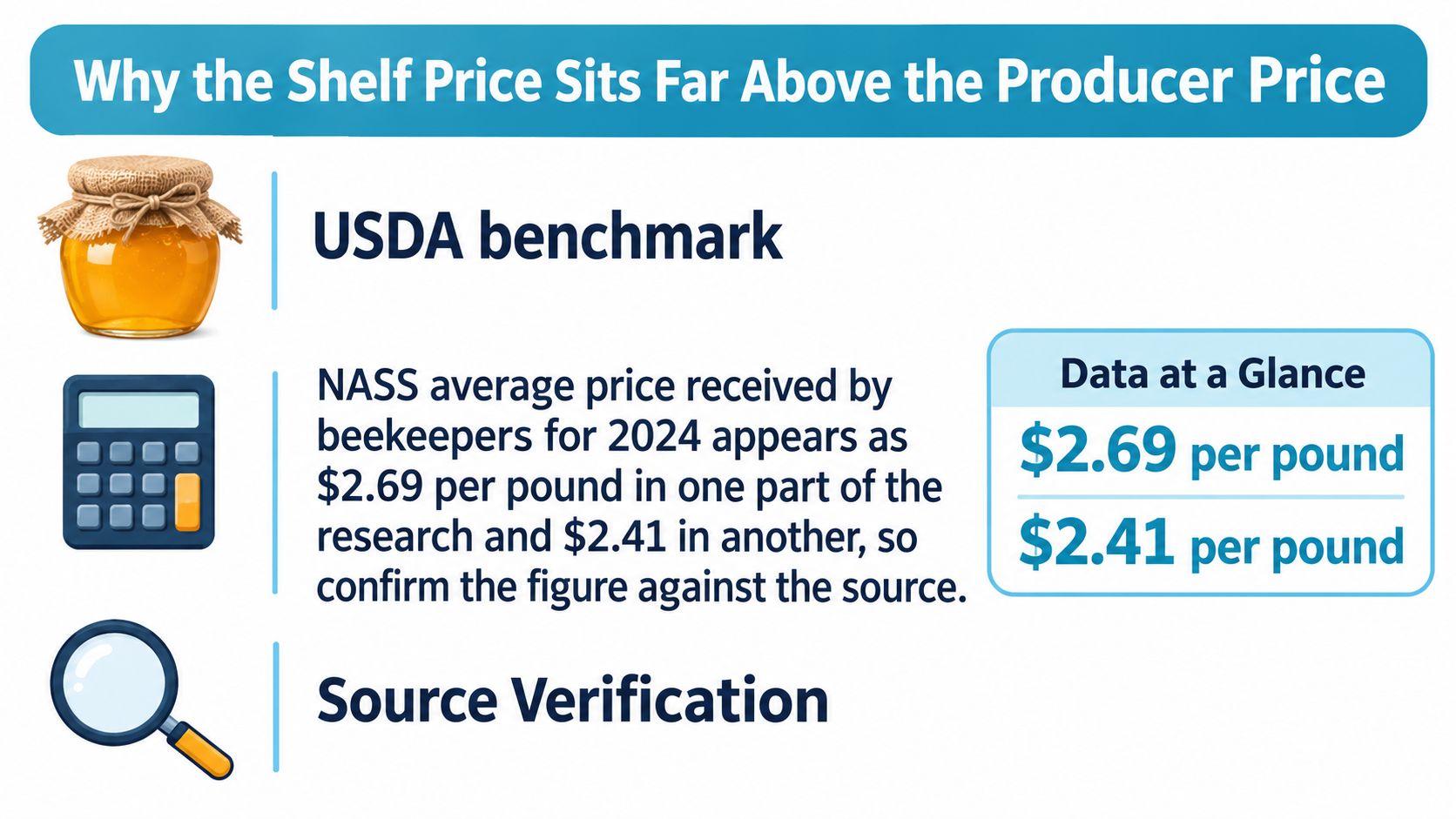
The USDA's 2024 honey release reported an average honey price of $2.69 per pound, up 5% from $2.55 in 2023. That average combines multiple sales channels. It is not the price of a finished jar delivered to your door.
Reporting context matters, too. An earlier annual estimate and a later revision may not describe identical transactions. Neither gives the cost of a specific floral variety in a specific package.
What the jar price has to cover
Beekeeping costs start before honey is ready to pack. Equipment maintenance, bee care, pest management and feed when needed all add to production costs. In some operations, hives move with the seasons to follow flowering crops or wildflower ranges, adding planning, handling and transportation costs. A promising bloom still has to produce usable nectar while bees can work it.
Harvesting and selling the honey add more costs:
- Extraction and handling: Removing honey from comb and preparing it for packing.
- Packaging: Jars or squeeze bears, closures, labels and protective materials.
- Verification: Testing, certification administration and product records.
- Order handling: Picking, packing and preparing parcels for shipment.
- Delivery and operations: Freight, customer service and the work of running an online store.
These costs do not all represent a quality premium. Some cover the work and materials needed to package honey and deliver it intact.
Why a smaller harvest changes the economics
A Mississippi State Extension economic model uses 85 pounds per hive and assumes 63% of the honey sells in one-pound bottles at $8.50 per pound. Under those assumptions, the model approaches break-even around its assumed yield and price. Lower yields or prices make returns negative.
The cost of labor, equipment and transportation must be spread across the honey harvested. Those expenses do not fall in proportion when a bloom produces less honey than expected.
Packaging has its own trade-off. Every container needs a closure, label and handling, so splitting honey into more packages increases packaging work per pound. Sticks suit single servings, but they use more packaging per pound than a larger container.
A higher price can reflect a difficult harvest or a convenient package. Neither guarantees that you'll prefer the flavor.
For a comparison with another agricultural product, fair trade explained by Cartograph Coffee examines what a purchasing label is meant to address. Apply the same practical question to honey: identify the specific claim behind a label rather than treating every label as the same promise.
When a jar costs more, compare the factors behind its price: harvest conditions, handling, package and delivery. That gives you a clearer basis for judging value than assuming every price difference means better honey.
How Floral Variety Changes the Price
Flowers shape the honey's color, aroma and flavor. They also set the harvest opportunity: beekeepers can't extend a particular bloom because people want more of that variety.
The range from pale to dark is a useful starting point, not a ranking of quality.
Match intensity to the dish
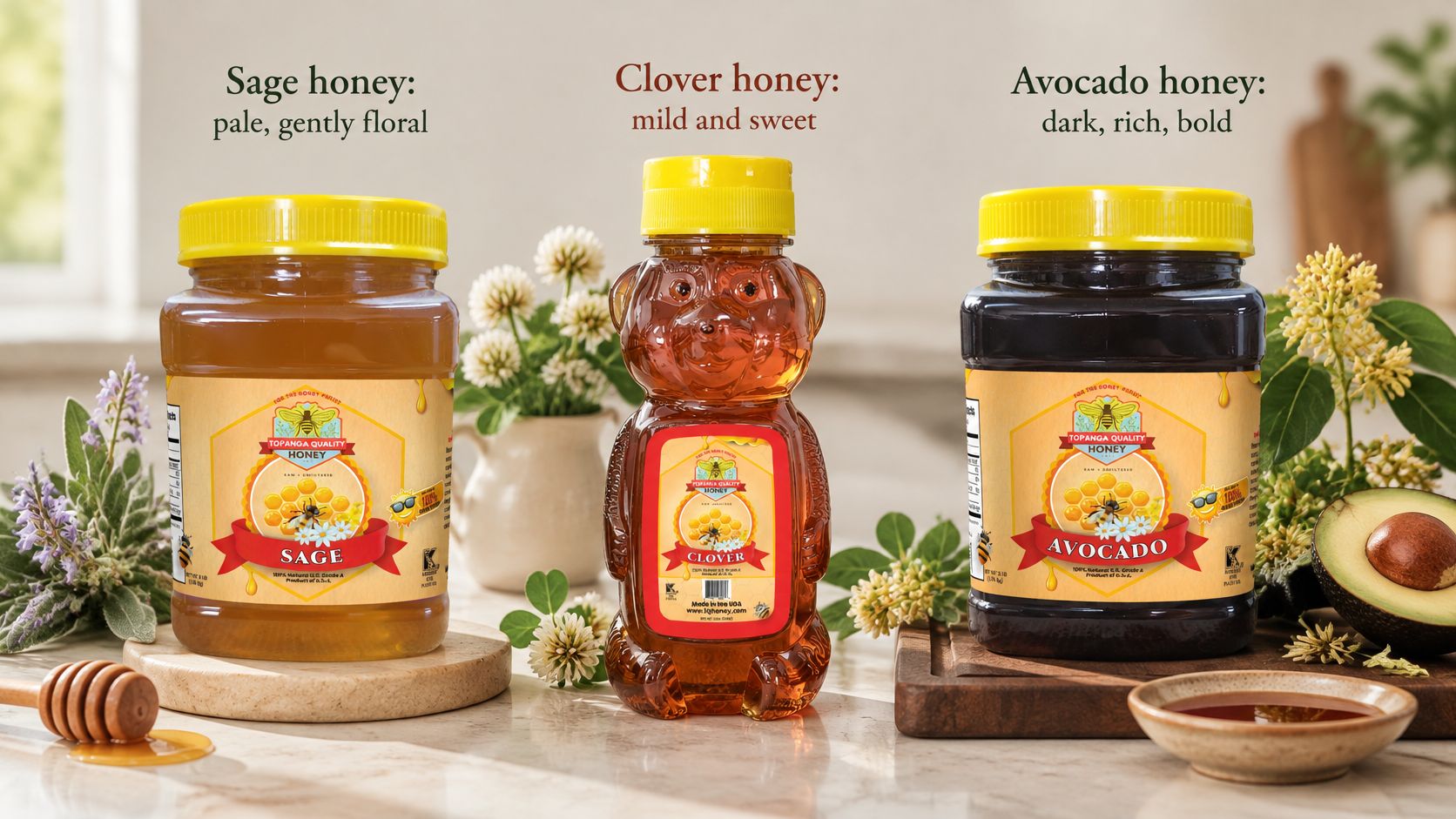
Sage is pale and gently floral. I'd start there for tea, yogurt or a light drizzle when you want honey without a heavy flavor.
Orange blossom and clover are mild, flexible kitchen choices. They're sensible options when honey is an ingredient in a dressing or bake and you don't want its character to dominate.
Avocado is dark amber, with molasses and caramel notes. It doesn't taste like avocado fruit. Use it where a deeper honey flavor belongs, such as a glaze or a strongly flavored bake.
Buckwheat is dark, malty and less sweet-tasting. It works better alongside bold ingredients than in a delicate drink where you want the tea itself to lead.
Cactus identifies honey from the cardón cactus. Choose it to explore a distinct floral origin, not because an unfamiliar name alone proves better value.
Our honey varieties guide helps match those differences to your cooking. This video offers another way to explore the range.
A floral name is a claim
Under FDA honey-labeling guidance, pure honey is a single-ingredient food, and identifying a floral source is optional. A named plant or blossom needs supporting information that it is the chief floral source.
That makes a variety name meaningful, but it doesn't make it a universal quality grade. It tells you what floral character the product claims.
- Single-variety honeys: Nothing added.
- Pomegranate honey sticks: Honey blended with pomegranate.
- Super Honey: Honey blended with bee pollen, propolis and royal jelly.
Choose the variety for the dish first. Expect a limited harvest opportunity to affect cost, but don't pay for a strong flavor if you'd rather have a mild one.
Where the Honey Comes From and What Certification Adds
A packing location is not necessarily the honey's origin. Topanga Quality Honey packs its honey in California, but the product listing is the place to check where a particular variety comes from.
| Variety | Origin |
|---|---|
| Blackberry | Oregon |
| Brazilian wildflower | Brazil |
| Sage, orange blossom, avocado and California wildflower | See the product listing for origin |
| Clover, buckwheat and blueberry blossom | See the product listing for origin |
| Cactus | See the product listing for origin |
| Eucalyptus | See the product listing for origin |
Origin can affect transport and handling costs. A California packing address alone does not tell you how far the honey travelled before it was packed.
What certification adds to the work
Organic certification adds production and handling requirements, including review and inspection for operations that need certification. Those requirements can add work and cost. For a plain-language comparison of organic honey and regular honey, read our guide to organic honey versus regular honey. Pep Tea's guide to organic certification explains certification in another agricultural context.
Read labels separately: Origin identifies where the honey comes from. Processing and certification describe different parts of its production.
Every honey Topanga Quality Honey sells is raw, unfiltered, organic and kosher. Raw honey is never pasteurized; unfiltered honey is not ultra-filtered. These terms describe processing, not geographic origin.
Compare the full product description: floral source, listed origin, processing and certification. A country name by itself does not establish authenticity or explain the full price.
How to Check Quality Before You Pay More
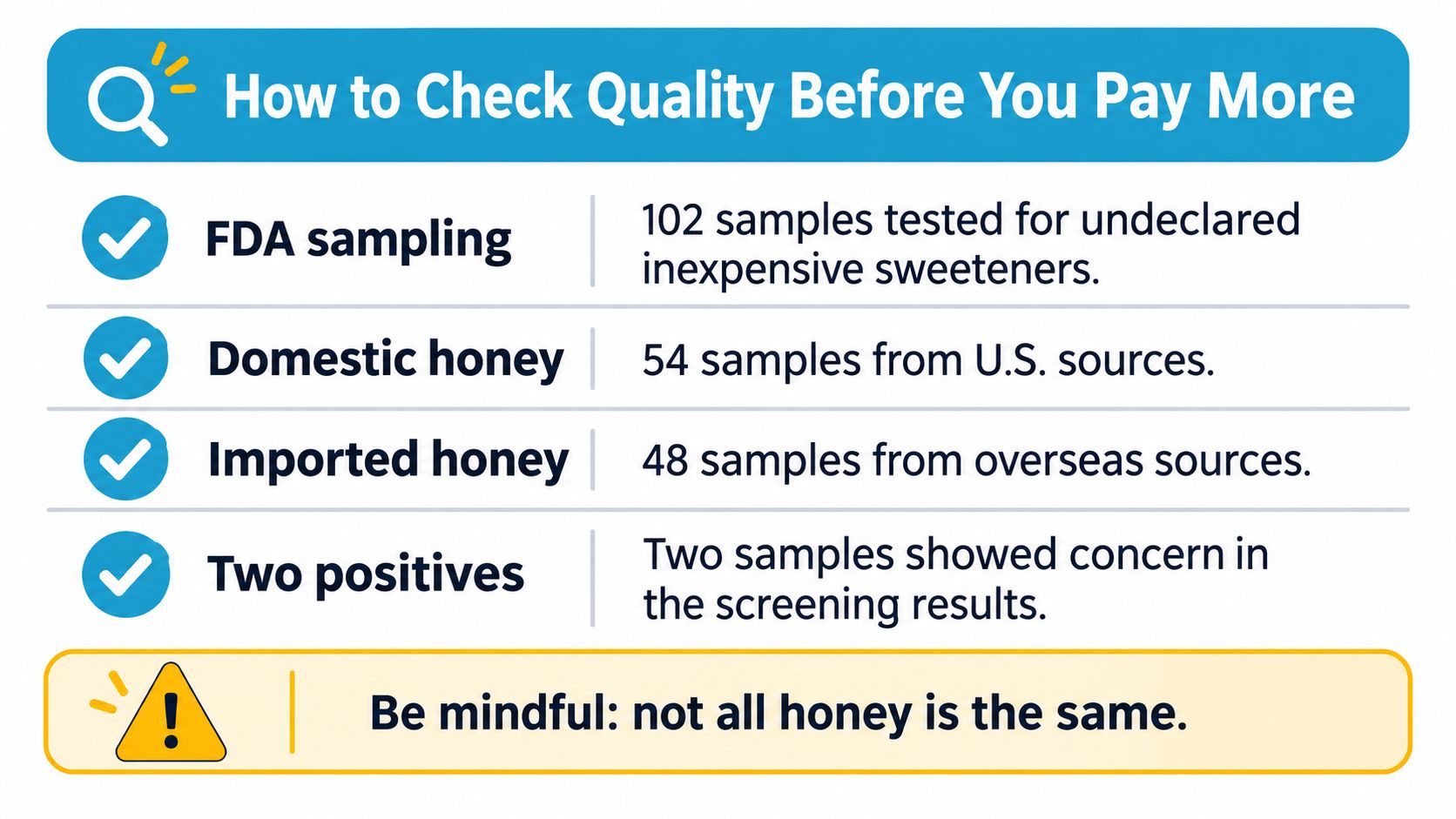
The FDA's fiscal-year 2025 sampling tested 102 honey samples, comprising 54 domestic and 48 imported samples; two in each group violated its criteria for undeclared inexpensive sweeteners, approximately 4% in each category, as described in Mordor Intelligence's organic honey market overview.
That sampling result doesn't establish a violation rate for every jar on the market. It does challenge the shortcut of assuming imported honey is automatically less trustworthy, or that an expensive label guarantees authenticity.
Use the sampling figures as context, not as a certification for an individual product.
Ask what each piece of evidence establishes
Regulatory sampling examines selected products against particular criteria. Organic certification addresses production and handling standards. Traceability connects a package to records, while authenticity testing addresses the substances or characteristics a particular test can detect.
Those tools aren't substitutes for one another. An organic claim isn't a universal guarantee against added syrup, and a raw claim describes processing rather than proving floral origin.
Before paying a premium, use this checklist:
- Origin: Is the country or region identified separately from the packing location?
- Floral source: Is the variety named, with information supporting that description?
- Certification: Is the relevant certification explained rather than replaced by vague language?
- Traceability: Can the package be connected to a lot or batch record?
- Testing: If testing is claimed, what was tested and what did the result establish?
We identify our varieties' origins and state our processing and product distinctions. For questions about a particular package, contact us rather than assuming a general label answers every batch-specific question.
Don't mistake texture for failure
Raw honey may crystallize naturally and is still good. Crystals alone aren't evidence that honey has gone bad or that someone added sugar.
To re-liquefy it, set the jar in warm, not boiling, water. Our guide to checking whether honey is real gives more context for evaluating a purchase.
Pay for information you can use. Words such as natural and premium don't replace an origin statement, a clear ingredient description or documentation.
Choose the Honey and Size That Fits Your Budget
A useful honey purchase fits your taste, budget and routine. Compare the cost per pound, but also consider how you'll dispense and use it.
Make the decision in three steps
-
Choose the honey for its use.
Sage or orange blossom suits tea and light drizzling. Buckwheat or avocado brings a stronger flavor to baking, glazes and coffee. If you're new to raw honey, sage is a mild starting option. -
Choose the package for where you'll use it.
Compare 1 lb and 3 lb jars by their per-pound price. A 12 oz squeeze bear is convenient for pouring, while honey sticks suit single servings away from the kitchen. Choose honeycomb for the chewable beeswax comb, not as another format for extracted honey. -
Compare the total you'll pay.
Use the package weight and final price after any eligible discount and delivery charge. Buy extra only if you expect to use it.
Buy for your actual pace
A larger jar can suit regular use in drinks, dressings or baking. For an unfamiliar floral variety, a smaller package limits how much you commit before you know whether you like its flavor.
For gifts, selectable sets let you offer different flavor profiles rather than guessing that everyone prefers the same honey. Consider the recipient's kitchen: easy-pouring packages, a range of varieties and edible comb each serve a different purpose.
Topanga Quality Honey offers raw, unfiltered, organic and kosher honey in jars, squeeze bears, sticks and honeycomb. Visit Topanga Quality Honey and start with Raw Sage Honey for a mild everyday option. Choose a package that suits your budget and how quickly you'll use it.
Do not feed honey to infants under 12 months old.