

Organic Honey vs Regular Honey: A Shopper Guide
Organic honey and regular honey mainly differ in certification and sourcing, not in their sugar makeup, and organic isn't a reliable guarantee of better taste. The organic label describes a production and land-management system, while floral source and handling do more to shape what you taste.
Two jars on a shelf can look alike and taste alike, even if only one carries an organic certification. That's because both are honey made by bees from floral nectar; the distinction isn't a special sugar recipe. In the United States, organic honey must meet rules for apiary management and handling, while conventional honey isn't required to follow that organic system.
The words raw, unfiltered, and natural describe different things. They aren't substitutes for organic certification. And because bees cross property lines as they forage, organic management can't create a sealed bubble around a hive. A useful way to compare jars is to check the rulebook, residue findings, label details, and flower named on the jar. For background on how honey is made and handled in the United States, see our guide to honey production.
Table of Contents
- What Organic Honey and Regular Honey Mean
- Organic vs Regular Honey at a Glance
- Pesticide Residues Found in Real Samples
- Labels That Do Not Prove Organic Honey
- Kitchen Jobs for Light and Dark Honeys
- Choose a Jar You Can Trace
What Organic Honey and Regular Honey Mean
USDA organic certification covers more than the honey in the jar. It sets rules for apiary management, including permitted colony treatments, prohibited substances, and acceptable forage conditions.
Those requirements govern how beekeepers manage their colonies and handle honey. For more background, read our guide to honey production in the United States.
Organic, raw, and unfiltered describe different things. Organic refers to a certified production system. Raw describes honey that has not been pasteurized, while unfiltered describes honey strained to remove wax without ultra-filtration. A flower name, in turn, points to the nectar source that shapes a honey's color, aroma, and flavor.
Words such as natural, raw, and unfiltered do not establish organic certification or identify the flowers behind a honey. Check the certification and handling terms on the label, then consider the named floral source.
Organic vs Regular Honey at a Glance
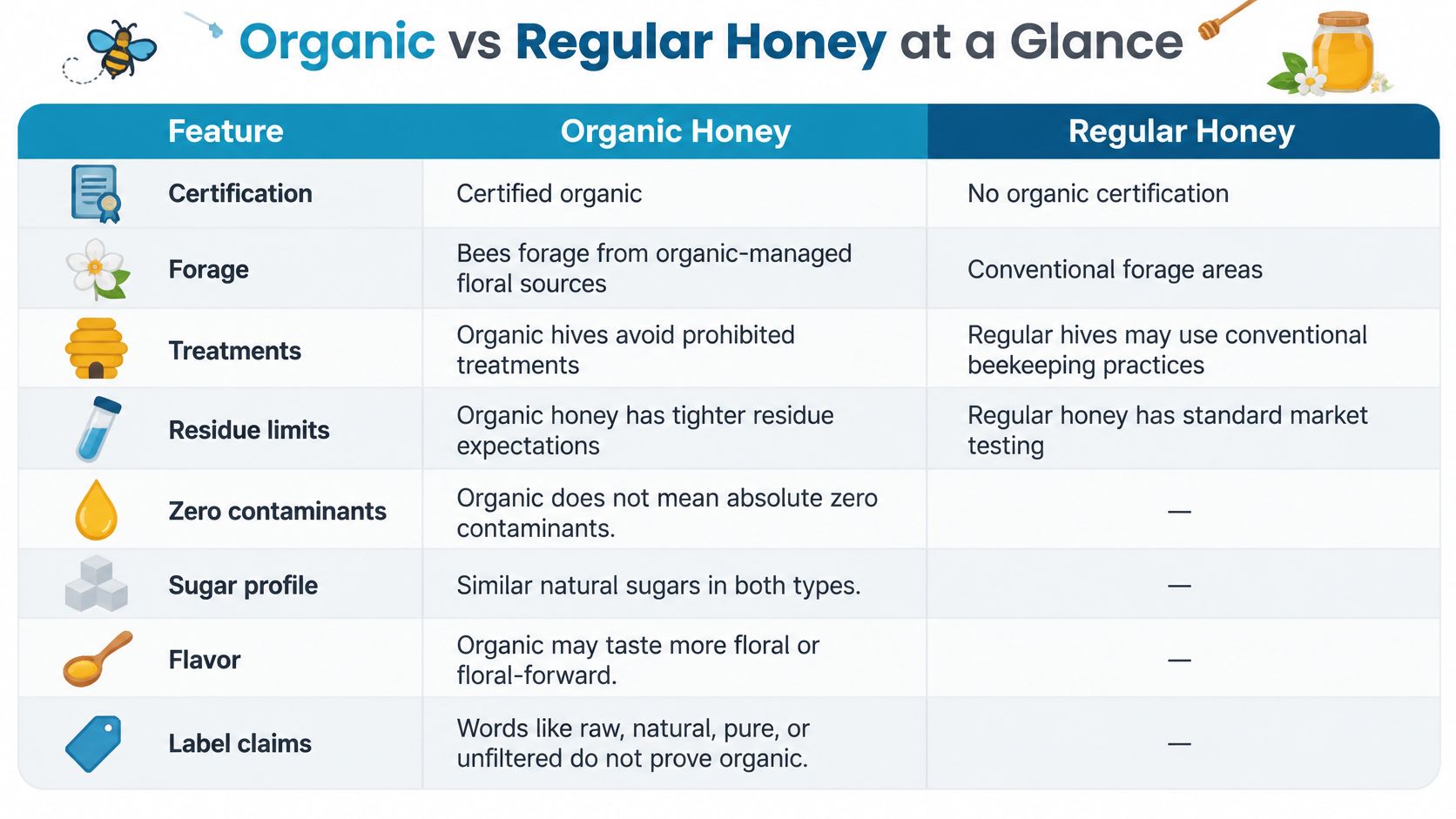
Organic certification describes how honey is produced and handled. It does not set a flavor profile. The comparison below focuses on the production rules and residue limits that distinguish the two categories.
| Criterion | Organic honey | Regular honey |
|---|---|---|
| Certification | Produced and handled under organic rules | Organic certification is not required |
| Forage area | Forage conditions must meet organic requirements | No corresponding organic forage requirement |
| Colony treatments | Only organically permitted treatments | Other treatments may be used if they meet general rules |
| Residue limits | Organic standards set limits for certain substances | General food-safety and pesticide rules apply |
What certification and forage cover
Organic honey is produced and handled under an organic system. Beekeepers must use permitted colony treatments, avoid prohibited substances, and meet forage requirements. The Penn State explanation of USDA organic honey standards describes a surrounding area of up to approximately 3 miles of certified-organic or otherwise acceptable land.
Bees cross property lines as they forage, so meeting those conditions can be demanding where farms, orchards, and developed areas sit close together. Regular honey has no corresponding organic forage requirement, though general food-safety and pesticide rules still apply.
How treatments and residue caps work
Organic rules restrict colony treatments and set limits for certain residues. The Agricultural Marketing Service standard sets maximum levels of 150 parts per billion for coumaphos, 200 parts per billion for amitraz, and 20 parts per billion for tau-fluvalinate, alongside restrictions on antibiotic residues. These are compliance limits, not a guarantee that every sample will have no detectable contaminants.
Regular honey is not subject to the organic production system. That difference describes the rules beekeepers follow; it does not, by itself, sort jars into “clean” and “unclean.”
Why flower and handling still matter
Organic certification does not create a universal difference in sugar composition or guarantee a flavor advantage. A 2024 study comparing organic and conventional honey matched by botanical origin found that organic samples were not consistently superior in nutritional, physicochemical, antioxidant, or sensory measures. It reported some compositional differences, but they did not establish a broad quality advantage.
Floral source helps explain why a light, gently floral honey tastes different from a dark, malty one. Freshness and handling shape the experience, too. Choose organic when the production system matters to you; choose by floral source and handling when you're deciding what flavor and texture you prefer.
When reading residue figures on a label, check which substance was measured and compare its reported level with the applicable limit.
Pesticide Residues Found in Real Samples
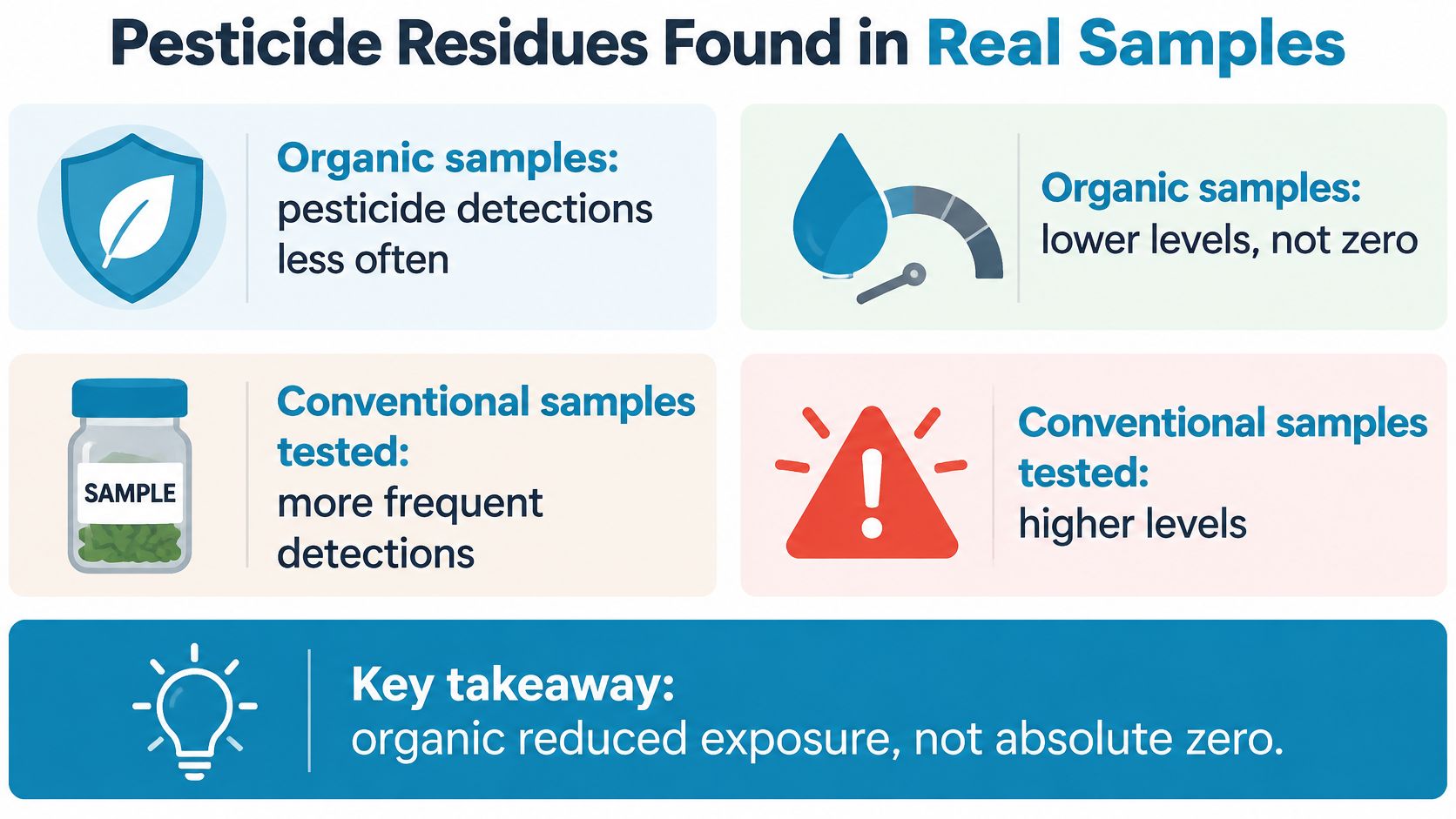
Organic honey can have detectable pesticide residues. In the studies below, organic samples generally had fewer detections or lower reported levels than conventional samples, though results varied.
A Croatian investigation tested 61 honeys collected in 2018–2019: 16 from registered organic beekeepers and 45 from conventional beekeepers. Synthetic acaricides appeared in 2 of 16 organic samples, or 12.5%, and 34 of 45 conventional samples, or about 75.6%. Coumaphos was the most frequent compound. The study reported lower average concentrations of coumaphos, amitraz, and the amitraz metabolite N-(2,4-dimethylphenyl) formamide in organic honey. All samples were below applicable legal maximum levels and were considered safe for consumers, according to the Croatian honey residue study.
| Study | Organic result | Conventional result | Safety note in the paper |
|---|---|---|---|
| Croatia 2018–2019, 61 honeys | Acaricides in 2 of 16 samples (12.5%) | Acaricides in 34 of 45 samples (about 75.6%) | All samples under applicable legal maximums |
| 2024 QuEChERS analysis, 200 samples | No investigated pesticide residues detected | Boscalid 0.01 µg/kg; coumaphos 0.012–0.016 µg/kg | Reported as detected amounts, not a health claim |
| Northeast organically managed colonies, 96 residues screened | 98.2% met organic contamination limits | Higher than the organically managed set, per the study | One organically managed sample exceeded the applicable maximum |
A 2024 analysis of 200 conventional and organic honey samples used the QuEChERS laboratory method. It found no investigated pesticide residues in the organic group. In conventional honey, it detected boscalid at 0.01 micrograms per kilogram and coumaphos ranging from 0.012 to 0.016 micrograms per kilogram.
The northeastern United States study screened honey from organically managed colonies for 96 pesticide residues. 98.2% of those samples met the applicable organic contamination limits. The study described contamination as low and comparable to certified organic honey, while one sample exceeded the applicable maximum.
Foragers may travel several miles from a hive to find flowers, so the plants and land around an apiary can affect what they encounter. Certification can set production rules and reduce some risks, but it cannot guarantee that a lab will find no residues.
Taken together, these studies show that organic production can be associated with fewer or lower residue detections, without guaranteeing zero exposure. They also do not establish that conventional honey is automatically unsafe. Each result applies to the samples and methods tested.
Labels That Do Not Prove Organic Honey
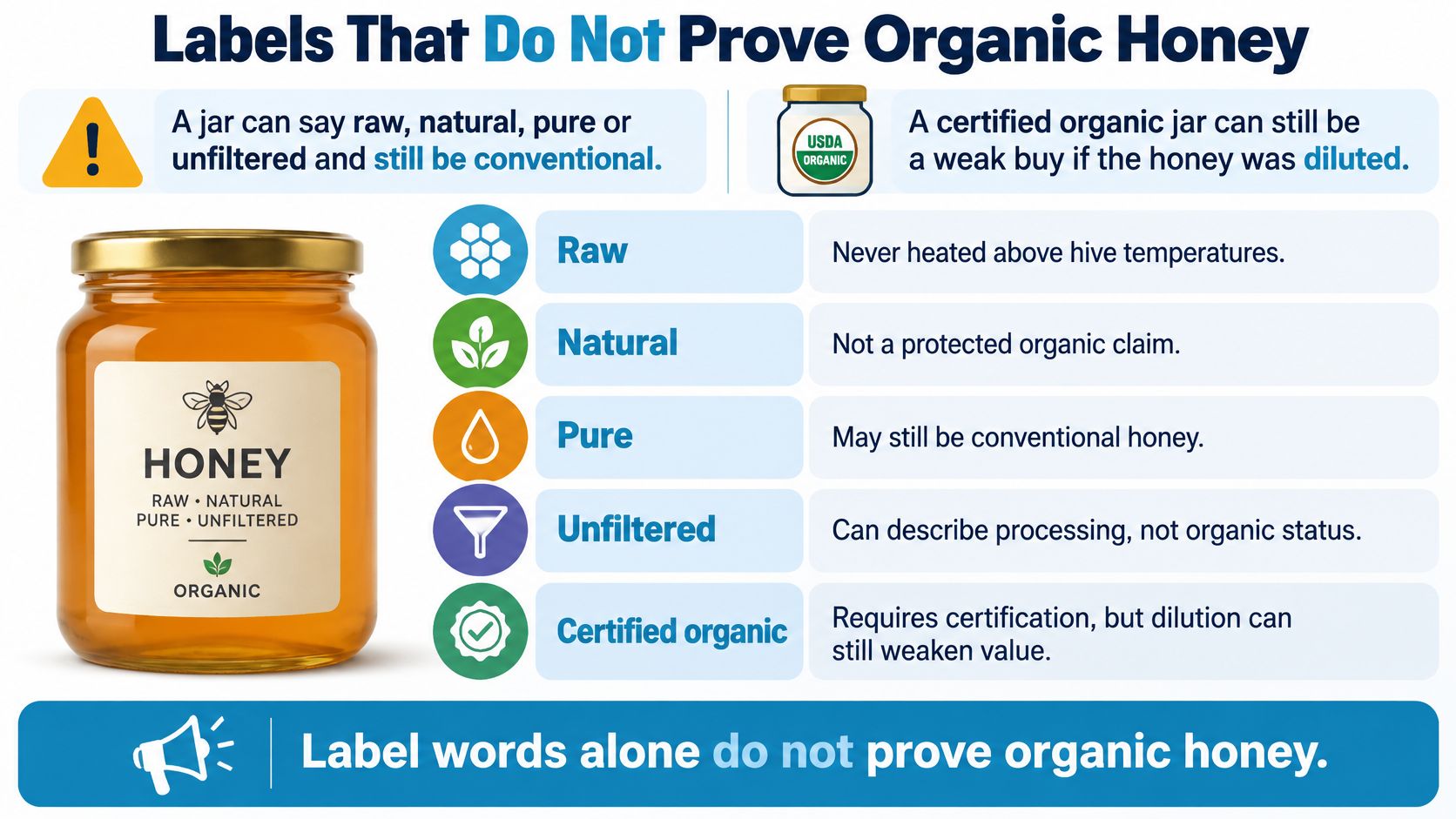
“Raw,” “natural,” “pure,” and “unfiltered” describe qualities other than organic certification. A jar can carry those words and still be conventional. A certified jar can still be diluted, so organic status alone does not establish purity.
Topanga Quality Honey describes every honey it sells as raw, unfiltered, organic, and kosher. Raw honey is never pasteurized, which preserves the natural character of its floral source. Unfiltered honey is strained to remove wax, but not ultra-filtered. These handling terms describe different things from organic production.
The company's single-variety honeys contain no sugar, syrups, or preservatives. Its Super Honey is a blend of raw honey, bee pollen, propolis, and royal jelly. A blend's ingredients are separate from the question of whether its honey is organic.
Look for more than a label word
Honey can be diluted with sweeteners, blended, mislabeled, or affected by undisclosed bee-feeding. An independent 2025 honey report discusses honey adulteration and developing infrared and machine-learning methods for detecting added glucose syrup, rice syrup, and high-fructose corn syrup. These methods are still developing, and their performance varies by model and test set.
For a practical checklist, consider the named floral or geographic origin, documented handling, credible certification where applicable, and testing that can detect added syrups. Floral source can help set expectations for aroma and flavor, while testing addresses a different question: whether the honey has been adulterated.
- Who packed it? Look for an identifiable producer.
- What flower or origin is named? A specific source gives you a better idea of flavor.
- Is organic stated as certification, or only implied by words like raw? The claims are not interchangeable.
For more practical checks, read our guide to checking whether honey is real. Certification describes production standards; it does not, by itself, prove that a jar has not been diluted.
Kitchen Jobs for Light and Dark Honeys
Choose honey by the flavor you want in the finished dish. Mild varieties sweeten without taking over, while darker honeys bring stronger flavors to bread, baked goods, and glazes.
| Kitchen job | Honey and origin | Why it fits |
|---|---|---|
| Tea, yogurt, fruit | Sage, California | Pale gold, gently floral, with a soft herbal finish |
| Dressings and citrus drinks | Orange blossom, California | Fresh, sweet citrus aroma |
| Plain sweetening | Clover, USA | Mild flavor when honey shouldn't dominate |
| Coffee, baking, cheese | Avocado, California | Buttery, molasses, and caramel notes |
| Gingerbread, rye bread, glazes | Buckwheat, USA | Very dark, malty, and less sweet than lighter honeys |
| Jar-only choices | Blackberry, Oregon; California wildflower; Brazilian wildflower | Different floral sources offer a range of colors and flavors |
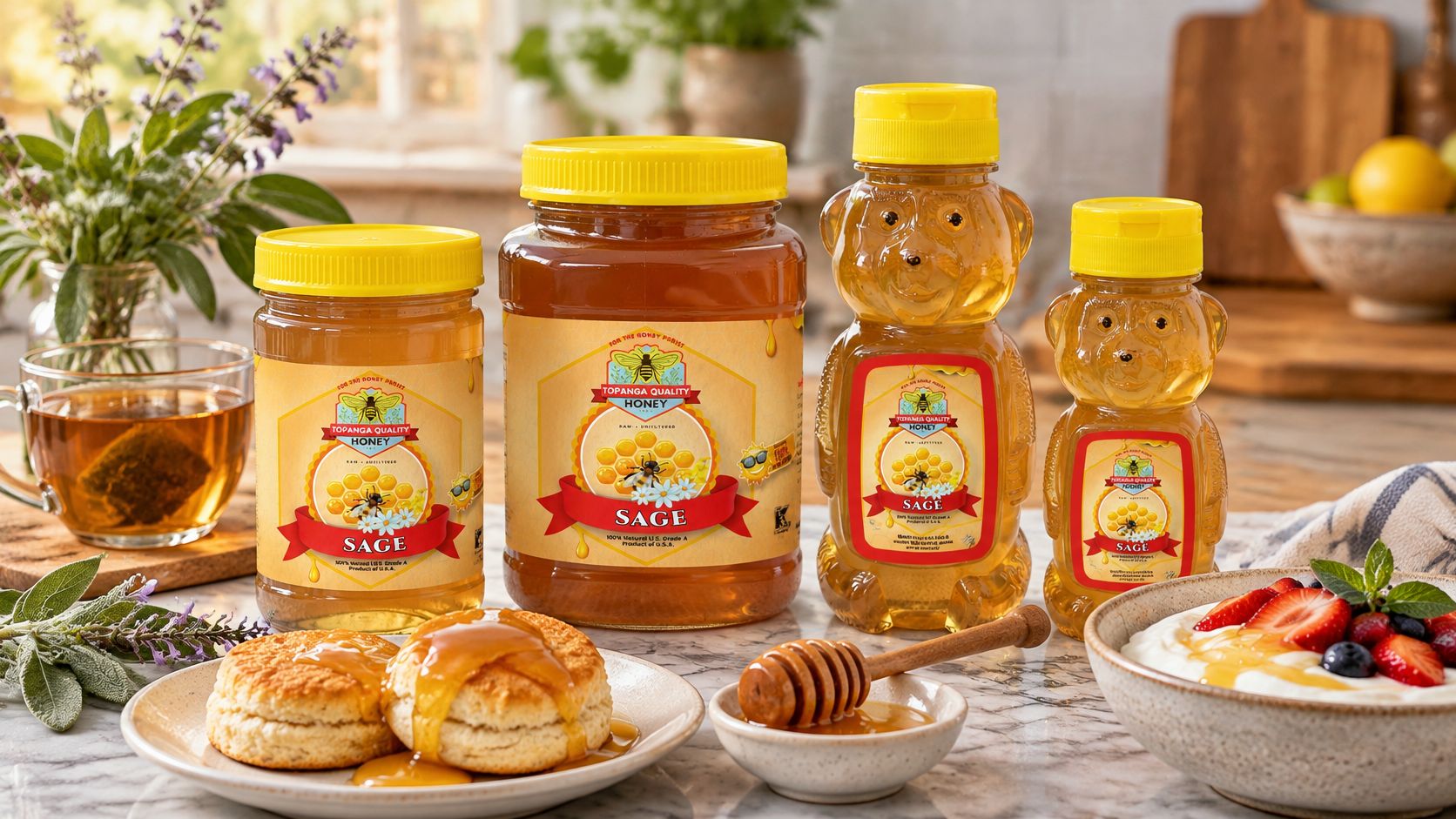
Sage honey pours pale gold, with a gentle floral taste and soft herbal finish. Its mild flavor suits tea, yogurt, and fruit. For another floral reference, read this guide to understanding honey from acacia blossoms.
Orange blossom honey comes from bees working citrus groves in full bloom. Its fresh, sweet citrus aroma works well in drinks and dressings. Clover is a light, mild choice when you want sweetness without a strong honey flavor. Avocado honey brings buttery, molasses, and caramel notes for coffee, baking, or cheese. Buckwheat is very dark, almost black in the jar, with a malty, molasses-like flavor that is less sweet than lighter honeys. Learn more about why buckwheat honey is so dark.
Honeycomb is another way to serve honey: the honey remains sealed in its beeswax comb, which is soft and chewable. Honey sticks offer a single serving sealed in a straw. Snip or bite an end, then squeeze the honey onto food or into a drink.
Raw honey may crystallize naturally. This change does not mean it has gone bad. To make crystallized honey pourable again, set the closed jar in warm, not boiling, water. For tasting, gift sets pair two or three honey varieties side by side, making it easy to compare lighter and darker flavors.
Choose a Jar You Can Trace
Organic certification describes how honey is produced and handled. It does not determine the honey's sweetness or flavor. For taste, look to the floral source: sage and clover are mild, while buckwheat and avocado have darker, stronger flavors.
For help checking what a label establishes, use the checklist in “Labels That Do Not Prove Organic Honey.” Topanga Quality Honey is a family-owned California beekeeping company that packs its honey in California.
Compare the varieties and formats to find a fit for your kitchen. The company offers honeys by floral source and origin, along with jars, honeycomb and honey sticks.
Topanga Quality Honey offers a collection of floral varieties and formats to explore. Choose based on the flavor you want and the production and handling details that matter to you.