

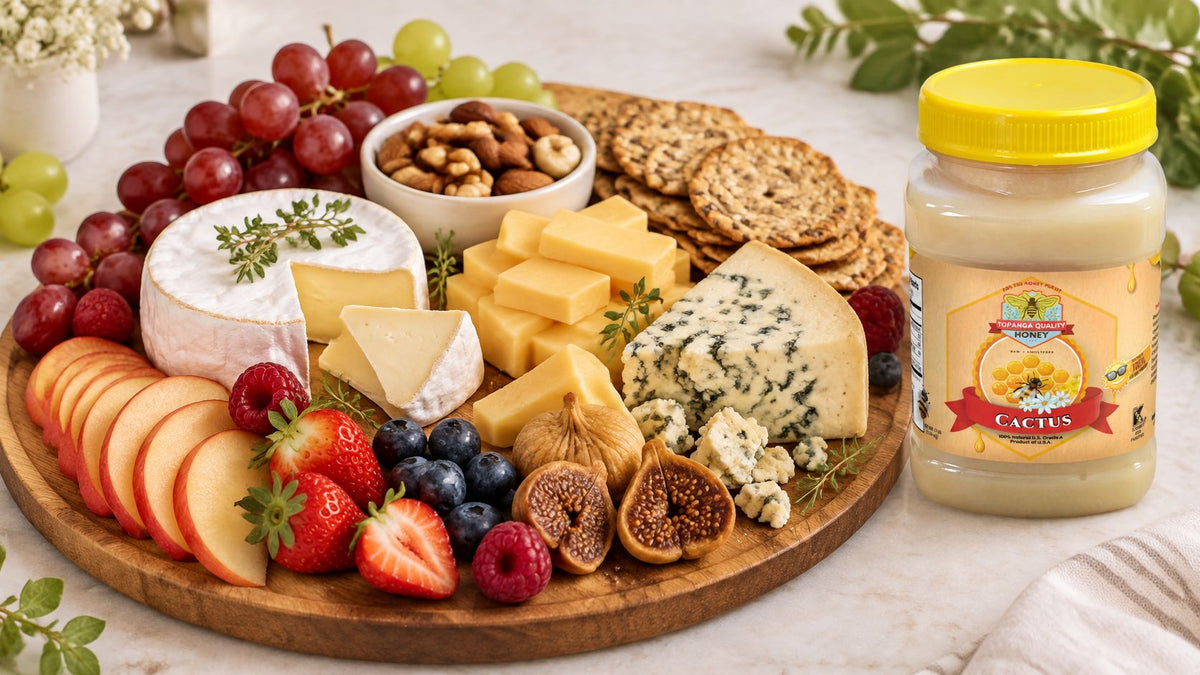
Fruit and Cheese Platter: Portions, Pairings and Safety
You're standing at the cheese counter, trying to decide whether another wedge will save the party or become next week's leftovers. The fruit and cheese platter needs to look generous, but you don't want it empty after the first round or half untouched when everyone leaves.
The fix isn't a bigger board. It's a shopping plan based on weight, pairings guests can understand, and a serving setup that lets you replace small sections while the rest stays refrigerated.
Table of Contents
- Portion Amounts for Any Guest Count
- Choose Cheeses with Different Textures and Strength
- Pair Each Cheese with the Right Fruit
- Keep Cold Foods Cold and Time the Service
- Assemble the Board in the Right Order
- Adjust the Board for Allergies, Pregnancy and Lighter Eating
- Build Your Board with Honey That Fits
Portion Amounts for Any Guest Count
Plan by weight, not by how full the platter looks. A broad wedge of Brie can occupy more space than a heavier block of cheddar, and grape stems can make a modest amount of fruit look abundant.
For a worked appetizer example, budget about 2 oz (57 g) of cheese and 3 oz of fresh fruit per guest. Treat that as a shopping scenario, not a dietary serving standard. A board before dinner needs a different allowance from a platter guests will treat as their meal.
Platter quantities by guest count
The example below uses those cheese and fresh-fruit allowances, with modest additions of dried fruit and nuts. Cracker sleeves are a shopping shorthand, so check the package size before buying.
| Guests and serving | Cheese | Fresh fruit | Dried fruit | Nuts | Crackers |
|---|---|---|---|---|---|
| 6 guests, appetizer | 12 oz | 18 oz | 3 oz | 3 oz | 1 sleeve |
| 12 guests, appetizer | 24 oz | 36 oz | 6 oz | 6 oz | 2 sleeves |
| 20 guests, appetizer | 40 oz | 60 oz | 10 oz | 10 oz | 3 sleeves |
Each row follows the same hypothetical calculation: guest count multiplied by the component allowance. Keep crackers in reserve rather than squeezing every sleeve onto the board.
For a dessert-style platter, shift the emphasis toward fruit and reduce the cheese. If dinner is substantial, guests usually need a tasting, not another full course.
USDA FoodData Central provides food-specific nutrient values and portion information, which matters because cheese, fresh fruit and dried fruit aren't nutritionally interchangeable. If you're calculating nutrients, record each ingredient and its weight separately rather than assigning a generic value to the whole platter.
Shopping check: Add the weights on the cheese labels, then divide by your guest count. The shape of the wedges shouldn't determine how much you buy.
Give guests contrasting cheeses rather than many near-duplicates. Leave room in the budget for ripe fruit, which does more for the platter than another cheese that tastes like everything already in your basket.
Choose Cheeses with Different Textures and Strength
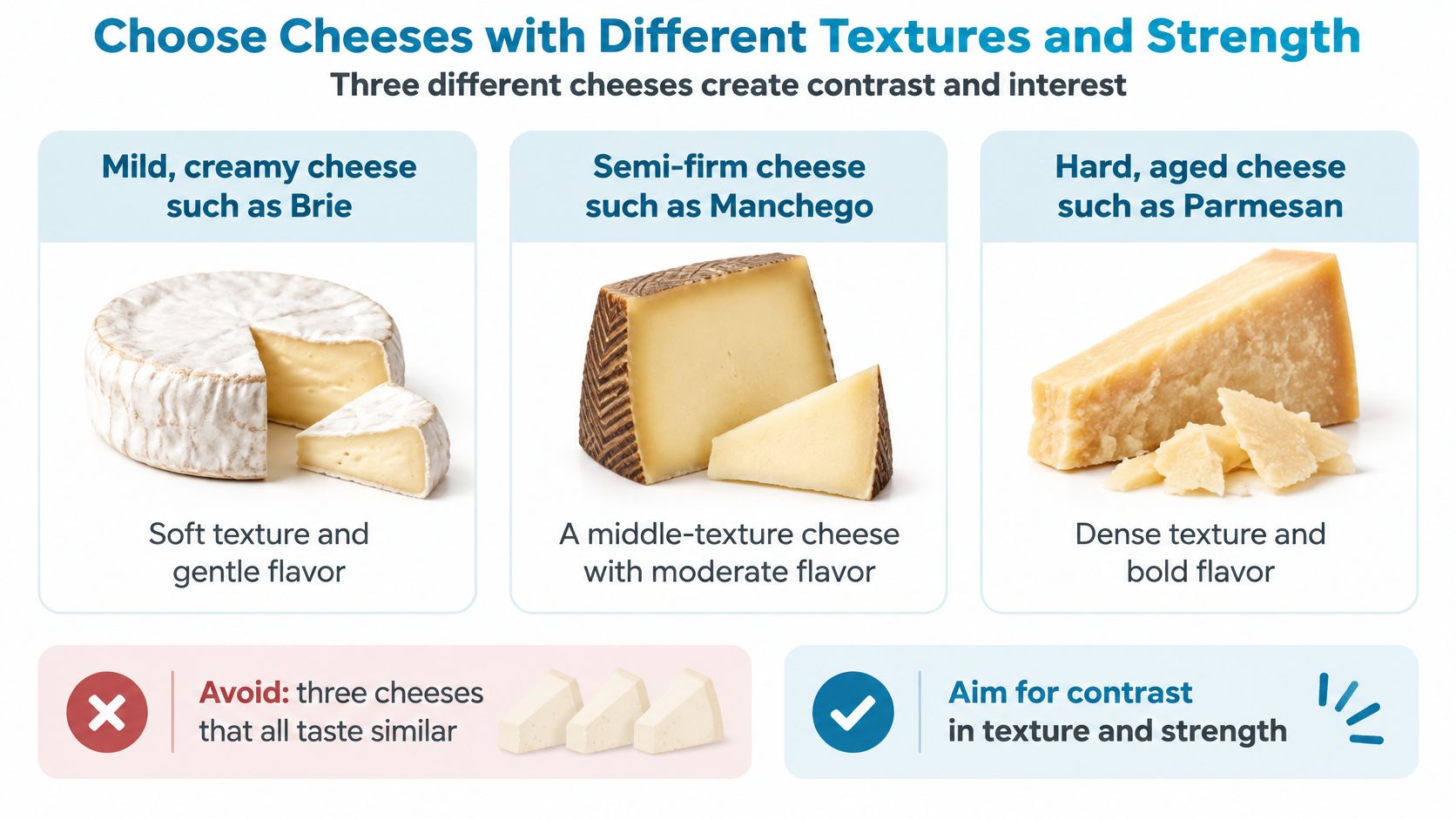
A platter of similar cheeses offers choice without much contrast. Brie, a soft young cheese and another gentle creamy cheese may all be pleasant, but guests keep getting a similar bite.
I'd start with a mild cheese, a firm cheese and a stronger cheese. For an example gathering of up to a dozen guests, that's enough variety to make the board interesting without scattering the cheese allowance across tiny pieces. Add another style for a larger event only when it contributes something distinct.
This visual shows how differences in texture and strength make the selection easier to understand.
Taste from gentle to assertive
| Cheese group | What it contributes | How to serve it |
|---|---|---|
| Mild and creamy | Brie offers richness; fresh goat cheese adds a brighter tang | Leave a recognizable piece with its own spreading knife |
| Firm or aged | Cheddar, Gouda or Manchego adds chew, structure and savory depth | Cut thin slices or manageable wedges |
| Pungent or strongly tangy | Gorgonzola, Stilton or another blue gives guests the boldest bite | Offer small pieces with a separate knife |
Texture doesn't tell you everything about intensity. Fresh goat cheese can be soft but distinctly tangy. An aged Gouda can be firm and quite assertive, so don't assume every Gouda belongs in the middle of the tasting order.
Soft cheese is easier to appreciate when it isn't refrigerator-hard, but that isn't permission to leave it warming throughout the party. Put out a modest serving portion and keep the remainder chilled.
Ask to taste before buying when sampling is available. Try the cheeses alone first, then consider their companions. If every selection is sharp, salty or smoky, replace one with something gentler rather than expecting fruit and honey to fix an overpowering lineup.
Pair Each Cheese with the Right Fruit
Fruit's sweetness and acidity balance cheese's salt and richness, while its texture changes the bite. The Know the Cheese fruit-pairing guide describes fruit as a partner that refreshes the palate, not just decoration.
Start with matches guests can recognize, then adjust for the actual cheese you bought. A young cheddar and a very mature cheddar may need different amounts of sweetness.
Cheese and fruit pairings that work
| Cheese | Best Fruit Partner | Why It Works |
|---|---|---|
| Brie or fresh goat cheese | Strawberries, raspberries or blackberries | Berry acidity cuts through the cheese's richness |
| Gouda | Grapes | Mild sweetness suits a mellow, nutty cheese |
| Cheddar | Crisp, tart apples | Tartness refreshes the palate after the fat |
| Manchego | Quince paste | Fruit paste stands up to a firm, savory cheese |
| Gorgonzola or Stilton | Ripe pears | Sweetness softens blue cheese sharpness |
| Aged, salty or assertive cheeses | Dried figs, dates or apricots | Concentrated sweetness balances salt |
The useful rule is match intensity, then adjust the contrast. Cheese Help's fruit-pairing guide recommends delicate fresh fruit with mild cheeses and concentrated dried fruit with stronger cheeses, with a fresh fruit and a dried fruit as a practical starting selection.
That doesn't mean every cheese needs its own fruit. Choose a seasonal fresh option that works across the board, then select the dried fruit for the strongest cheese.
If the cheese tastes sharp or salty, try sweeter fruit. If it tastes mild and creamy, try a tarter partner.
Quince paste is particularly useful when you want a tidy, sliceable accompaniment. For an example of that format, Saporia's organic quince selection shows the kind of fruit-for-cheese product to consider alongside Manchego.
Taste the fruit before arranging it. Underripe pears won't give blue cheese the sweet contrast you intended; use drained poached pear or dried pear slices instead.
Apply that same tasting habit to honey. Our guide on how to taste honey helps you compare flavors before deciding which cheese needs a small spoonful and which is better left alone.
Keep Cold Foods Cold and Time the Service
A fruit and cheese platter that has sat out too long is done, even if it still looks fresh. Cut fruit, soft cheese and opened ramekins all count as perishable, so plan the serve as timed portions: one platter on the table, reserves held cold, and a fresh swap ready.
Use this workflow rather than a vague instruction to serve everything at room temperature.
- Chill before assembly. Keep cheese and cut fruit refrigerated while you portion them. Hold reserve servings in a covered container in the coldest part of the fridge.
- Prepare cleanly. Wash and dry whole fruit before cutting. Clean and sanitize the preparation surface, use clean utensils, and portion cheeses with separate knives.
- Keep the assembled platter cold. Refrigerate it until service. For a longer gathering, set it on a tray over ice, keeping meltwater away from the food.
- Track unrefrigerated time. Under USDA safe-handling guidance, the danger zone runs from 40–140°F (4.4–60°C), bacteria can double in as little as 20 minutes, and perishable components should be discarded after 2 hours at room temperature or 1 hour above 90°F (32.2°C).
- Replace rather than top up. Bring out a fresh refrigerated platter instead of adding new cheese and fruit to food that has already been sitting out. Keep returned pieces out of the reserve container.
- Check temperature properly. Use a calibrated food thermometer, following its instructions for checking food. A cool-feeling board does not prove that every piece is still cold.
Write down when the platter leaves refrigeration and set a reminder for its discard deadline. In hot conditions, use the shorter deadline.
Assign one person to watch the clock and handle swaps. The plan fails when everyone assumes someone else is timing it.
Assemble the Board in the Right Order
Build a fruit and cheese platter so guests can reach each ingredient without dragging it through another. Separate zones protect crisp crackers, keep strong flavors contained and make small sections easier to refresh.
Keep each zone compact. A modest cluster of grapes or a small pile of crackers that empties can be swapped for a fresh portion from the refrigerator, while a large spread leaves you rearranging food that has been sitting out.
The visual below offers a broader grazing-board layout. Cured meat is optional and isn't necessary for this fruit-focused platter.
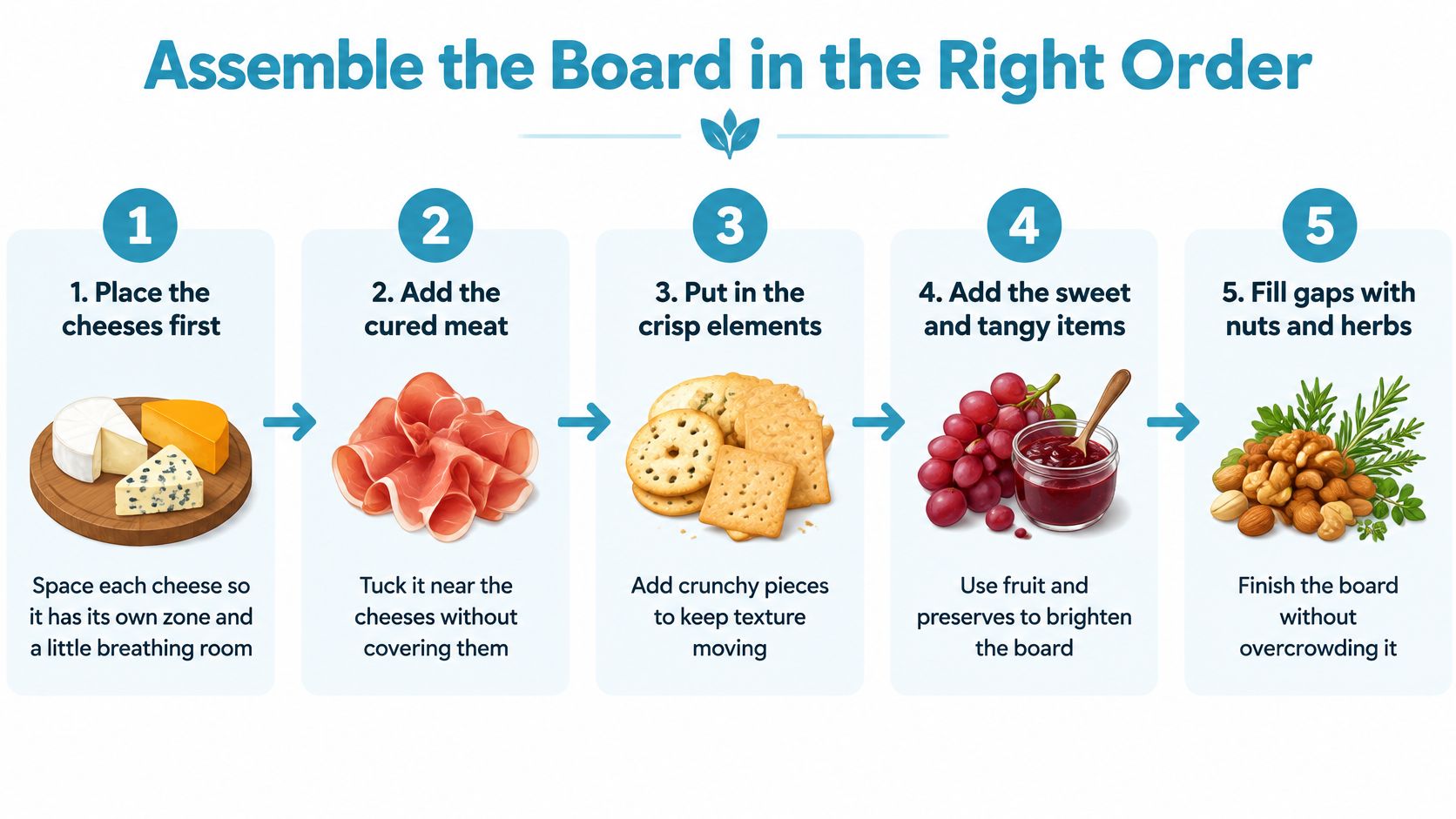
Build separate serving zones
- Place the cheeses first. Give each a visible edge and enough room for its knife. Don't bury a wedge beneath grapes just to fill space.
- Add fruit in recognizable groups, alternating colors and textures. Keep juicy berries and washed grapes away from crackers.
- Prepare apples and pears close to service. Briefly dip oxidation-prone slices in water acidulated with lemon juice, then drain and pat them dry. Wet slices can soften crackers and leave puddles around cheese.
- Fill suitable gaps with unsalted nuts and whole-grain crackers. Put extra crackers in a separate dish when the board is crowded.
- Add honey last. Use a small ramekin or drizzle it onto an individual serving, not the whole platter. Guests should be able to choose whether they want sweetness.
- Give strong cheeses separate knives and honey its own spoon or spreader. Keep utensil handles accessible rather than resting them across food.
Clean preparation and careful handling belong alongside presentation; the USDA Kitchen Companion is a useful food-handling reference for the work behind the finished board.
Choose the sweet accompaniment deliberately
For mild cheeses, consider sage honey or orange blossom honey. Raw Cactus Honey has a mild sweetness that suits soft cheeses and fresh fruit.
For sharp aged cheese, try buckwheat honey, a dark honey that stands up well on a cheese board. If you prefer a cuttable accompaniment, our honeycomb guide explains honey served in its beeswax cells, ready to slice and set beside the cheese.
Watch how the video places cheeses before fruit, then copy that order on your own board.
For a larger table, MODERN LYFE's creative buffet presentation ideas can help you think about access and separate serving areas. Finish by looking from every side: guests should see the choices and reach them without disturbing the whole arrangement.
Adjust the Board for Allergies, Pregnancy and Lighter Eating
One guest can't have nuts, another is pregnant, and someone else is watching sodium. A single crowded board isn't automatically the most welcoming option. Separate components make meaningful adjustments possible.
Start by asking guests about dietary needs before shopping. Don't assume that removing an ingredient after assembly makes the remaining food suitable.
Choose cheese for the guests attending
Soft cheeses made from unpasteurized milk can be a source of Listeria, a concern highlighted in USDA food-safety guidance. Check labels and choose pasteurized soft cheeses for pregnant guests, older adults and people with weakened immune systems.
Pasteurization doesn't replace clean preparation or refrigeration. Keep packaging available so guests can check ingredients rather than relying on your memory.
Keep allergy-sensitive servings separate
- Prepare the separate portion first. Use clean equipment and a clean surface before handling the allergen-containing ingredients.
- Move nuts off the shared board. Use a clearly labeled bowl or a separate serving area with its own utensil.
- Prevent utensil swapping. Give nuts, cheese and honey separate serving tools, and keep the allergy-sensitive portion protected from shared hands and utensils.
Everti's tips for avoiding cross-contamination offer additional preparation habits to consider. For a severe allergy, confirm the guest's requirements directly rather than promising that a shared kitchen is allergen-free.
For lighter eating, give fresh whole fruit more space, compare cheese labels for lower-sodium choices, and offer unsalted nuts and whole-grain crackers. Put honey in a dip bowl so each guest controls the amount.
Repeated small helpings can be hard to judge. A modest platter with deliberate replenishment makes portions more visible than a sprawling board that invites continuous grazing.
Build Your Board with Honey That Fits
Two honeys are enough for one board: a mild variety for fresh fruit and soft cheese, and a bolder one for aged cheddar or blue cheese. Guests get a useful comparison, and the platter avoids becoming a crowded tasting station with a dozen open jars.
Topanga Quality Honey is a family-owned California beekeeping company, and its honey is packed in California. Every variety is raw, unfiltered, organic and kosher.
Finish with a practical serving format
For aged cheddar or blue cheese, Raw Avocado Honey brings a rich, buttery taste with molasses and caramel notes. Dark honeys such as avocado, buckwheat and eucalyptus also earn their keep in baking and marinades, so pick a flavor you will finish after the party rather than a jar that sits in the cupboard.
Honeycomb adds a different texture. Cut an 11 oz honeycomb square, which comes packed in its own box, into small serving pieces, or set a piece of 1 lb raw honeycomb beside the cheese. Put out only what the board needs and keep the rest aside until the platter runs low, so each fresh piece reaches guests in good condition.
For spooning, fill a small dip bowl from a 1 lb or 3 lb jar. When it empties, swap in a clean bowl instead of drizzling fresh honey over the dregs. A 12 oz squeeze honey bear, where offered for the variety, lets guests portion their own drizzle without a shared spoon. Compare flavors with the honey varieties guide before choosing.
Raw honey crystallizes naturally over time and is still good. To re-liquefy it, stand the jar in warm water kept below boiling.
Choose honey and honeycomb in one mild flavor and one bolder option, so guests can portion the sweetness themselves. Do not feed honey to infants under 12 months old.