

How to Make Whipped Honey Butter: Ratios and Steps
You've got warm biscuits coming out of the oven, a stick of butter that's either rock hard or halfway to melted, and a jar of honey that's turned thick and cloudy in the pantry. That's the usual starting point for this spread, and it's a fine one. Whipped honey butter isn't complicated, but it is sensitive to temperature. Get the butter soft without melting it, add the honey slowly, and you get a pale, fluffy spread in minutes. Rush either part and you'll get something greasy, dense, or gritty. Learning how to make whipped honey butter well is mostly about managing that trade off between smoothness, heat, and flavor.
Table of Contents
- Whipped Honey Butter Ratios at a Glance
- Choosing a Honey That Suits the Spread
- How to Whip Honey Butter Step by Step
- Fixing Grainy, Greasy or Dense Batches
- Serving Ideas, Portions and Storage
- Pick Your Honey and Whip the First Batch
Whipped Honey Butter Ratios at a Glance
Start with the classic batch: 3/4 cup (170 g) softened unsalted butter with 1/4 cup (84 g) honey. The Allrecipes honey butter recipe lists 3/4 cup butter to 1/4 cup honey, a 3:1 butter to honey ratio by volume, with the butter at room temperature.
By weight, that same batch works out to about 2:1, which is the number I'd trust. Butter builds the structure of the spread. Honey supplies most of the sweetness. Flip that balance and you get a sweet, runny sauce that slides off toast.
Butter and Honey Amounts by Batch Size
| Batch | Butter | Honey | Whipping time |
|---|---|---|---|
| Half batch | 6 tablespoons (85 g) | 2 tablespoons (42 g) | 3 to 5 minutes |
| Classic batch | 3/4 cup (170 g) | 1/4 cup (84 g) | 3 to 5 minutes |
| Large batch | 1 1/2 cups (340 g) | 1/2 cup (168 g) | 3 to 5 minutes |
Weigh when you can. A cup of softened butter packs differently depending on how you scooped it, and that small swing changes how sweet and how loose the finished spread feels. A simple scale removes the guesswork, and it's also the easiest way of keeping portions consistent across kitchen shifts if more than one person makes the same recipe.
Working from spoons instead of a scale? The quarter cup of honey in the classic batch comes to about 84 g, which is roughly 21 g a tablespoon. That conversion earns its keep when a jar is almost empty and you're scraping out the last of it.
Weigh the honey if the jar is crystallized. A spoonful of thick, crystallized honey and a spoonful of liquid honey don't hold the same amount, but 84 g is 84 g either way.
A few points worth settling before you start mixing:
- Salt is optional and small. Add a pinch only when your butter is unsalted. Salted butter doesn't need more.
- Softened doesn't mean melted. Melted butter can't hold air, so the spread stays glossy and loose no matter how long you beat it. If the stick went too far, chill it back down instead of pushing on.
- Whipping time stays the same across batch sizes because you're judging texture, not volume. Stop when it looks pale and fluffy.
One trade-off to accept up front. Maximum smoothness comes from liquid honey and slightly warmer butter, and both of those loosen the final set. A slightly grainy result from a jar that's crystallized in the pantry is a fair price for a spread that holds its shape, and gentle warmth protects the flavor of raw honey better than forcing the issue with heat.
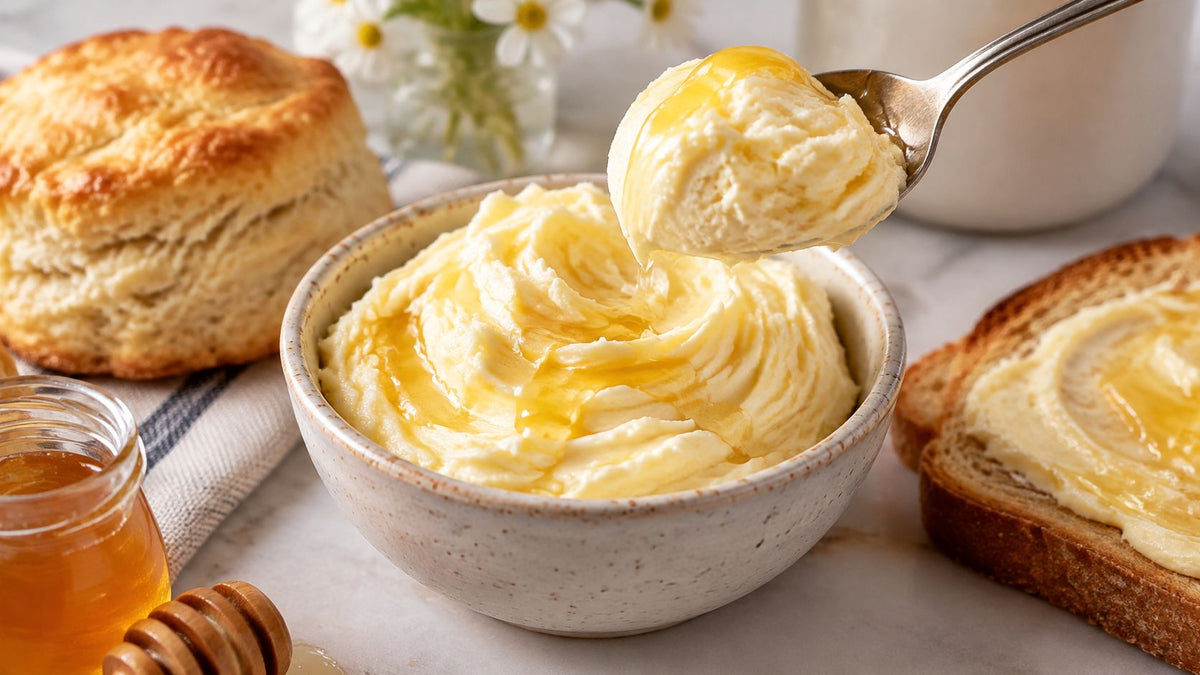
A finished batch should look noticeably paler than the butter you started with. It should spread on warm toast without tearing the crumb, and it should hold soft peaks on the spoon instead of running off it. If it pours, there's too much honey or the butter was too warm. If it barely moves, the butter was too cold.
Choosing a Honey That Suits the Spread
Honey sets both the flavor and the texture here, so choose it first. The BJCP mead reference guide describes honey as a supersaturated sugar solution containing more than 70% sugars and often less than 20% water, where glucose can separate as crystals. The fructose to glucose ratio predicts speed. Above 1.33 is slow crystallizing, 1.11 to 1.33 is medium, and below 1.11 crystallizes more rapidly.
That's practical, not academic. A naturally crystallized honey gives the spread more body and a finer, spoonable set. A liquid honey gives you a smoother but looser result. Neither is wrong. Crystallization isn't spoilage, it's just texture, so pick by flavor and let the texture follow.
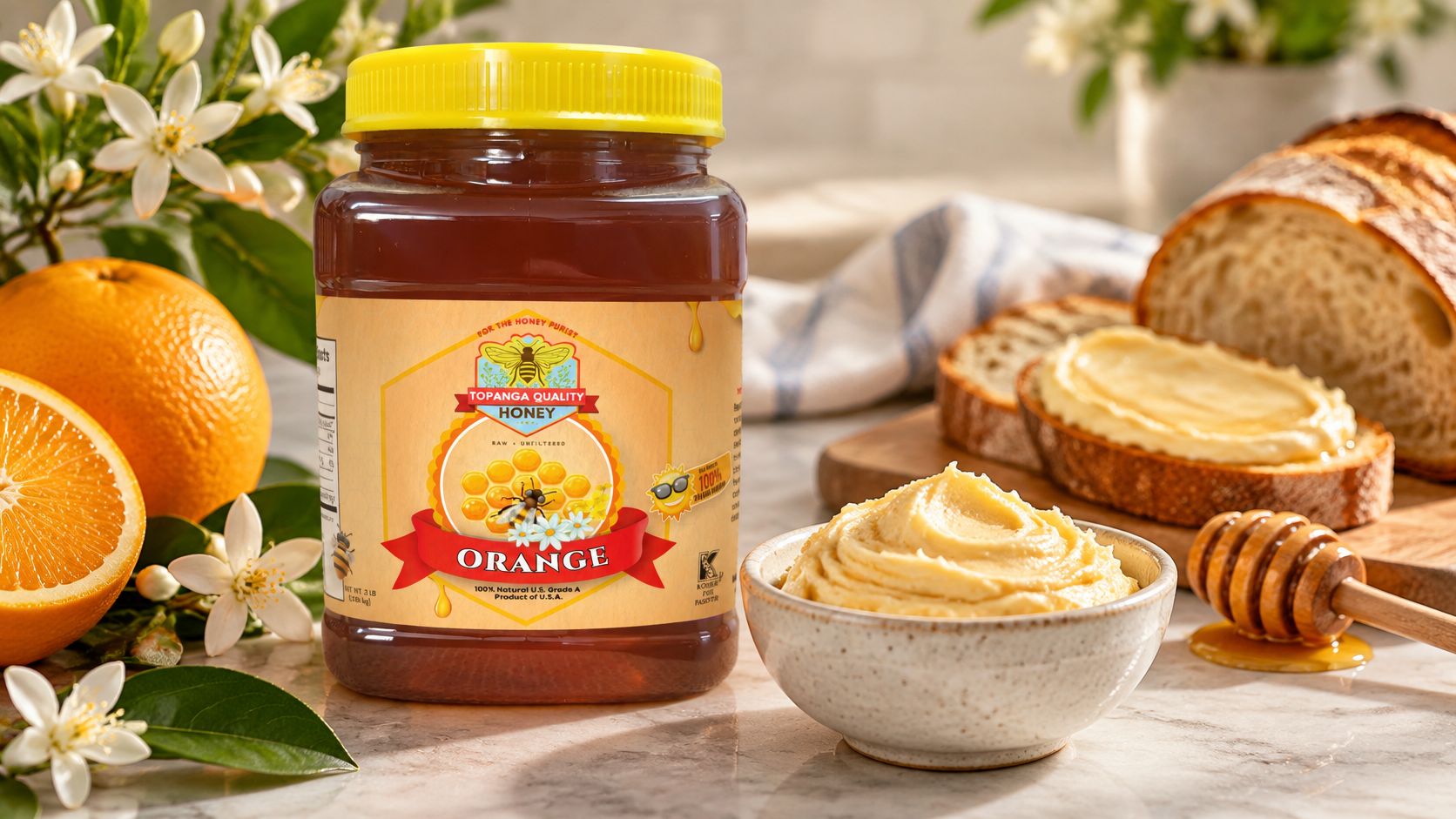
Here's a light, citrus option that shows what a pale honey does in the bowl.
Honey Varieties for Whipped Honey Butter
| Honey | Flavor | Color |
|---|---|---|
| Clover | Mild, sweet, gently floral | Light |
| Orange blossom | Fresh, sweet citrus aroma | Light |
| Sage | Gently floral and mild | Light |
| Cactus | Mild, delicate sweetness | Nearly white |
| Avocado | Rich, buttery, molasses and caramel notes | Dark amber |
| Buckwheat | Malty, molasses like, less sweet | Very dark |
Clover from the USA is the familiar starting point, mild and sweet with a gentle floral taste. Raw Orange Blossom Honey is made by bees working citrus groves in full bloom in California. It's light amber with a fresh, sweet citrus aroma and a smooth, silky body, and it comes in 1 lb jars, 3 lb jars, and 12 oz squeeze honey bears. If you want to compare varieties side by side before committing to a batch, our guide to how to taste honey walks through aroma and finish in plain terms.
California sage is gently floral and mild, a good pick when you want sweetness without a strong honey flavor taking over. Cactus honey, from cardón cactus in Mexico, is nearly white, thick and creamy, with a mild, delicate sweetness. Both keep a breakfast spread light.
The dark end behaves differently. California avocado honey is rich and buttery with molasses and caramel notes. It works in baking, spooned into coffee, as a glaze for roasted vegetables, or paired with aged cheddar and blue cheese. USA buckwheat is malty and molasses like, and less sweet than the pale honeys. Dark honeys like avocado, buckwheat, and eucalyptus suit baking, marinades, and cheese boards, and that same depth carries into a whipped butter.
Simple rule: pale honey for breakfast toast, biscuits, and tea. Dark honey for savory glazes, roasted vegetables, and bold baking where the flavor needs to stand up to other ingredients.
One caution with dark honeys. Their flavor is strong enough that the classic ratio can taste intense on plain toast. That's not a flaw. It's a reason to make a half batch first, taste it on the food you'll serve, and adjust from there.
How to Whip Honey Butter Step by Step
This is a short routine, but the order matters. Butter first, honey second, salt last. Each step protects the air you're trying to beat in.
The overview below shows the basic flow before you get into temperatures and timing.
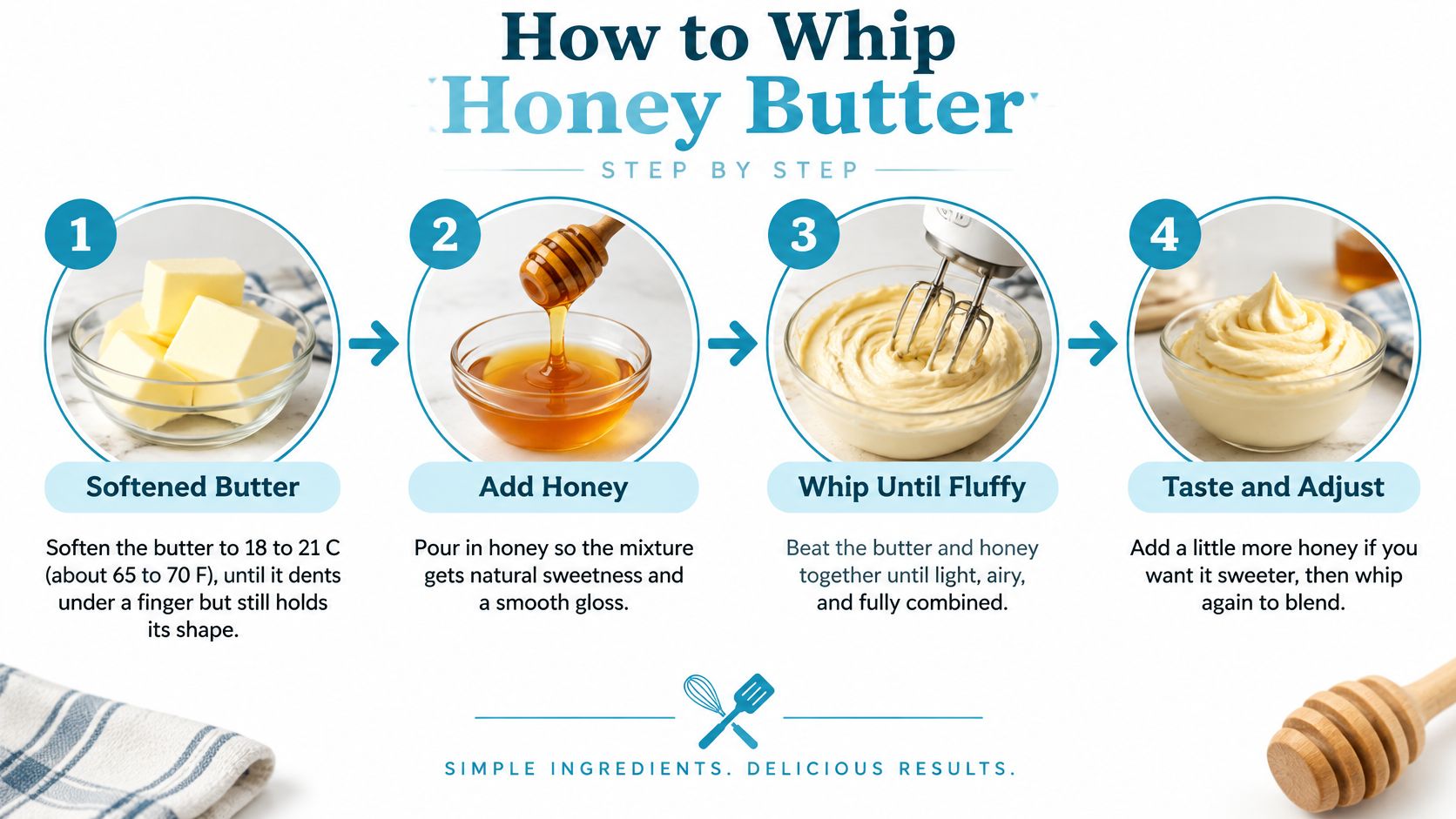
Working numbers for a classic batch: unsalted butter softened to approximately 18 to 21°C, beaten until visibly lighter before honey goes in gradually, a practical ratio of 2 parts butter to 1 part honey by weight, 1 to 2 g fine salt if you want it, and 3 to 5 minutes of whipping at medium high speed.
The Routine
- Soften the butter to 18 to 21°C, about 65 to 70°F. It should dent under a finger and still hold its shape. Cut it into cubes and leave it on the counter rather than microwaving it, because microwaves melt the outside while the center stays cold. Softened butter traps air. Melted butter doesn't, and refrigerator cold butter resists the whisk and stays dense.
- Check the honey. If it's crystallized, set the closed jar in warm, not boiling, water until it turns spreadable, then let it cool a little. Skip direct heat, and don't stir in water to thin it. Honey normally contains less than 20% water, and a peer reviewed honey composition review on PMC reports that honey stays resistant to fermentation under normal storage when its moisture sits below 17.1%. Added water pushes against both numbers. A few fine crystals in the jar are fine too. A slightly textured honey still whips into a smooth spread, and gentle warmth protects the aroma that aggressive heat would dull.
- Beat the butter alone for 1 to 2 minutes. Use a stand mixer with the whisk or paddle, or a hand mixer in a deep bowl. You're looking for a visible change. The color lightens and the edges look soft and billowy. Beating the butter first builds the air pockets, so don't skip it by adding honey right away.
- Add the honey in three or four additions. Whip after each one until it disappears into the butter. Dumping it in all at once gives you a temporary separation, with honey pooling at the bottom and butter streaked on top. Slow additions keep the mixture uniform without extra beating.
- Add salt only if the butter is unsalted. Start with a pinch, up to 1/8 teaspoon fine salt, about 1 g, for a classic batch. Taste before adding more. Salt sharpens the honey flavor, but it's easy to overshoot in a small batch, and you can't take it back out.
- Whip 3 to 5 minutes at medium high speed. Scrape the bowl once, halfway through, so the honey hiding at the bottom gets worked in. Stop when the spread is uniform, pale, and aerated. Don't keep going for extra fluff. If butter gets warmer than roughly 24°C, the fat softens too much and the spread turns greasy and slack, and prolonged high speed mixing warms it.
- Jar it and chill it. Spoon the spread into a clean, dry, covered container and refrigerate until firm.
If you want to see the texture change as the butter lightens, this short video shows the whipping stage clearly.
A note on tools. A whisk attachment puts in the most air, which suits a light breakfast spread. A paddle gives a slightly denser, more stable result that holds up better on a warm buffet. Beating by hand with a sturdy whisk works for a half batch, but it's slow, and your arm will tire before a large batch gets properly fluffy.
Darker, strongly flavored honeys benefit most from this method. The butter moderates their intensity and rounds out the sharper notes without any added water, so an avocado or buckwheat batch tastes deep rather than harsh. With a mild honey, the same routine gives you something delicate enough for plain toast. Knowing how to make whipped honey butter at home really comes down to this: control the butter temperature, add honey gradually, and stop whipping as soon as it's light.
Fixing Grainy, Greasy or Dense Batches
A gritty spoonful sends more cooks back to the recipe than any other flaw, and most of the time the batch is fine. Crystallization is natural and safe. It happens when sugars separate from honey's water and form crystals, and how quickly it happens depends partly on the fructose to glucose ratio, foreign material, and storage temperature. The Purdue Extension FoodLink honey page reflects USDA guidance identifying approximately 130°F (54.4°C) as a temperature used to liquefy crystallized honey for grading, which gives you a sense of how modest the fix can be.
Smoothness here is a temperature trade-off rather than a pass or fail test. Warming a crystallized jar the same gentle way you softened it before whipping loosens the crystals enough to blend. Real heat is the risk: it dulls the aroma that makes raw, unfiltered honey worth using, and once that aroma is gone the batch only ever gets sweeter. For my money, a fine-grained batch beats a greasy one every time.
Perfectly smooth isn't always the right goal. A controlled, fine crystal texture gives you a stable, spoonable spread and keeps more of the honey's original character.
If your jar has gone solid and you're not sure whether it's still good, our notes on why honey can be hard explain what you're looking at. In short, a firm, crystallized honey is still good honey.
Symptoms, Causes and Fixes for Whipped Honey Butter
| Symptom | Likely cause | Fix |
|---|---|---|
| Gritty or sandy texture | Honey crystallized into coarse crystals | Rewarm gently until spreadable, or accept a fine, creamy grain |
| Greasy, slack or shiny | Butter too warm, or whipped too long at high speed | Chill until the edges firm, then rewhip only until pale |
| Dense, heavy, no lift | Butter too cold, or fully melted | Whip softened butter at 18 to 21°C until lighter; melted butter needs a fresh start |
| Separated or curdled look | Honey added all at once | Add honey in several additions, whipping between each |
| Weak honey taste | Honey overheated or diluted | Warm gently, never boil, and keep the honey undiluted |
| Too salty | Salt added to salted butter | Skip added salt when using salted butter |
Read the symptoms in order of how recoverable they are. A greasy or separated batch usually comes back, because cooling lets the fat firm up around the honey again. Chill it the way the jarring step describes, then rewhip just until it turns pale. Dense butter that was too cold is even easier: let the bowl sit at room temperature, then beat again.
Two failures stay dead. Butter that fully melted will never aerate, and chilling it only gives you a hard block with honey streaked through it. Aroma cooked out of overheated honey is gone for good, and adding more honey to a bland batch only makes it sweeter.
When to accept the batch: fine, even graininess that spreads easily and tastes good. That is the texture creamed honey is made to have on purpose, and it suits toast beautifully. When to start over: coarse, crunchy crystals that feel sandy on the tongue, a spread that stays shiny and slack after a chill and rewhip, or a batch too salty to enjoy.
Serving Ideas, Portions and Storage
This spread earns its place on warm, plain foods where it can melt in. Biscuits and cornbread are the obvious ones. Pancakes, toast on a cold morning, and baked sweet potatoes at the table are close behind. It also works on dinner rolls, muffins, and a slice of banana bread that needs a little help.
For a savory direction, make a batch with a dark honey and spoon it over roasted carrots or a pork chop as it rests. The butter carries the honey across the surface and the heat loosens it into a light glaze. If you're planning a full meal around ideas like that, browsing meal inspiration for Thermomix home cooks is a handy way to find mains that pair well with a sweet, buttery finish.
Portions
Treat this as an aerated fat and sugar spread, not as creamed honey on its own. The USDA FoodData Central honey butter entry reports approximately 70 calories, 4.5 grams of total fat, 2.5 grams of saturated fat, 7 grams of total sugar, 30 milligrams of sodium, and 15 milligrams of cholesterol per serving. Air incorporated during whipping increases the volume, so a spoonful looks generous while weighing less than plain butter.
Use those figures as a reference serving and measure what you spread against them. Because the profile is energy dense at about 70 calories per reference serving, portion size matters when this is an everyday topping rather than an occasional dessert accompaniment.
- Everyday toast or a biscuit: a teaspoon or two per slice is plenty once it melts in.
- Pancakes or sweet potatoes: a rounded tablespoon, since it spreads across a larger, hotter surface.
- Dessert plates: more is fine, but plate it deliberately instead of leaving the whole jar on the table.
Storage
Keep the spread refrigerated in a clean, covered jar. It firms up in the cold because the butterfat sets, so take it out 15 to 20 minutes before serving to restore spreadability. Use a clean, dry knife each time, since crumbs and moisture shorten how well it keeps.
Store the honey you didn't use the same careful way. Our guidance on how to store honey correctly covers keeping jars sealed and away from heat. Raw honey may crystallize in the pantry over time. That doesn't spoil it. Set the jar in warm, not boiling, water to bring it back.
Pick Your Honey and Whip the First Batch
Choose one jar and commit to a small first run. Weigh the butter and honey in the ratio you selected, let the butter soften until it yields to a fingertip without turning glossy, then whip just until the mixture lightens and holds soft ridges. Taste it on warm toast. If it tastes flat, add honey in small amounts; if it turns greasy, the butter was too warm and needs a few minutes in the cool before the next whip.
Smoothness is a temperature trade-off. Butter that is too cold stays lumpy, butter that is too soft goes slick, and overheated honey loses the floral notes you paid for. A faint grain from naturally crystallized raw honey is acceptable in a rustic batch; warm the jar gently and keep the water comfortable rather than hot.
I'd judge the second batch after the first has sat on toast, not beside it. Check sweetness, salt, spreadability and how quickly it melts, then adjust one variable at a time. For a first jar from Topanga Quality Honey, the range runs from mild orange blossom and sage to dark avocado and buckwheat, in 1 lb and 3 lb jars plus 12 oz and 24 oz honey bears, packed by a family-owned California beekeeping company and described as raw, unfiltered, organic and kosher. Orders ship to the continental US, free at $50 or more and $9.95 below that.