

Is Pure Honey Same as Raw Honey? Key Differences
No, pure honey and raw honey aren't the same, because pure describes what's in the jar, only honey with nothing added, while raw describes how it was processed, not substantially heated or finely filtered. Treat those as two separate claims and the common advice to pick whichever word sounds healthier falls apart, since a jar can satisfy one claim, both, or neither.
Table of Contents
- Pure and Raw Honey Are Not the Same Thing
- Pure and Raw Honey Side by Side
- What the Word Pure Actually Guarantees
- What Raw Honey Means for Processing
- Which Label Wordings Guarantee What
- Crystals, Infant Safety and Other Misreadings
- Which Honey Fits Your Kitchen and Household
- Check the Label Before Your Next Purchase
Pure and Raw Honey Are Not the Same Thing
If you're asking is pure honey same as raw honey, you're probably comparing two jars that each show only one word. That missing word is the problem. Pure is a composition claim. It says the product contains honey rather than added sweeteners or other ingredients. Raw is a processing claim. It says the honey stayed close to its extracted state, without substantial heat or fine filtration, so pollen and fine particles may still be present.
Four combinations on real jars
Reading the claims independently gives you four possibilities, not a quality ranking.
- Pure but not raw: Nothing was added, but the honey was heated or heavily filtered for clarity and pourability.
- Raw but not pure: The honey wasn't substantially heated or finely filtered, yet syrup could still have been mixed in. The word raw alone doesn't prove composition.
- Pure and raw: Only honey is present, and processing stayed limited.
- Neither claim printed: The jar may say honey. That isn't automatically a flaw, but it leaves you with no stated answer on heating or filtration.
Labels invite guesswork because a single-ingredient honey can carry little detail beyond the word honey itself. Shoppers then fill the gap by assuming pure must mean unprocessed, or that raw must mean nothing could have been added. Neither assumption follows from the word printed.
Pure is an ingredient question and raw is a processing question.
Pure and Raw Honey Side by Side
Start with the added-sugar row, because it exposes the limit of each word at once. Neither column permits blended sweeteners, yet only one of them is even talking about contents.
| Criterion | Pure honey | Raw honey |
|---|---|---|
| What the term describes | Composition, only honey, nothing added | Processing and physical state, not substantially heated or finely filtered |
| US basis | FDA labeling guidance for honey and honey products | USDA raw honey specification, not a formal grade |
| Added sugar or syrup | Not allowed | Not addressed by the term, raw describes handling only |
| Filtration | May be filtered | Strained only to remove wax and comb debris |
| Pollen and particles | May be removed or remain | May remain, including pollen grains, fine particles, air bubbles and propolis |
| Heating | May be heated | Not substantially heated |
| Crystallization | Can be delayed by heating and fine filtration | Can set sooner because no heat is applied to delay it |
| Infant safety under 12 months | Not safe | Not safe, raw and pasteurized honey can both contain botulinum spores |
Reading the columns as separate claims
The two columns work like two checkboxes on the same form. Ticking one says nothing about the state of the other. The pure column answers a contents question. The raw column answers a handling question. A jar can satisfy either column alone, both, or neither, which is why the same product can be accurately described by one word and still leave the other claim unanswered.
That independence decides what a label can tell you. A shopper who cares about pollen and minimal handling gets no signal from pure, because that claim stays silent on processing. A shopper who wants assurance about what went into the jar gets no signal from raw, because that claim stays silent on composition. Each gap closes only when wording addresses the missing claim directly.
Crystallization and infant safety sit in the same place for both columns, so neither word moves them. When a row matters to your household and both columns read identically, the choice between pure and raw gives you nothing, and the answer has to come from storage habits, kitchen use or medical guidance instead.
What the Word Pure Actually Guarantees
The clearest way to picture the guarantee is to look at how the label itself is built.
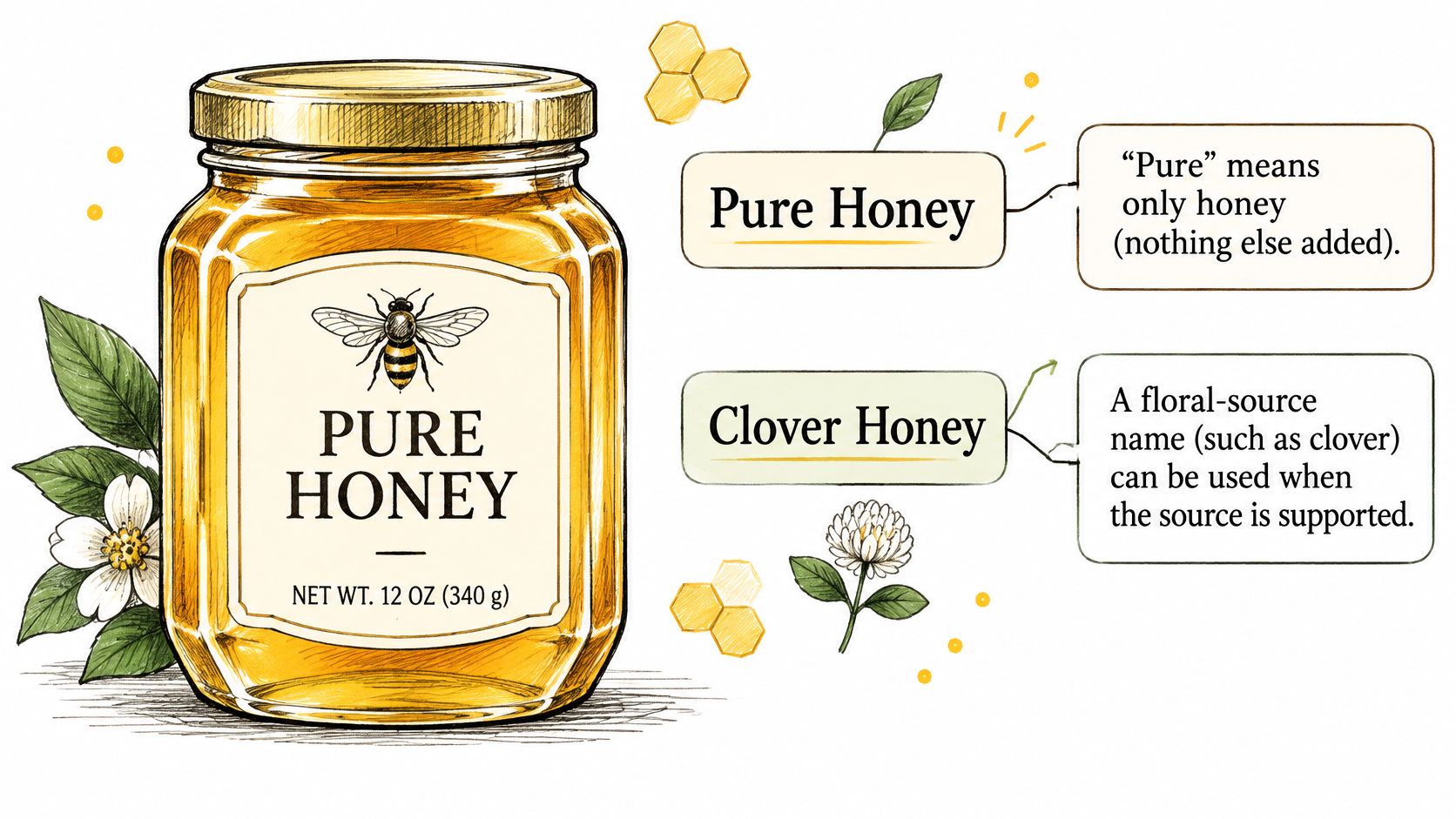
A claim about contents
Under the FDA guidance for industry on proper labeling of honey and honey products, a product containing only honey should be named “honey”, and a floral-source description such as “clover honey” may be used when supported by information about the chief nectar source. That same guidance notes honey as a single-ingredient food doesn't require an ingredient statement.
So pure answers one narrow question. Was anything added? It doesn't tell you whether the honey was heated, filtered, strained or left pollen-rich. Honey can stay a single-ingredient product while going through full commercial processing, which is why a jar can be pure and not raw at the same time. The absence of an ingredient list also means the seller's own statements carry unusual weight. There's no panel on the back to check against the claim on the front.
Why testing sits behind the word
Composition claims need testing because added sweeteners are hard to spot by taste. The European Commission Joint Research Centre report on honey authenticity found 147 of 320 imported honey consignments, or 46%, were suspicious of adulteration with added sugar sources in 2023. That figure concerns purity, not whether any of that honey was raw.
Testing itself has limits worth knowing. A Food Standards Agency research publication on honey authentication reported in 2024 that its authentication model misclassified 1.1% of pure honey samples as adulterated and 3.64% of adulterated samples as pure honey. A test result supports a pure claim. It doesn't prove origin, floral source or gentle handling.
This short video walks through the same distinction visually, which helps if the labeling language feels abstract.
Two checks put this into practice. First, see whether the label names a floral source and whether the seller can explain the chief nectar source behind it. Second, look for an explicit statement that nothing was added, rather than relying on the word honey alone. If both answers are missing, pure is doing more marketing work than informational work.
What Raw Honey Means for Processing
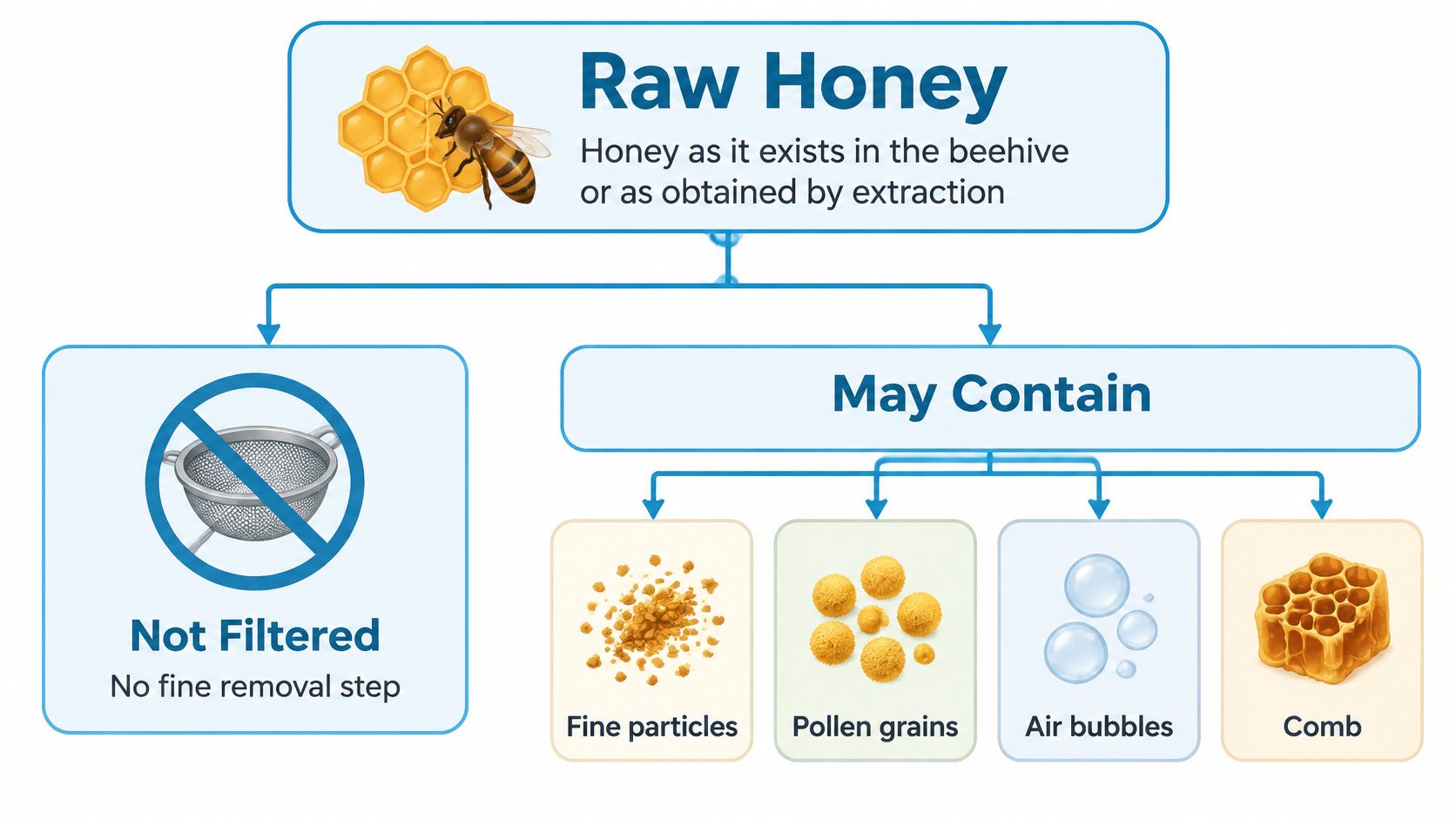
Raw describes handling, and the definition is physical. A USDA agricultural specification for honey defines raw honey as honey “as it exists in the beehive or as obtained by extraction”, but not filtered, and notes it may contain fine particles, pollen grains, air bubbles, comb, propolis and other naturally occurring suspended material.
The processing chain in order
Each step after extraction moves honey further from that definition, and the order matters.
- Extraction: Honey leaves the comb through centrifugal force, gravity, straining or other methods. This step alone changes nothing about rawness, since the definition covers honey as obtained by extraction.
- Straining: A coarse screen removes wax fragments and larger debris, cleaning the honey while leaving it raw.
- Filtration: Finer filters, especially ultra-filtration, remove what the specification expects raw honey to contain. Here the definition stops applying.
- Heating: Commercial packers warm honey to slow crystallization and make bottling and pouring easier. Substantial heating is the step shoppers most often associate with losing raw status, even though the honey can remain completely pure.
Why cloudy honey isn't defective honey
That chain explains the look of a raw jar. Cloudiness, visible texture, tiny bubbles or specks are exactly what the specification expects to find, so none of them signal adulteration. Highly clarified honey looks different because someone removed those components on purpose. Judging raw honey by the clarity standard of filtered honey is judging it against a goal it never had.
Grading measures something else entirely. USDA grading ranks extracted honey on a points system and awards letter grades for qualities such as clarity and freedom from visible crystals, while staying silent on heat treatment and handling. Under those same standards, liquid honey is defined by the absence of visible crystals, so a raw jar can pour or sit spoonable depending on the floral source and how it is stored. A set jar and a runny jar can both be raw.
A raw label tells you how the honey was handled, not what is in it.
For shoppers, the practical reading is this. Raw speaks to the journey from hive to jar, and two jars with identical handling can look nothing alike once floral source, storage temperature and time do their work. The word stays fixed on one question: how far did anyone take this honey from the hive?
Which Label Wordings Guarantee What
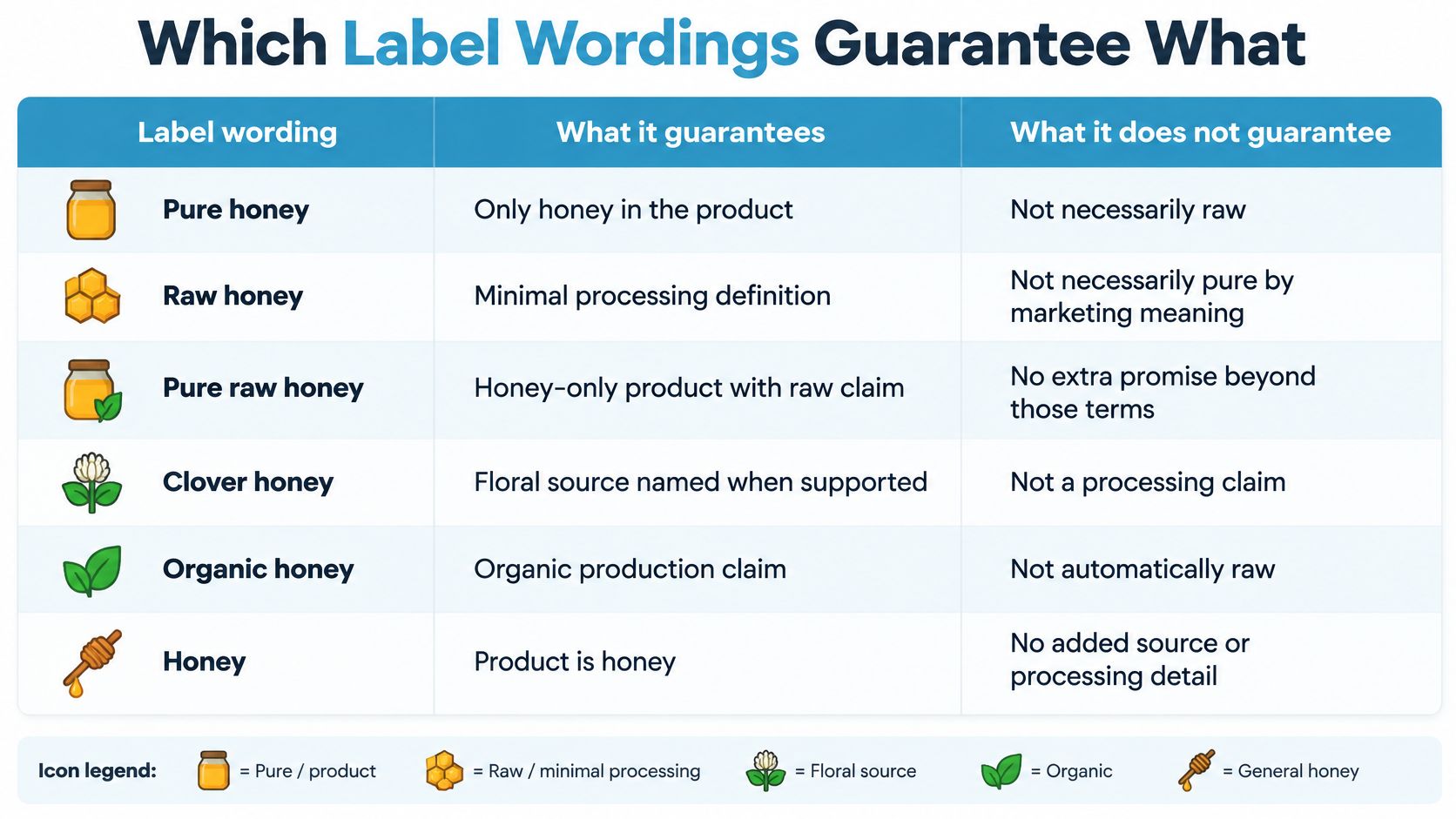
A jar stamped "pure clover honey" names a nectar source and promises honey-only composition, yet stays silent on heat. A jar stamped "raw" answers the processing question and leaves composition unaddressed. Trouble starts when a shopper treats either word as a complete answer, so the reliable method is to read each wording as one claim with a defined edge and to ask which questions it leaves open.
| Label reads | What it guarantees | What it leaves open |
|---|---|---|
| Pure honey | Only honey, with no added sweeteners | Whether it was heated, filtered or pollen-rich |
| Raw honey | Not substantially heated and not finely filtered | Whether it is pure, look for a honey-only statement |
| Pure raw honey | Honey-only composition plus limited processing | Floral source and origin unless printed |
| Clover honey or another floral name | Chief nectar source named, with supporting information | Heating, filtering and purity |
| Organic and kosher | Certification claims as stated by the seller | Heat and filtration level |
| Unlabelled bulk honey | Honey as a single ingredient | Processing, origin and floral source unknown |
Reading combinations instead of single words
Certifications sit beside these claims rather than replacing them. Organic and kosher describe how production and handling were certified. They don't tell you the filtration level, so a certified honey still needs its own raw or unfiltered statement if that detail matters to you.
Apply the same column-by-column reading to stacked wordings. "Raw wildflower honey" covers handling and names a nectar source, while the word pure is absent, so composition rests on the seller's honey-only statement. "Organic clover honey" covers certification and floral source and leaves both heating and filtration open. Each additional word closes one column of the table and nothing beyond it.
The composition column isn't theoretical. The FDA summary of imported honey testing for economically motivated adulteration reported that in 2023 it tested 107 imported honey samples collected from April 2022 through July 2023 and found 3 samples, or 3%, violative for undeclared added sweeteners. That's the gap a raw-only label leaves open.
Strongest label to look for: pure raw honey with a printed floral source and origin, checked against the seller's sourcing claims.
Because a single-ingredient honey carries no ingredient statement, the seller's sourcing and processing claims carry the weight. When both composition and handling matter to you, that combination gives you the most verifiable information per jar.
Crystals, Infant Safety and Other Misreadings
The two label words get misread in opposite directions: pure gets credited with freshness it never claims, and raw gets credited with safety it can't deliver. Three corrections clear up most of the confusion.
Raw means safer for babies
It doesn't, and this is the correction that matters most. University of California food-preservation guidance on infants and honey reports that both raw and commercially pasteurized honey can contain botulinum spores, and recommends no honey for children under one year. Ordinary pasteurization doesn't make honey safe for infants either. The decisive rule is age, not processing status, so the raw label and the pure label are equally irrelevant here.
Crystals prove purity or spoilage
Crystallization varies with floral source and storage conditions, so it doesn't by itself establish rawness, adulteration or spoilage. A set jar can be excellent honey, and a permanently liquid jar isn't automatically fake. The reverse misreading is just as common: a jar labelled pure that crystallizes hasn't gone off and hasn't proven itself raw, because crystals say nothing about either claim. If a jar has gone firm and you want the mechanics of why, our guide on why honey can be hard covers the storage side in detail. Why some commercial honey resists crystals longer comes down to heating, which is a processing question rather than a purity one.
Dark means old and pure means fresh
Color follows the flower, not the calendar. Buckwheat honey is dark straight from the hive, so a deep color tells you about nectar source, not age or heavy processing. A pale honey isn't younger or gentler by default.
Pure has the same problem in reverse. It refers to composition, not freshness, harvest date or storage quality. A pure honey can sit in a warm warehouse and stay pure the whole time, because nothing was added to it. Freshness questions need harvest and storage information, which the word pure never supplies.
Sellers who state processing practices, origin, storage guidance and age-related safety information plainly give you more grounds for trust than any single word on the front of the jar.
Which Honey Fits Your Kitchen and Household
The right jar depends on the job the honey has to do. Read the table from the strictest need down to the most flexible use.
| Situation | Better fit | Why |
|---|---|---|
| Infants under 12 months | Neither type, give no honey | Both raw and pasteurized honey can contain botulinum spores |
| Gingerbread, rye bread and dark cakes | Raw or dark single-variety honey | Strong malty, molasses-like flavor is the goal |
| Everyday tea and coffee | Mild pure honey or raw clover | Light flavor blends without overpowering |
| Squeeze bears and pourable use | More processed pure honey | Heating can delay crystallization, so pouring lasts longer |
| Tasting and food pairing | Raw single-variety honey | Unheated handling keeps the floral character of the nectar source |
| Gifts for label-conscious buyers | Pure raw honey with stated origin | Clear labels reduce guesswork |
Matching the jar to the job
Age sits at the top of that table because it outranks every preference below it. For a mixed household, our notes on choosing honey for children and adults with different needs work through the use cases in more detail.
Strong-flavored baking is where a dark honey earns its place, because the flavor survives the oven. Raw Buckwheat Honey is very dark, almost black in the jar, with a malty, molasses-like flavor that's less sweet than lighter honeys, which is exactly what gingerbread, rye bread and dark cakes can carry. A milder honey would disappear into the same batter.
Everyday drinks reward the opposite direction. A mild pure honey or raw clover sweetens tea and coffee without taking over the cup, and squeeze bears reward more processed pure honey, since heating keeps it pourable longer and nobody wants to warm a plastic bear before breakfast. Tasting flights and cheese boards sit at the far end: a raw single-variety honey, where the floral character of the nectar source is the whole point.
A single-variety label doesn't guarantee raw handling. Clover, buckwheat or wildflower names describe floral source, so the processing statement on the jar decides whether that variety reached you heated, filtered or close to its extracted state. Two jars can share the word clover and still belong in different rows of this table.
Check the Label Before Your Next Purchase
This check takes under a minute once you know the order.
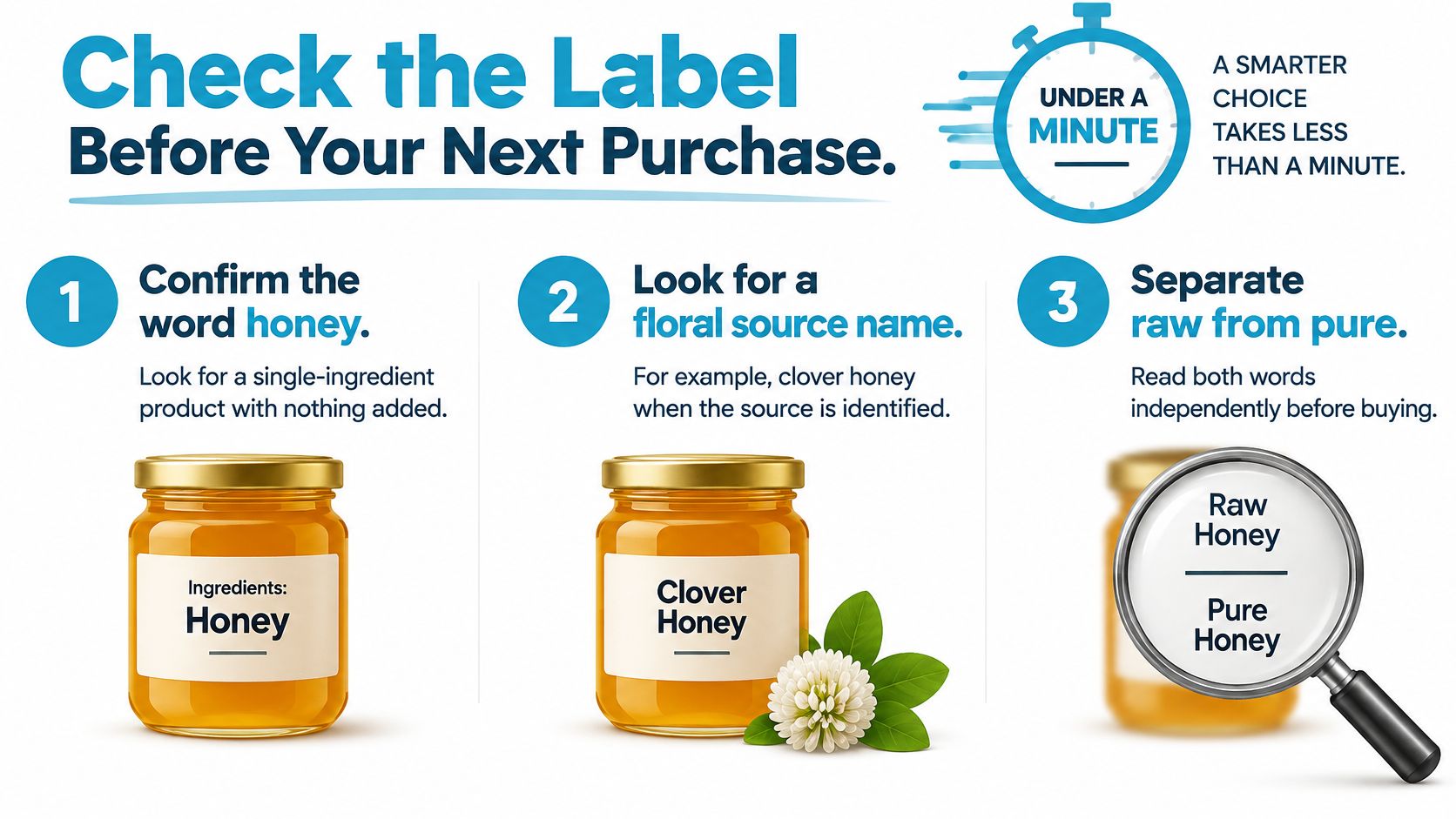
- Confirm the word honey: Check that it's a single-ingredient product with nothing added.
- Look for a floral source name: See whether the seller explains the chief nectar source behind it.
- Check for raw or unfiltered wording: Confirm the seller states the honey isn't pasteurized or finely filtered.
- Look for origin: Find a state, region or country, or a note that origin varies by harvest.
- Read certifications separately: Treat organic and kosher as their own claims, not substitutes for processing details.
- Apply the age rule: If the honey is for a child under one year, skip it entirely.
- Store it plainly: Keep the jar at room temperature and expect crystals in raw honey without assuming a problem.
We make steps one through five easy to verify because every honey we sell is raw, unfiltered, organic and kosher, our Raw Clover Honey is raw, unfiltered and never pasteurized, and our single-variety honeys contain no sugar, syrups or preservatives. If you're comparing regional producers while you shop, a listing such as Really Good Honey in Oregon City on Shopifarm shows how another seller presents its sourcing, which gives you a useful benchmark for the detail to expect.
Because a single-ingredient honey doesn't have to print processing details, ask us for any missing answer before you buy. Our guide on how to check if your honey is real goes deeper on authenticity checks if you want them. Then make one decision. Pick the label that matches your use, and verify the honey-only composition, the processing wording and the origin on the jar before it goes in your basket.
If you want both claims answered on the same jar, we sell raw, unfiltered, organic and kosher honey packed in California, with floral sources from mild clover to dark buckwheat and no sugar, syrups or preservatives in our single-variety honeys. Browse the varieties, check the processing and origin notes on each one, and pick the jar that fits your kitchen at Topanga Quality Honey.